

Manuel Piar
Images
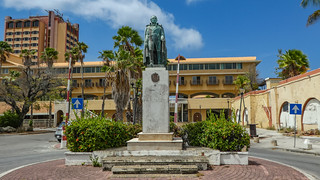
Statue of Manuel Carlos Piar


The Genesis of a Revolutionary Leader
Manuel Carlos María Francisco Piar Gómez, born April 28, 1774, emerged as a towering figure in the tumultuous landscape of early 19th-century South America. His life was inextricably linked to the struggle for Venezuelan independence, a complex and protracted conflict against the formidable Spanish Empire. Piar's early life and experiences, though not detailed in the provided source, undoubtedly forged the resolve and strategic acumen that would define his military career.
He ascended to the rank of General-in-Chief, a position of immense responsibility, tasked with leading the nascent Venezuelan army against a well-established colonial power. This role placed him at the epicenter of the nation's fight for self-determination, demanding not only military prowess but also exceptional leadership and unwavering commitment to the cause of liberty.
Commanding the Tide
The Venezuelan War of Independence (roughly 1810-1823) was a defining chapter in the history of Latin America, a series of conflicts aimed at severing ties with Spain. Within this grand narrative, Manuel Piar's role as General-in-Chief was paramount. He was not merely a participant but a principal architect of the military strategy and operations that challenged Spanish authority.
Leading the army meant orchestrating complex maneuvers, managing resources, and inspiring a diverse group of soldiers united by the dream of a free Venezuela. Piar's command was instrumental in numerous campaigns, contributing significantly to the gradual erosion of Spanish control over the territory. His leadership provided a crucial anchor for the independence movement during its most critical phases, demonstrating remarkable resilience in the face of adversity.
The Strategic Imperative
The significance of Manuel Piar's position as General-in-Chief cannot be overstated. In the context of a war for independence, a unified and effective military command is the bedrock upon which national sovereignty is built. Piar's leadership provided this essential element, offering strategic direction and fostering a sense of collective purpose among the revolutionary forces.
His ability to command the army meant he was responsible for the overarching military objectives, translating political aspirations into tangible battlefield actions. The success of the independence movement was intrinsically linked to the effectiveness of its military leadership, and Piar's tenure as General-in-Chief was a critical factor in weakening Spanish dominance and ultimately securing Venezuela's future as an independent republic. His actions directly contributed to the political and territorial integrity of the nascent nation.
Enduring Impact
Manuel Piar's life concluded on October 16, 1817, but his legacy continues to resonate through Venezuelan history. He is remembered as a national hero, a symbol of courage, sacrifice, and the unyielding pursuit of freedom. His contributions to the Venezuelan War of Independence were foundational, shaping the course of the conflict and paving the way for the nation's eventual liberation.
The struggle for independence was a testament to the collective will of a people, and leaders like Piar embodied that spirit, inspiring generations to fight for their ideals. His story serves as a powerful reminder of the human cost and profound significance of achieving national sovereignty, a concept that remains vital in contemporary global politics.
Connecting Piar's Fight to Modern Concepts of Nationhood
Manuel Piar's role as General-in-Chief during the Venezuelan War of Independence offers a compelling case study in the formation of modern nation-states. His leadership was not just about military victory; it was about forging a national identity and establishing the legitimacy of a new sovereign entity. In today's world, the concept of national sovereignty is a cornerstone of international relations, and understanding its historical origins, like Piar's struggle, provides valuable context.
His fight against colonial rule mirrors contemporary movements for self-determination and challenges to external influence. By examining Piar's career, we can better appreciate the complex interplay of military strategy, political will, and popular support that underpins the creation and maintenance of independent nations, a process that continues to shape global dynamics.
See also
Frequently Asked Questions
Who was Manuel Piar?+
When was he born?+
What role did he play in the Venezuelan War of Independence?+
How did he help Venezuela become independent?+
When did he die and why is he remembered?+
Based on content from Wikipedia · Licensed under CC BY-SA 4.0