

Louis de Funès
Images

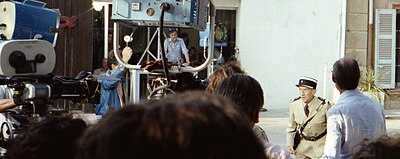
Expo Louis de Funès à Paris - 19 (cropped)


The Art of Exaggeration
Louis de Funès, born Louis Germain David de Funès de Galarza, remains an indelible figure in global cinema, celebrated for a comedic style that was both intensely personal and universally understood. His acting technique was a masterclass in physical comedy, characterized by a frenetic energy, an astonishing repertoire of facial contortions, and distinctive vocalizations and tics. This approach allowed him to embody characters who, while often appearing tyrannical or self-important, were fundamentally flawed and prone to hilarious breakdowns.
His most iconic roles, frequently directed by Jean Girault, saw him portraying the 'petit bourgeois' – characters obsessed with status, order, and authority, who would often crumble under pressure or reveal their incompetence in the most comical ways. This resonated deeply with audiences in the 1960s, a period of significant social and economic change in Western societies, as his characters often represented a recognizable, if exaggerated, segment of the population grappling with modernity.
Beyond Borders
The sheer scale of Louis de Funès's popularity is remarkable. He is consistently ranked as France's favorite actor, a testament to his enduring appeal within his home country. His fame, however, extended far beyond French borders, achieving massive success across continental Europe, including the former Eastern Bloc, the Soviet Union, Iran, Turkey, and Israel.
This widespread recognition solidifies his status as one of the most bankable actors in French cinema history. Despite this international reach, he remained an obscure figure in the English-speaking world, with his 1973 film 'The Mad Adventures of Rabbi Jacob' being his most notable, albeit limited, exposure in the United States. The film's nomination for a Golden Globe and its memorable dance scene underscore the potential for broader appeal, yet the linguistic and cultural nuances of his comedy perhaps presented a barrier to wider adoption in Anglophone markets.
The Paradox of Performance
One of the most compelling aspects of Louis de Funès's legacy is the profound dichotomy between his on-screen persona and his private life. While his characters were often loud, bombastic, and domineering, de Funès himself was known to be a deeply shy, reserved, and introspective individual. This personal disposition, coupled with his devout Catholicism, offers a fascinating insight into the man behind the manic energy.
It raises questions about how such a private person could channel such uninhibited, larger-than-life performances. This contrast not only adds depth to his character as an artist but also highlights the transformative power of acting, allowing individuals to explore and express facets of personality that might remain dormant in their everyday lives. His ability to inhabit these boisterous roles while maintaining a quiet personal demeanor is a testament to his extraordinary talent.
Enduring Relevance
Louis de Funès's influence continues to be felt decades after his death in 1983. His enduring legacy is cemented by the existence of two dedicated museums: one located at the Château de Clermont, where he resided, and another in the picturesque town of Saint-Raphaël. These institutions serve not only as tributes to his career but also as cultural landmarks preserving his impact on French and European cinema.
His films, characterized by their sharp wit, physical comedy, and relatable characters, are still widely watched and appreciated, demonstrating the timeless quality of his humor. In an era where comedy often relies on different tropes, de Funès's unique blend of slapstick, social satire, and expressive performance offers a distinct and enduring contribution to the art of filmmaking, proving that genuine comedic genius transcends generational and geographical boundaries.
See also
Frequently Asked Questions
Who was Louis de Funès?+
What made his comedy so funny?+
Why did he play characters called "petit bourgeois"?+
Where can I see museums about him?+
Did he act in English movies?+
Based on content from Wikipedia · Licensed under CC BY-SA 4.0