

Les Invalides
Images

Paris




The Genesis of a Grand Institution
The Hôtel des Invalides, conceived by King Louis XIV and initiated in 1670, stands as a testament to the monarch's strategic and humanitarian impulses. Driven by a desire to provide for the growing number of soldiers disabled or aged by constant warfare, Louis XIV commissioned this vast complex as a 'house for the disabled soldiers of the kingdom.' This was not merely an act of charity but a calculated move to ensure the welfare of his veterans, thereby bolstering morale and national loyalty.
The architectural design, spearheaded by Liberal Bruant and later refined by Jules Hardouin-Mansart, was intended to be both functional and imposing, a reflection of the Sun King's absolute power and the glory of his reign. The complex was designed to house thousands of soldiers, complete with dormitories, chapels, and administrative buildings, creating a self-contained community dedicated to those who had served France. Its scale and ambition set a precedent for state-sponsored care for military personnel, laying the groundwork for future institutions.
Architectural Grandeur and the Sacred Space of the Dôme
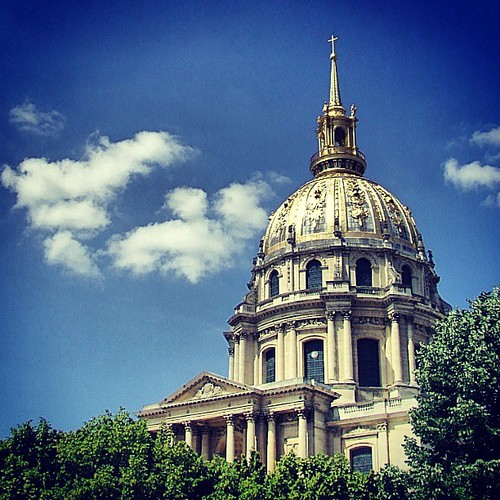
The Dôme des Invalides, designed by Jules Hardouin-Mansart, is arguably the most iconic element of the complex. Completed in 1706, its soaring 107-meter height and resplendent golden cupola made it a dominant feature of the Parisian skyline and a masterpiece of French Baroque architecture. Originally serving as the Royal Chapel, it was intended to be a space of spiritual solace and royal grandeur.
However, its most profound transformation occurred in the 19th century when it was repurposed as a mausoleum. The decision to inter Napoleon Bonaparte beneath its dome in 1861, following his reburial in France, cemented its status as a national shrine. The architectural magnificence of the dome, with its intricate detailing and gilded surfaces, now serves as a dramatic backdrop for the sarcophagi of France's most revered military leaders, including Turenne, Vauban, and Joseph-Napoléon Bonaparte, creating a powerful visual narrative of French military history and national heroes.
The Musée de l'Armée
The Musée de l'Armée, one of the largest military museums in the world, is the intellectual heart of Les Invalides. Its extensive collections span from antiquity to the present day, offering an unparalleled insight into the evolution of warfare, military technology, and the socio-political context of French conflicts. The museum's galleries are meticulously organized, featuring displays of arms and armor, uniforms, artillery, military prints, and historical artifacts.
Particularly noteworthy are the collections related to the Napoleonic Wars and the World Wars, which provide detailed narratives of these pivotal periods. Adjacent to the main museum is the Musée des Plans-Reliefs, housing an extraordinary collection of three-dimensional scale models of fortified towns and cities, originally created for military planning and defense strategy. This unique collection offers a cartographic and architectural perspective on military history, complementing the broader narrative presented by the Musée de l'Armée.
Enduring Significance
Les Invalides transcends its function as a mere historical site; it is a dynamic institution that continues to embody French military identity and national memory. While the original hospital and retirement home functions have largely been superseded by modern healthcare facilities, the complex still houses a military hospital and maintains its connection to active service through the Cathedral of Saint-Louis-des-Invalides, which serves as the bishopric for the Catholic Church in the French Armed Forces.
The presence of the Musée de l'Armée ensures that the sacrifices and achievements of French soldiers are continuously studied and remembered by both French citizens and international visitors. The site's enduring significance lies in its multifaceted role: a monument to military prowess, a repository of historical artifacts, a place of remembrance for national heroes, and a continuing symbol of the nation's respect for its armed forces. It serves as a tangible link between France's martial past and its present-day identity.
See also
Frequently Asked Questions
What is Les Invalides in Paris?+
Why does Les Invalides have a golden dome?+
Who is buried under the dome of Les Invalides?+
What can you see at the Musée de l'Armée?+
What is the Musée des Plans-Reliefs?+
Based on content from Wikipedia · Licensed under CC BY-SA 4.0