

Law of the United States
Images

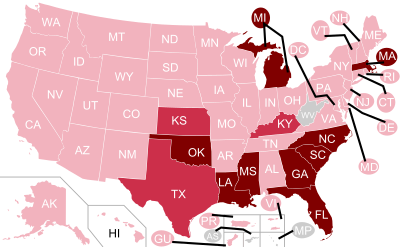
Status of Social Media Age Verification laws in the United States as of June 13, 2026




The Constitutional Apex
The Constitution of the United States stands as the supreme law of the land, a foundational document that establishes the structure of the federal government and enumerates fundamental civil liberties. It delineates the boundaries of federal authority, encompassing Acts of Congress, treaties ratified by the Senate, regulations issued by the executive branch, and judicial decisions from federal courts.
The U.S. Code serves as the official codification of these general and permanent federal statutory laws. Crucially, the Constitution mandates that it, along with federal laws and treaties made pursuant to it, supersedes any conflicting state or territorial laws.
This principle of federal supremacy is a cornerstone of the American legal system, ensuring a degree of uniformity and national coherence across diverse jurisdictions. The Constitution is not merely a historical artifact; it is a living document interpreted and applied by courts to contemporary issues, shaping the ongoing evolution of American jurisprudence.
Federalism in Action
The United States operates under a system of federalism, a complex arrangement where power is divided between a national (federal) government and individual state governments. While federal law is supreme in areas where the federal government has constitutional authority, the scope of this federal power is not unlimited. States retain significant sovereign powers, each possessing its own constitution and the authority to govern matters not exclusively delegated to the federal government.
This dual-sovereign system, sometimes described as tripartite due to the inclusion of Indian reservations, means that states can grant their citizens rights that are broader than those guaranteed by the federal Constitution, provided they do not infringe upon federal constitutional protections. Consequently, much of the law that citizens encounter daily-such as contract, tort, property, probate, criminal, and family law-is primarily state law. While efforts exist to harmonize state laws through organizations like the Uniform Law Commission, substantial variations persist, reflecting the diverse needs and values of different states.
Historical Roots and Divergent Evolution
The legal landscape of the United States is deeply rooted in the English common law system, which was in effect in the British American colonies at the time of the American Revolution. This historical inheritance provided the initial framework for legal principles and judicial procedures. However, American law has not remained static; it has significantly diverged from its English ancestor in both substance and procedure.
Over centuries, the U.S. legal system has incorporated numerous innovations, adapted to unique American circumstances, and developed distinct legal doctrines. This evolution reflects the nation's growth, changing societal norms, and the ongoing process of judicial interpretation and legislative action. While the common law tradition remains a powerful influence, American law is a dynamic entity, continuously shaped by new challenges and evolving societal expectations.
The Practical Application of Law
The practical application of law in the United States involves a constant interplay between federal and state legal systems. Federal laws, enacted by Congress and interpreted by federal courts, address issues of national scope, such as interstate commerce, federal taxation, and civil rights. State laws, on the other hand, govern a vast array of daily activities, from traffic regulations and property disputes to family matters and most criminal offenses.
Even in areas where federal law applies, state law often supplements rather than preempts it, creating a layered legal environment. For instance, federal environmental laws set minimum standards, but states can enact stricter regulations. This intricate relationship ensures that laws are both nationally consistent where necessary and locally responsive to the specific needs of communities across the country, creating a rich and varied legal tapestry.
See also
Frequently Asked Questions
What is the Constitution and why is it important in U.S. law?+
How do federal and state laws work together?+
What does federal supremacy mean?+
Why do some laws look different in different states?+
Where did U.S. law come from originally?+
Based on content from Wikipedia · Licensed under CC BY-SA 4.0