

The Big Cloud in the Sky!
Images
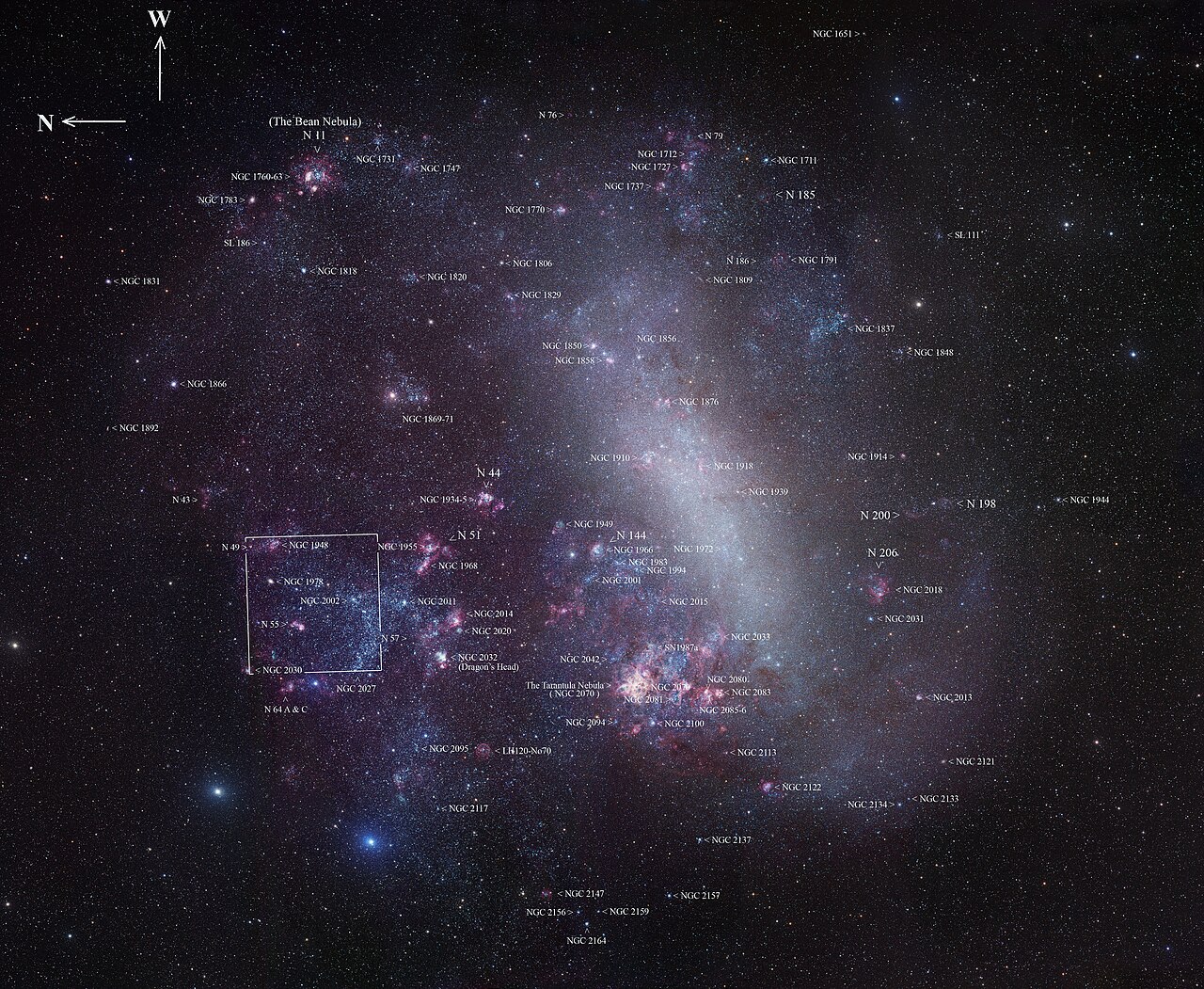
Large Magellanic Cloud
An Irregular Neighbor
The Large Magellanic Cloud (LMC) is classified as a dwarf irregular galaxy, a designation that belies its immense significance in extragalactic astronomy. It is the fourth-largest galaxy in our Local Group, trailing only the Milky Way, Andromeda, and the Triangulum Galaxy. Its irregular morphology is a direct consequence of its dynamic history, marked by gravitational interactions with the Milky Way and its smaller companion, the Small Magellanic Cloud (SMC).
The LMC is a vibrant stellar system, estimated to contain between 10 and 20 billion stars. Its composition is rich in gas and dust, particularly in star-forming regions, making it an ideal location to study the processes of star birth. Unlike more structured galaxies, the LMC lacks a prominent spiral arm structure or a well-defined bulge, presenting a unique opportunity to study galactic evolution in a less ordered environment.
Its stellar populations are diverse, ranging from very old stars to extremely young, massive stars, providing a comprehensive timeline of star formation.
A Chronicle Written in Stars
Pinpointing an exact 'birth date' for the LMC is challenging, as galaxy formation is a continuous process. However, astronomical models suggest its formation began billions of years ago, likely through the accretion of smaller gas clouds and proto-galactic fragments. Its evolutionary path has been profoundly influenced by its gravitational dance with the Milky Way. Evidence suggests that the LMC has undergone multiple close passes with our galaxy, leading to tidal stripping of its gas and stars, and triggering bursts of star formation.
The LMC also possesses a stellar halo, which contains some of the oldest stars and globular clusters, offering insights into the early universe. Studying the LMC's metallicity (the abundance of elements heavier than hydrogen and helium) across its different stellar populations provides crucial data for understanding nucleosynthesis and the chemical enrichment of galaxies over cosmic time. Its ongoing interaction with the Milky Way continues to shape its structure and stellar content.
The LMC as an Astronomical Observatory
The LMC's proximity, at approximately 160,000 light-years, makes it an unparalleled astronomical laboratory. This distance allows astronomers to resolve individual stars and nebulae with remarkable clarity, enabling detailed studies that are impossible for more distant galaxies. The LMC is particularly famous for hosting the Tarantula Nebula (30 Doradus), a colossal H II region that is the most active star-forming complex in the Local Group.
Within 30 Doradus, astronomers can observe the birth and early evolution of massive stars, including Wolf-Rayet stars and blue supergiants, which are rare and short-lived. Furthermore, the LMC serves as a crucial benchmark for calibrating cosmological distances. By studying Cepheid variable stars within the LMC, astronomers can refine their understanding of the period-luminosity relationship, a fundamental tool for measuring distances to other galaxies and determining the expansion rate of the universe.
Its unique stellar populations also help in understanding stellar evolution models.
Cosmic Tapestry
The Large Magellanic Cloud is a dynamic celestial entity, characterized by several prominent features. Its irregular shape is punctuated by numerous star clusters, including both young, open clusters and older, globular clusters. The Tarantula Nebula (30 Doradus) is its most iconic feature, a vast emission nebula spanning hundreds of light-years, illuminated by the intense radiation of young, hot stars.
The LMC is also a prolific source of supernovae, the explosive deaths of massive stars. Studying these supernovae remnants helps astronomers understand the end stages of stellar evolution and the distribution of heavy elements in the universe. The galaxy is also known to host a supermassive black hole at its center, although its mass is significantly smaller than that of the Milky Way's central black hole.
The ongoing gravitational interaction with the Milky Way has created a stream of gas and stars connecting the LMC to our galaxy, a phenomenon known as the Magellanic Stream, which provides valuable information about galactic dynamics and gas flows.
Go deeper
Frequently Asked Questions
What is the Large Magellanic Cloud?+
Why is the Large Magellanic Cloud important for science?+
Where is the Large Magellanic Cloud located?+
What is the Tarantula Nebula?+
How does the Large Magellanic Cloud interact with the Milky Way?+
Based on content from Wikipedia · Licensed under CC BY-SA 4.0