

The Local Group: Our Galactic Neighborhood
Images
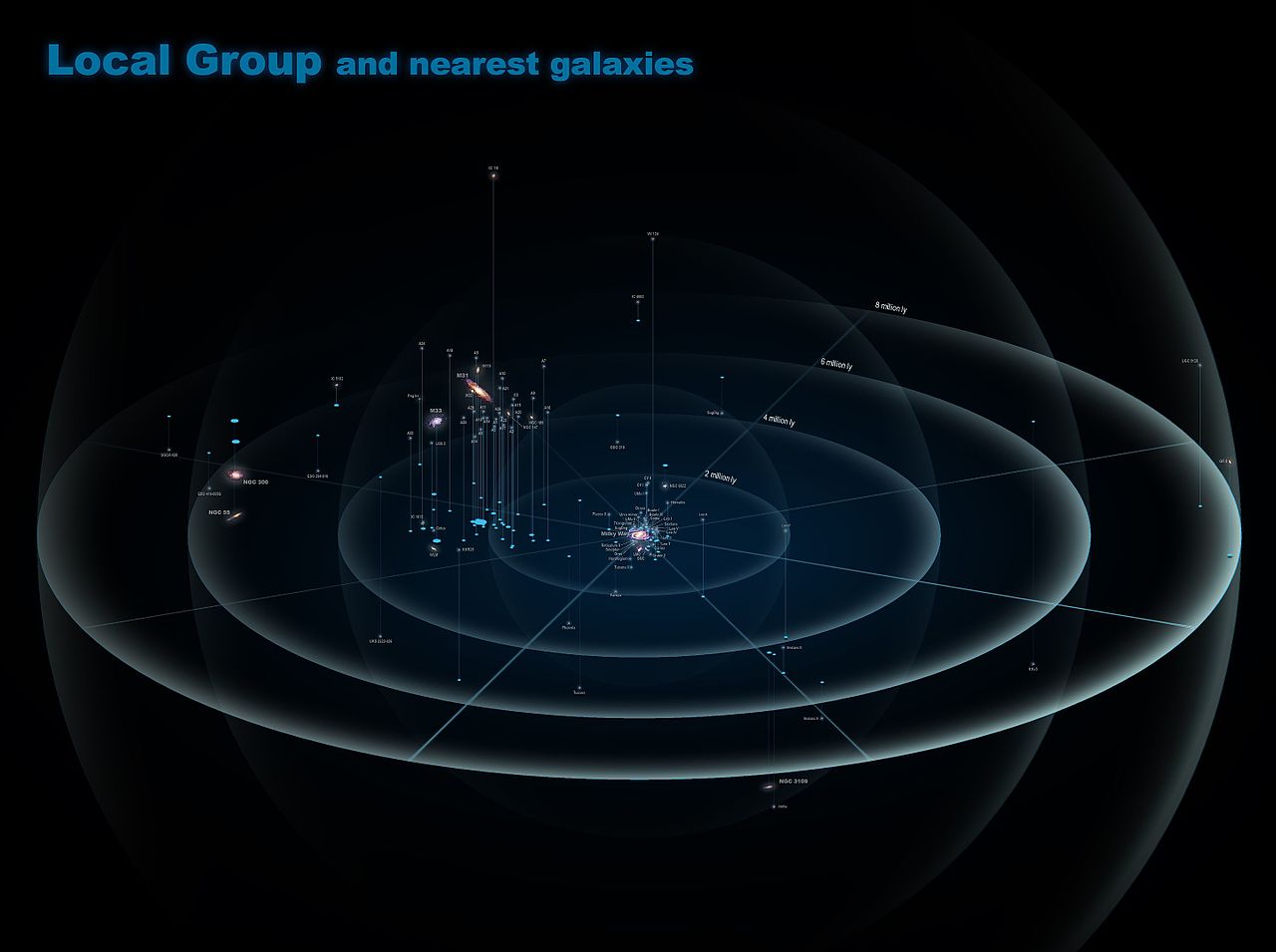
Local Group
The Dumbbell Configuration
The Local Group is the nearest galaxy group to us, and its structure is fundamental to our understanding of galactic dynamics. It's characterized by a distinctive 'dumbbell' shape, arising from two prominent concentrations of galaxies. One concentration is dominated by the Milky Way and its satellite galaxies, while the other is centered on the Andromeda Galaxy (M31) and its extensive retinue of satellite systems.
These two massive components are not static; they are gravitationally bound and are approaching each other at a relative velocity of approximately 123 km/s. This convergence suggests a future collision and merger between the Milky Way and Andromeda billions of years from now, a process that will dramatically reshape both galaxies. The center of mass for the Local Group is located closer to Andromeda, hinting at its potentially greater total mass, though precise mass measurements remain challenging.
Scale and Composition
The Local Group is a substantial cosmic entity, with an estimated total mass on the order of 2 x 10^12 solar masses. Its diameter is approximately 17 million light-years, defining the spatial extent of its gravitational influence. While the Milky Way and Andromeda are the dominant spiral galaxies, each with a mass around 10^12 solar masses, the vast majority of the Local Group's members are dwarf galaxies.
These dwarf galaxies, often ultra-faint and difficult to detect, are crucial for understanding galaxy formation and evolution, as they are thought to represent the building blocks of larger galaxies. The precise number of galaxies within the Local Group remains uncertain due to obscuration by the Milky Way's own disk and the difficulty in resolving faint, distant objects. However, over 134 members are currently known within a megaparsec of the group's center.
The Triangulum Galaxy and Other Members
The Triangulum Galaxy (M33) stands as the third-largest member, a spiral galaxy with a mass of approximately 5 x 10^10 solar masses. Its relationship with Andromeda is complex; they are separated by about 750,000 light-years, and evidence points to a close encounter 2-4 billion years ago that may have triggered significant star formation in Andromeda's disk. The Pisces Dwarf Galaxy occupies an interesting position, equidistant from both Andromeda and Triangulum, raising questions about its potential satellite status.
Beyond these major players, numerous other smaller galaxies populate the Local Group, some gravitationally bound to the main subgroups, while others exist in more isolated orbits. The membership of galaxies like NGC 3109 and its companions is debated due to their extreme distances, potentially placing them outside the Local Group's gravitational dominance, though this boundary may shift as the Milky Way and Andromeda merge.
Hierarchical Structure
The Local Group does not exist in isolation but is embedded within a larger cosmic hierarchy. It is part of the Local Volume, which itself is a component of the Virgo Supercluster. The Virgo Supercluster, a vast collection of galaxy groups and clusters, is then part of the even more immense Laniakea Supercluster.
This layered structure illustrates the interconnectedness of the universe on grand scales. Studying the Local Group provides a unique laboratory for understanding the processes of galaxy formation, interaction, and evolution under relatively accessible conditions. Its dynamics, the distribution of its members, and its eventual merger with Andromeda offer profound insights into the past, present, and future of our cosmic environment and the universe as a whole.
Go deeper
Frequently Asked Questions
What is the Local Group?+
Why do the Milky Way and Andromeda look like a dumbbell?+
How fast are the Milky Way and Andromeda moving toward each other?+
Where does the Local Group fit in the larger universe?+
What are dwarf galaxies and why are they important?+
Based on content from Wikipedia · Licensed under CC BY-SA 4.0