

Laptev Sea
Images
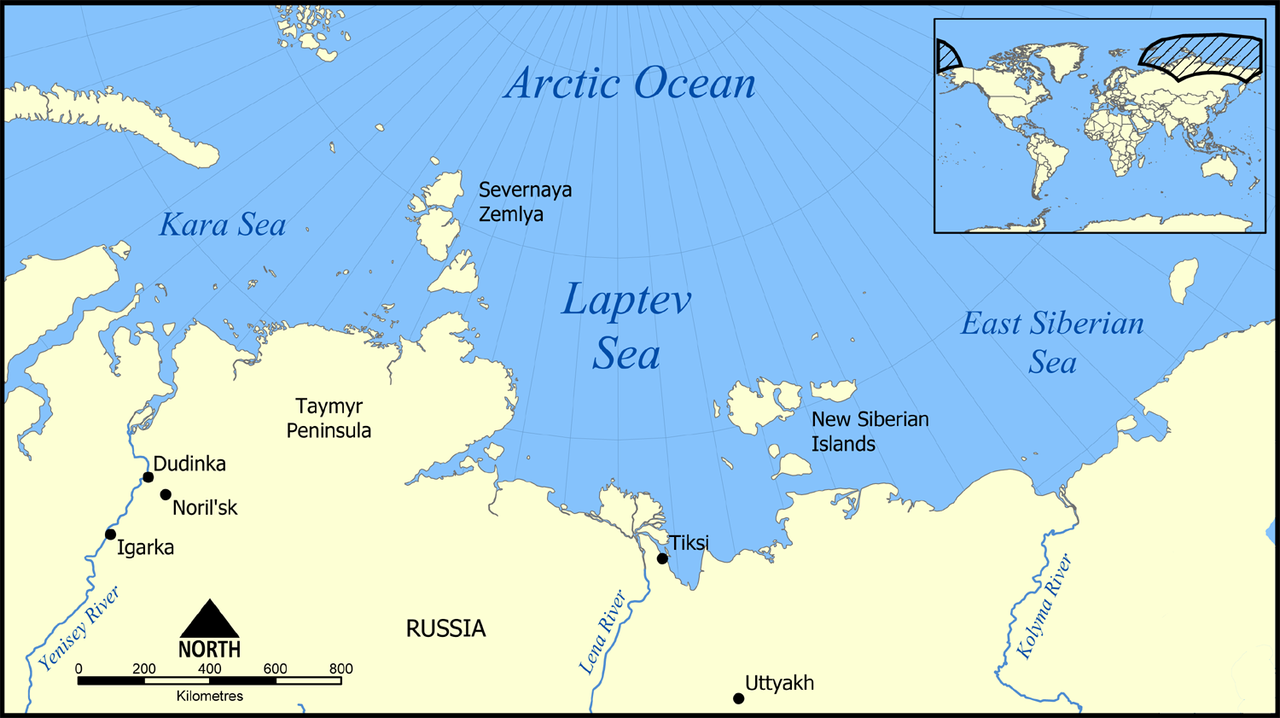
Laptev Sea map


Geopolitical and Environmental Significance
The Laptev Sea, a marginal sea of the Arctic Ocean, occupies a critical position between the northern Siberian coast, the Taimyr Peninsula, Severnaya Zemlya, and the New Siberian Islands. Its northern boundary, defined by coordinates extending to 79°N latitude, places it at the forefront of Arctic exploration and scientific inquiry. Adjacent to the Kara Sea to the west and the East Siberian Sea to the east, it forms a contiguous icy expanse.
The sea's ecological and geopolitical importance is amplified by its role as a major source of freshwater input into the Arctic Ocean, primarily from large Siberian rivers like the Lena, Khatanga, Anabar, Olenyok, Omoloy, and Yana. This freshwater discharge significantly influences Arctic Ocean circulation and salinity, impacting global climate patterns. The sea's shallow depths, generally under 50 meters, contribute to its rapid freezing and thawing cycles, making it a highly sensitive indicator of climate change.
A Palimpsest of Exploration and Prehistory
The Laptev Sea's history is etched by the footsteps of explorers and the remnants of ancient life. Named after the 18th-century Russian explorers Dmitry and Khariton Laptev, it was previously known as the Nordenskiöld Sea, after Adolf Erik Nordenskiöld's expeditions. These voyages were part of a broader era of Russian exploration aimed at charting the Northern Sea Route.
The explorers navigated challenging conditions, often relying on the vast river systems that act as natural highways from the south. Beyond human history, the Laptev Sea's islands are globally renowned for their exceptionally well-preserved Pleistocene megafauna, particularly woolly mammoths. These ancient remains, often found encased in permafrost, offer invaluable insights into prehistoric ecosystems and the evolutionary history of these iconic creatures.
The sea's low biodiversity and extreme climate have preserved these relics for millennia.
The Dynamics of an Arctic Ice Environment
The climate of the Laptev Sea is characterized by extreme cold, with temperatures remaining below 0 °C for more than nine months annually. This prolonged freezing period results in extensive sea ice cover for the majority of the year. While generally ice-bound, the sea experiences a brief period of ice clearance, typically in August and September, allowing for limited navigation and scientific observation.
The low salinity of the water, a consequence of significant freshwater input from Siberian rivers and minimal evaporation, further influences ice formation and stability. This dynamic interplay between freshwater, ice, and temperature makes the Laptev Sea a crucial natural laboratory for studying Arctic oceanography and the impacts of global warming on polar regions. The scarcity of flora and fauna is a direct result of these harsh environmental conditions.
Human Habitation and Resource Potential
Historically, the shores of the Laptev Sea have been inhabited for millennia by indigenous groups such as the Yukaghirs, Evens, and Evenks, who sustained themselves through fishing, hunting, and reindeer husbandry. Later migrations brought Yakuts and Russians, establishing a more permanent presence. Despite its remoteness and challenging climate, the region holds potential economic significance, particularly concerning natural resources.
However, the extreme conditions, including vast ice cover and limited infrastructure, present substantial challenges to resource extraction and development. The sparse human population reflects the difficulty of sustaining large communities in such an environment. Understanding the delicate balance of this ecosystem is paramount as global interest in Arctic resources grows.
The Laptev Sea as a Climate Barometer
The Laptev Sea is increasingly recognized as a critical barometer for global climate change. Its extensive sea ice cover acts as a significant albedo, reflecting solar radiation back into space and helping to regulate Earth's temperature. As global temperatures rise, the extent and duration of sea ice in the Laptev Sea are diminishing.
This reduction in ice cover leads to increased absorption of solar radiation by the darker ocean water, creating a feedback loop that accelerates warming in the Arctic and beyond. Changes in freshwater discharge from Siberian rivers, influenced by melting permafrost and altered precipitation patterns, also impact ocean circulation and marine ecosystems. Scientific research in the Laptev Sea is vital for monitoring these changes and predicting their global consequences, from sea-level rise to shifts in weather patterns.
Go deeper
Frequently Asked Questions
What is the Laptev Sea?+
Where is the Laptev Sea located?+
Why is the Laptev Sea important for freshwater?+
How does the Laptev Sea help scientists study climate change?+
What ancient animals can be found in the Laptev Sea?+
Based on content from Wikipedia · Licensed under CC BY-SA 4.0