

Kandariya Mahadeva Temple
Images

Kandariya Mahadeva Temple




The Apex of Chandela Temple Architecture
The Kandariya Mahadeva Temple, situated in the UNESCO World Heritage site of Khajuraho, Madhya Pradesh, represents the zenith of Chandela architectural and sculptural achievement. Its name, translating to 'the Great God of the Cave,' alludes to the divine presence enshrined within its sanctum. As the largest and most elaborately adorned of the Khajuraho temples, it stands as a paramount example of North Indian Nagara style temple architecture.
Constructed around the 11th century CE, likely during the reign of Vidyadhara, the temple is a testament to the sophisticated engineering, artistic vision, and religious fervor of the Chandela rulers. Its remarkable state of preservation allows for an in-depth study of medieval Indian temple construction, religious iconography, and societal norms, making it an invaluable resource for scholars and enthusiasts alike. The temple's enduring magnificence and its role as a cultural repository underscore its status as a global heritage treasure.
Chronicles in Stone
The construction of the Kandariya Mahadeva Temple is deeply intertwined with the history and cultural patronage of the Chandela dynasty. Flourishing from the 9th to the 13th centuries, the Chandelas were instrumental in shaping the architectural landscape of their kingdom, commissioning numerous temples that showcase their wealth, power, and devotion. The building of such a monumental structure would have been a multi-generational endeavor, involving the quarrying of sandstone, intricate stone cutting, and meticulous assembly.
The temple's design reflects a mature phase of the Nagara style, characterized by a curvilinear shikhara (tower) that rises majestically, adorned with numerous urushringas (smaller subsidiary spires), creating a visually dynamic silhouette. The sheer scale and complexity of the temple suggest a highly organized society with specialized labor and a deep understanding of architectural principles, allowing for the creation of a structure that is both spiritually resonant and aesthetically sublime.
A Tapestry of Belief and Life
The Kandariya Mahadeva Temple transcends its function as a mere place of worship; it serves as a comprehensive visual encyclopedia of medieval Indian life, religion, and cosmology. Its profound significance lies in its unparalleled sculptural program, which adorns virtually every surface of the temple. These thousands of meticulously carved figures depict a vast pantheon of Hindu deities, celestial beings (apsaras and surasundaris), musicians, dancers, warriors, and scenes of daily life, offering invaluable insights into the social, cultural, and religious milieu of the Chandela period.
The temple's inclusion on the UNESCO World Heritage List in 1986 highlights its outstanding universal value, recognizing its contribution to human history and artistic expression. It stands as a powerful symbol of India's rich cultural heritage, prompting ongoing efforts for its preservation and study, ensuring its legacy continues to inform and inspire future generations.
The Art of Devotion
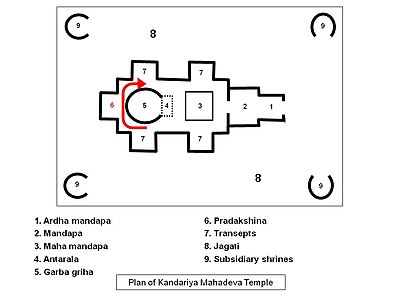
The Kandariya Mahadeva Temple is renowned for its extraordinary sculptural artistry, which forms an integral part of its architectural narrative. The temple's layout follows the traditional plan of a Panchayatana temple, though it is primarily dedicated to Shiva. The main shrine houses a large lingam, symbolizing Lord Shiva's abstract form.
The exterior is divided into several architectural bands, each teeming with sculptures. The most celebrated are the depictions of apsaras and surasundaris, celestial nymphs and beautiful women, rendered with exquisite detail and sensuous grace, showcasing the Chandela aesthetic. Beyond these, the temple's walls narrate stories from Hindu epics and Puranas, illustrating the complex theological framework and the diverse aspects of human experience as understood in medieval India.
The temple's design, with its series of progressively higher towers culminating in the central shikhara, creates a sense of upward movement, symbolizing the journey of the soul towards spiritual liberation.
Enduring Relevance
In the contemporary world, the Kandariya Mahadeva Temple remains a vital site for cultural tourism, religious pilgrimage, and scholarly research. Its designation as a UNESCO World Heritage site underscores the global responsibility to protect such irreplaceable monuments from the ravages of time and environmental factors. Ongoing conservation efforts are crucial to maintaining the structural integrity and the delicate beauty of its sandstone carvings.
The temple continues to inspire artists, architects, and historians, offering a tangible connection to India's glorious past. Its enduring appeal lies not only in its architectural grandeur but also in its capacity to evoke a sense of wonder and contemplation, inviting visitors to engage with the spiritual and artistic expressions of a bygone era and to appreciate the continuity of cultural traditions.
See also
Frequently Asked Questions
What does the name "Kandariya Mahadeva" mean?+
When was the Kandariya Mahadeva Temple built?+
Why is the temple famous for its carvings?+
Where is the Kandariya Mahadeva Temple located?+
What style of architecture is the temple?+
Based on content from Wikipedia · Licensed under CC BY-SA 4.0