

Heraclitus
Images
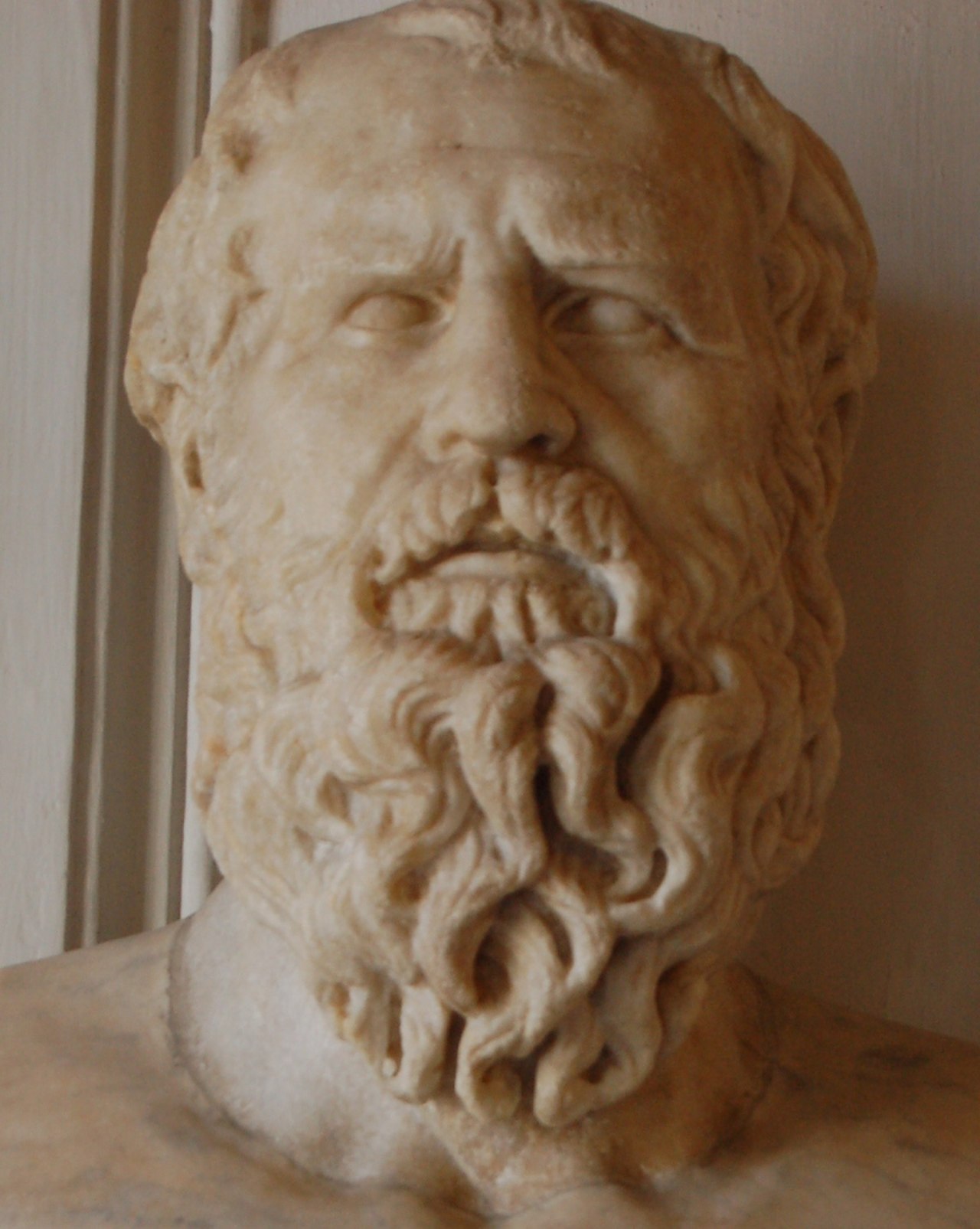
Heraclitus
The Enigmatic Ephesian
Heraclitus of Ephesus, flourishing around 500 BC, stands as one of the most influential yet enigmatic figures of pre-Socratic philosophy. His birthplace, Ephesus, then a prominent Greek city within the Persian Empire, provided a cosmopolitan backdrop for his unique intellectual development. Little is definitively known about his life; he was a member of the aristocracy but famously relinquished his royal privileges.
His solitary nature and cryptic aphoristic style earned him epithets like 'the Obscure' and 'the Dark,' contrasting sharply with the more jovial Democritus, the 'Laughing Philosopher.' This obscurity, however, belies the profound impact of his thought, which deeply influenced subsequent philosophers like Plato, Aristotle, Hegel, and Nietzsche. His single, lost work, known only through surviving fragments, presented a paradoxical philosophy, rich in wordplay and oracular pronouncements, often interpreted as a deliberate challenge to conventional understanding and a reflection of his melancholic disposition.
The Doctrine of Universal Flux
At the core of Heraclitus's philosophy is the radical concept of perpetual change, famously encapsulated in the phrase 'panta rhei' (everything flows). He posited that reality is not a static state of 'being' but a continuous process of 'becoming.' His iconic metaphor of the river illustrates this: 'No man ever steps in the same river twice.' This statement implies that both the river and the individual are in constant flux. The water molecules are always different, and the person stepping in is also subtly altered by time and experience.
This insistence on ceaseless transformation stands in stark contrast to Parmenides's philosophy of immutable being. For Heraclitus, strife and tension between opposing forces were not destructive but were the very mechanisms that maintained cosmic order and harmony. He saw the world as a dynamic interplay, a constant struggle that paradoxically results in stability.
Fire as Arche and the Structuring Logos
Following the Milesian tradition of identifying a single fundamental substance (arche), Heraclitus proposed fire. This choice was not arbitrary; fire is inherently dynamic, consuming, transforming, and radiating energy. He viewed the cosmos as an 'ever-living fire, kindled and put out in measures,' suggesting a cyclical process of cosmic creation and destruction governed by specific proportions.
Beyond the material element, Heraclitus introduced the concept of the 'logos.' This term, often translated as 'word,' 'reason,' or 'account,' represented the underlying rational principle or universal law that governs the cosmos and its transformations. The logos provides structure and intelligibility to the constant flux, ensuring that change occurs in an ordered, albeit complex, manner. It is the unifying force that binds together the apparent contradictions and ceaseless motion of existence.
The Unity of Opposites
Heraclitus’s philosophy is deeply concerned with the 'unity of opposites.' He argued that seemingly contradictory concepts are, in fact, interdependent and essential for existence. For example, he suggested that 'the way up and the way down are one and the same,' and 'sea water is both very pure and very foul; drinkable and not drinkable.' This perspective challenges dualistic thinking, proposing that opposites are not mutually exclusive but are different aspects of a single underlying reality. Strife, or conflict between these opposites, was not seen as a flaw but as the very engine of change and the source of cosmic justice.
The tension between opposing forces creates the dynamic equilibrium that characterizes the universe. This idea of interconnectedness and interdependence has profound implications for understanding reality, ethics, and even human psychology.
Enduring Relevance and Philosophical Impact
The fragmented nature of Heraclitus's writings has allowed for diverse interpretations, but their core message about the pervasive nature of change continues to resonate. His ideas laid crucial groundwork for dialectical philosophy, influencing figures like Hegel, who saw history as a progression through the conflict of opposites. Nietzsche drew inspiration from Heraclitus's embrace of flux and the affirmation of life's inherent struggles.
In contemporary thought, his concepts find echoes in fields ranging from chaos theory and quantum physics, which describe inherently dynamic and probabilistic systems, to postmodern philosophy's critique of fixed truths. Heraclitus compels us to question our assumptions about stability and permanence, urging us to appreciate the profound beauty and order inherent in the universe's ceaseless transformation. His legacy is a testament to the enduring power of challenging, paradoxical thought.
Go deeper
Frequently Asked Questions
What did Heraclitus say about everything changing?+
Why did Heraclitus choose fire as the main element of the world?+
What is the "logos" that Heraclitus talked about?+
How did Heraclitus think opposites like "up" and "down" are related?+
Why was Heraclitus called "the Dark" or "the Obscure"?+
Based on content from Wikipedia · Licensed under CC BY-SA 4.0