

Gustav Kirchhoff
Images
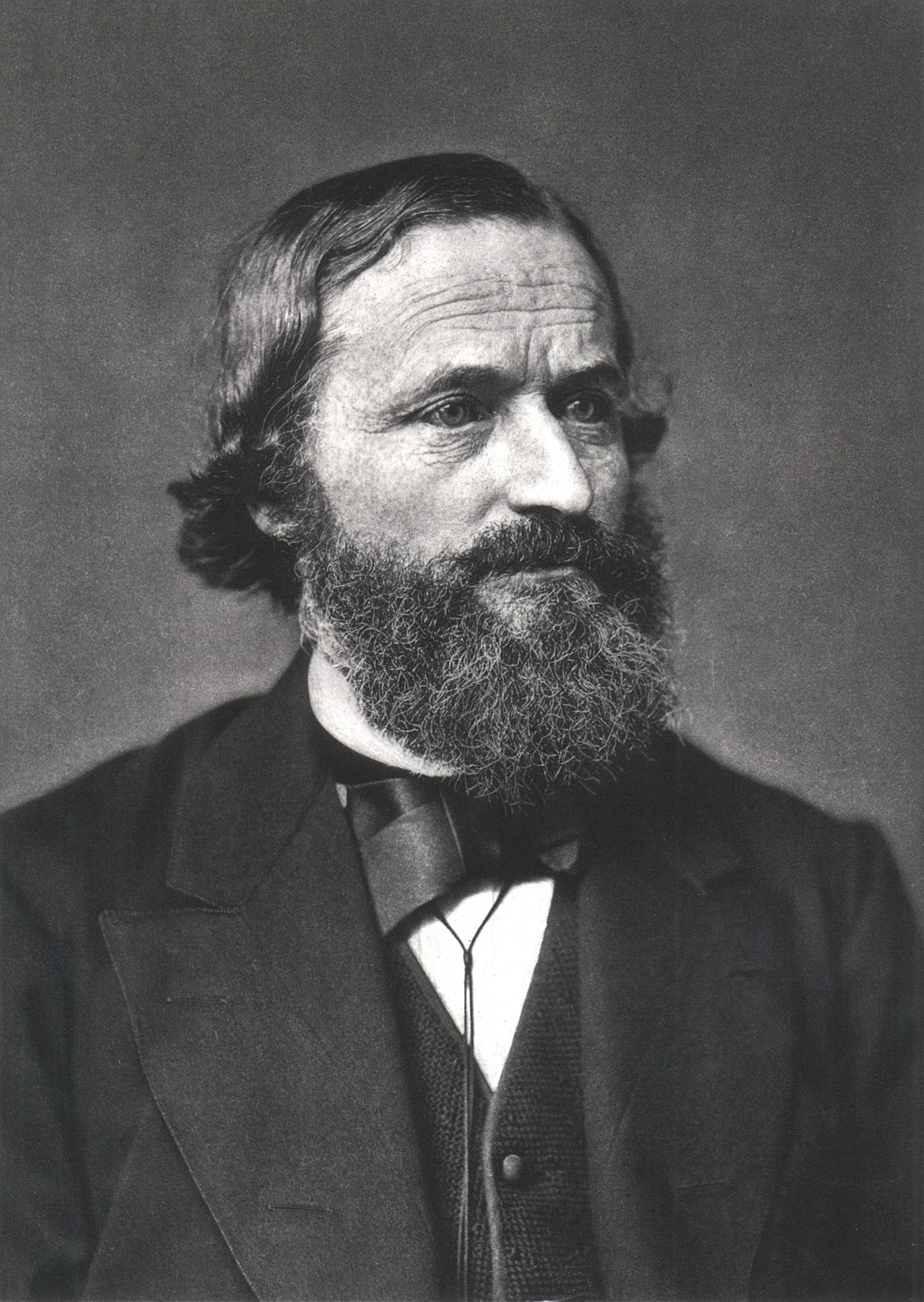
Gustav Kirchhoff
The Genesis of Kirchhoff's Circuit Laws
Born in Königsberg, Prussia, on March 12, 1824, Gustav Robert Kirchhoff was a pivotal figure in the development of physics. His most enduring legacy in electrical engineering stems from his formulation of two fundamental laws governing electrical circuits. The first, Kirchhoff's Current Law (KCL), is a direct consequence of the conservation of electric charge, stating that the algebraic sum of currents entering any junction in a circuit must equal the algebraic sum of currents leaving it.
This principle is indispensable for analyzing complex networks where current divides. The second, Kirchhoff's Voltage Law (KVL), is derived from the conservation of energy, asserting that the algebraic sum of all voltages around any closed loop in a circuit must be zero. These laws, published in 1845, provided a systematic mathematical framework for analyzing circuits that was previously lacking, enabling the design and understanding of increasingly sophisticated electrical systems.
Their application is ubiquitous, from simple household appliances to advanced telecommunications infrastructure.
Pioneering Spectroscopy and the Nature of Light
Kirchhoff's scientific genius extended dramatically into the realm of light and heat. His investigations into the emission of radiation from heated objects led him to coin the term 'black body' in 1860. A black body is an idealized physical body that absorbs all incident electromagnetic radiation, regardless of frequency or angle of incidence.
By studying the spectrum of light emitted by such bodies (black-body radiation), Kirchhoff, alongside his collaborator Robert Bunsen, developed the principles of spectroscopy. They demonstrated that heated elements emit light at specific, characteristic wavelengths, creating unique spectral 'fingerprints.' This breakthrough allowed scientists to identify the chemical composition of distant stars and other celestial objects by analyzing the light they emit, effectively transforming astronomy into an astrophysical science.
This ability to 'read' the light from the cosmos was a monumental leap in our understanding of the universe.
The Interplay of Heat, Light, and Matter
Kirchhoff's work on thermal radiation was deeply intertwined with his understanding of how matter interacts with energy. His law of thermal radiation, formulated around 1859, established a crucial relationship between the emission and absorption of radiation by a body at a given temperature. It states that for an opaque object in thermal equilibrium with its surroundings, the emissivity of the surface is equal to its absorptivity at the same temperature and wavelength.
This principle is fundamental to thermodynamics and has implications for understanding heat transfer in various systems, from planetary atmospheres to industrial furnaces. His research into thermochemistry also contributed to understanding the energy changes involved in chemical reactions, further solidifying his impact across multiple scientific disciplines.
Enduring Impact and Scientific Legacy
Gustav Kirchhoff passed away on October 17, 1887, but his scientific contributions continue to resonate profoundly. His circuit laws remain foundational in electrical engineering education and practice, essential for designing and troubleshooting any electrical network. The field of spectroscopy, which he helped establish, is now a cornerstone of analytical chemistry, physics, and astronomy, enabling discoveries from new elements to the detection of exoplanets.
The Bunsen–Kirchhoff Award for spectroscopy stands as a testament to his and Bunsen's pioneering work. Kirchhoff's rigorous approach to physics and his ability to connect seemingly disparate phenomena – electricity, heat, and light – set a high standard for scientific inquiry. His work not only provided practical tools for technological advancement but also fundamentally altered our perception of the physical universe, from the smallest circuit to the grandest star.
Go deeper
Frequently Asked Questions
Who was Gustav Kirchhoff?+
What are Kirchhoff's laws?+
What is a black body?+
How did Kirchhoff help astronomy?+
When did Kirchhoff die?+
Based on content from Wikipedia · Licensed under CC BY-SA 4.0