

Great White Shark
Images
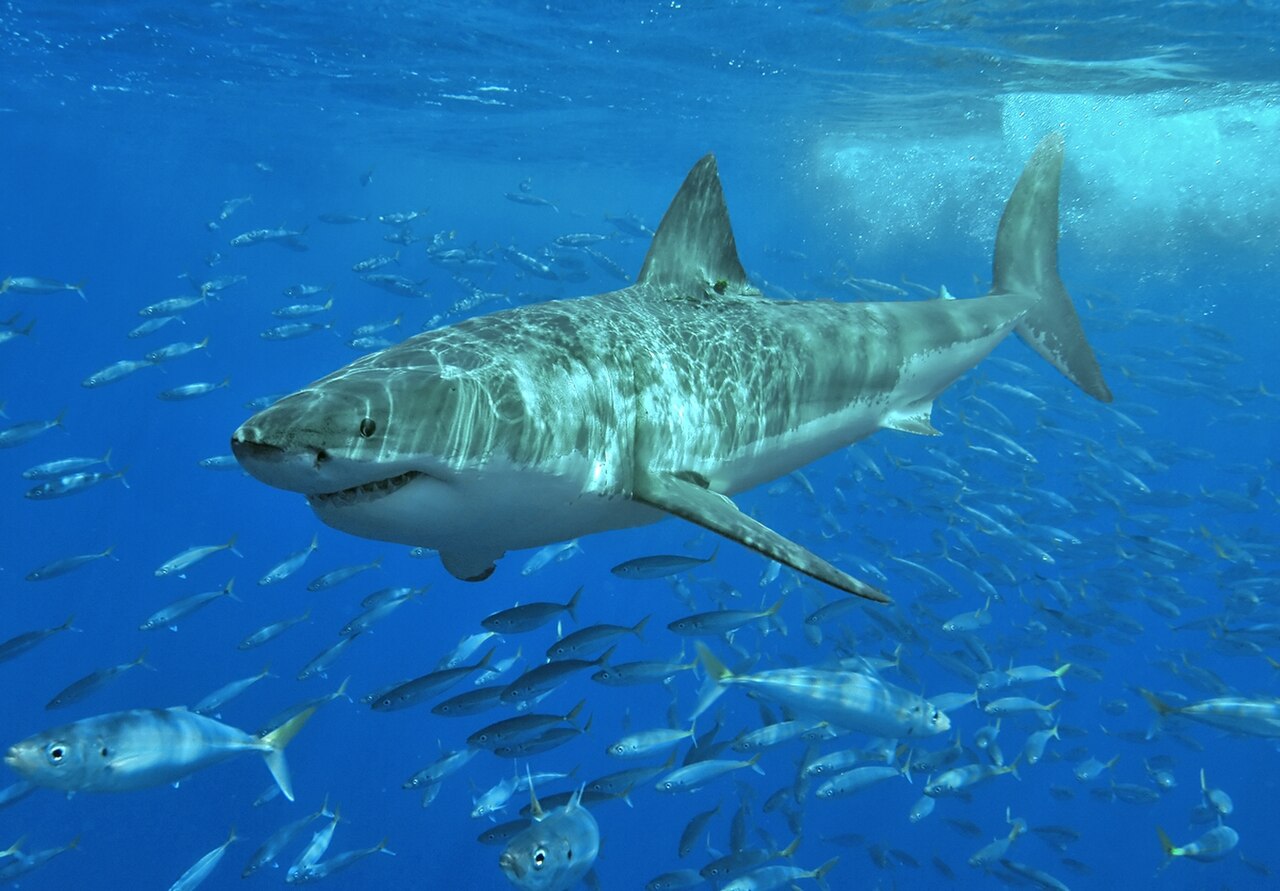
Great white shark


Anatomy and Physiology of a Top Predator
The great white shark (Carcharodon carcharias) is a marvel of evolutionary engineering, perfectly adapted for its role as an apex predator. Its streamlined, fusiform body shape minimizes drag, allowing for incredible bursts of speed, estimated to reach up to 35 miles per hour (56 km/h) over short distances. The powerful caudal fin provides propulsion, while the pectoral fins act as hydrofoils for lift and maneuverability.
Their skin is covered in dermal denticles, which reduce drag and protect them. Perhaps their most striking feature is their dentition: up to 300 serrated, triangular teeth arranged in multiple rows, designed for slicing through flesh. These teeth are constantly shed and replaced, ensuring a sharp set is always ready.
Their large size, with females often exceeding males, reaching up to 20 feet (6 meters) and weighing over 2,000 pounds (900 kg), makes them one of the largest predatory fish on Earth. Their countershading coloration-dark on top and white underneath-provides camouflage, blending them with the dark depths when viewed from above and the bright surface when seen from below.
Hunting Strategies and Diet
Great white sharks employ sophisticated hunting strategies tailored to their prey. Their diet is diverse, reflecting their wide distribution and opportunistic feeding habits. While often depicted as man-eaters, their primary prey consists of marine mammals such as seals, sea lions, and occasionally dolphins and whales.
They also consume large fish, seabirds, and sea turtles. Their hunting technique often involves a surprise attack from below, using their speed and power to breach the water's surface with their prey. The ampullae of Lorenzini, a network of pores on their snout, are highly sensitive electroreceptors that detect the minute electrical fields generated by the muscle contractions of potential prey, even those hidden in sand or murky water.
This sensory array, combined with an exceptional sense of smell capable of detecting a single drop of blood in vast volumes of water, makes them incredibly efficient hunters. They are known to exhibit 'investigative biting' when encountering unfamiliar objects or humans, which can be dangerous due to their immense power.
Reproduction, Lifespan, and Distribution
Reproduction in great white sharks is a slow and complex process. They are ovoviviparous, meaning the eggs hatch inside the mother, and the pups are born live. Gestation periods are estimated to be around 11 months, and litters typically consist of 2 to 10 pups, each measuring about 4 to 5 feet (1.2 to 1.5 meters) at birth.
These pups are precocial, meaning they are well-developed and capable of independent hunting from birth, though they are vulnerable to predation from larger sharks, including adult great whites. Great whites are long-lived animals, with recent research suggesting lifespans exceeding 70 years, making them one of the longest-living cartilaginous fishes. Their distribution is global, found in temperate and subtropical oceans worldwide, with notable populations in areas like South Africa, Australia, California, and the Mediterranean Sea.
They are migratory, often traveling long distances between feeding and pupping grounds.
Ecological Significance and Conservation Challenges
As apex predators, great white sharks play a critical role in maintaining the health and balance of marine ecosystems. By preying on seals, sea lions, and other large animals, they help regulate prey populations, preventing overgrazing of kelp forests and maintaining biodiversity. Their presence can influence the behavior of their prey, leading to cascading effects throughout the food web.
Despite their ecological importance, great white sharks are classified as Vulnerable by the IUCN. They face significant threats from human activities, including targeted fishing for their fins, teeth, and jaws, as well as incidental capture in fisheries targeting other species. Habitat degradation and pollution also pose risks. Conservation efforts are crucial, focusing on reducing fishing mortality, protecting critical habitats, and increasing public awareness to foster a greater appreciation for these magnificent, yet threatened, ocean inhabitants.
Understanding their biology and ecological role is key to ensuring their survival for future generations.
Go deeper
Frequently Asked Questions
What does a great white shark look like?+
How fast can a great white shark swim?+
What do great white sharks eat?+
How do great white sharks find their food?+
How are great white sharks born and how long do they live?+
Based on content from Wikipedia · Licensed under CC BY-SA 4.0