

Georges Pompidou
Images

Tunnel where Princess Diana was killed, Paris - Alma Tunnel - Voie Georges Pompidou




The Gaullist Successor and Modernization Drive
Georges Pompidou's presidency (1969-1974) was a pivotal period in post-war French history, building upon the foundations laid by Charles de Gaulle. As de Gaulle's former Prime Minister, Pompidou inherited a vision of French grandeur and autonomy, but he adapted it to a changing world. His tenure was characterized by a vigorous push for modernization, continuing the economic boom of the 'Trente Glorieuses.' This involved significant state investment in key industrial sectors: aerospace, telecommunications, nuclear energy, and automotive manufacturing.
The ambitious TGV high-speed train project, a symbol of French technological prowess, was initiated under his leadership. Furthermore, Pompidou's government implemented crucial social reforms, including the establishment of the SMIC (Salaire Minimum Interprofessionnel de Croissance), a significant increase in the minimum wage, and the creation of the Ministry of the Environment, signaling a growing awareness of ecological issues. His presidency aimed to solidify France's position as a major industrial and technological power.
Pragmatic Diplomacy and European Integration
In foreign policy, Pompidou pursued a pragmatic approach that maintained the Gaullist principle of French independence within the Western alliance while seeking to thaw Cold War tensions. He fostered warmer relations with the United States under Richard Nixon, moving away from de Gaulle's more confrontational stance. Simultaneously, he maintained close diplomatic ties with the Soviet Union under Leonid Brezhnev, demonstrating a balanced approach.
A landmark achievement of his foreign policy was the facilitation of the United Kingdom's accession to the European Economic Community (EEC) in 1973. This marked a significant shift from de Gaulle's previous vetoes and signaled Pompidou's commitment to a more inclusive and dynamic European integration, laying groundwork for the future European Union. He also played a role in initiatives like the 'snake in the tunnel' currency mechanism, aiming for greater economic stability in Europe.
The Centre Pompidou
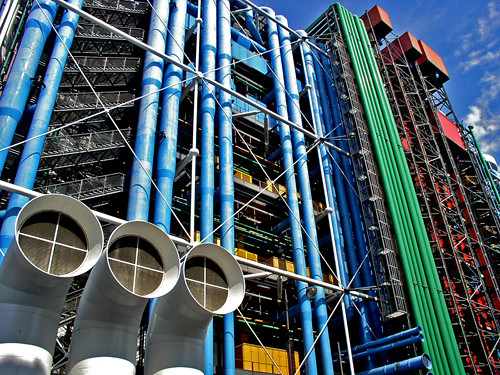
Georges Pompidou's most visible and enduring legacy is undoubtedly the Centre Pompidou in Paris. A passionate admirer of contemporary art, he envisioned a vibrant cultural center that would be accessible and dynamic. His initiative led to the construction of a building that was radically different from traditional museums.
Designed by architects Renzo Piano and Richard Rogers, the Centre Pompidou is famous for its 'inside-out' architecture, with its structural elements, mechanical systems, and circulation routes exposed on the exterior. This bold design, inaugurated in 1977, three years after Pompidou's death, challenged conventional aesthetics and created a lively hub for art, libraries, and public gatherings. The Centre Pompidou has since become an iconic landmark, inspiring similar cultural institutions globally and cementing Pompidou's name in the international cultural landscape.
Economic Transformation and Social Change
Pompidou's presidency coincided with the tail end of the 'Trente Glorieuses,' a period of unprecedented economic growth in France. He actively steered this growth towards industrial modernization, believing that a strong industrial base was crucial for national sovereignty and prosperity. Investments poured into sectors like nuclear power, aerospace (contributing to the development of the Airbus program), and telecommunications.
The creation of the SMIC was a significant social policy, aiming to improve the living standards of the lowest-paid workers and address some of the social inequalities that arose during rapid industrialization. While pursuing economic advancement, Pompidou also recognized the need for environmental stewardship, establishing the Ministry of the Environment. His approach was one of managed progress, seeking to balance economic dynamism with social welfare and a forward-looking vision for France.
Enduring Impact and Historical Context
Georges Pompidou's time in office, though relatively short, left an indelible mark on France. He successfully navigated a complex geopolitical landscape, strengthened France's industrial capabilities, and championed a bold vision for cultural expression. His presidency represented a transition from the more nationalist and sometimes isolationist policies of de Gaulle to a more pragmatic and outward-looking approach, particularly in European affairs.
The Centre Pompidou stands as a testament to his cultural vision, a building that continues to provoke discussion and inspire creativity. His death in office in 1974 from Waldenström's disease, a rare blood cancer, cut short a presidency that was actively shaping modern France. His legacy is one of modernization, pragmatic diplomacy, and a lasting cultural icon.
Go deeper
Frequently Asked Questions
Who was Georges Pompidou?+
What is the Centre Pompidou?+
What did Pompidou do to help France's industry?+
How did Pompidou help the United Kingdom join the European community?+
What were some of Pompidou's social reforms?+
Based on content from Wikipedia · Licensed under CC BY-SA 4.0