

Geopolitics: How Maps Shape Our World!
Images

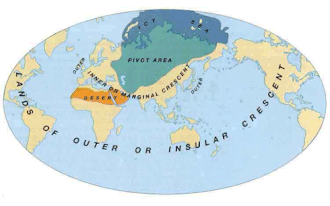
Geopolitical map.



Defining Geopolitics
Geopolitics is a complex analytical framework that examines how geographical factors-including physical location, climate, topography, natural resources, and demographics-influence the political behavior and international relations of states and other actors. It moves beyond mere description of spatial relationships to analyze how these elements confer power, create vulnerabilities, and shape strategic decision-making. While often used broadly as a synonym for international political relations, its core lies in understanding the impact of spatial variables on foreign policy and the global distribution of power.
This field seeks to explain and predict international political behavior by incorporating geographical dimensions, recognizing that the physical environment is not a passive backdrop but an active participant in shaping statecraft and global dynamics.
Historical Roots
The conceptualization of geopolitics has evolved significantly since its formal introduction by Emil Reich in 1902. Early 20th-century thinkers like Halford Mackinder, with his 'Heartland' theory, posited that control over the vast Eurasian interior was key to global dominance. Alfred Thayer Mahan emphasized the importance of naval power and control over sea lanes.
These theories, while sometimes criticized for their deterministic leanings, laid the groundwork for understanding how geography could be translated into strategic advantage. Later developments, including critical geopolitics, emerged to deconstruct these classical theories, highlighting their ideological functions and potential biases, particularly in serving the interests of great powers. The field continues to adapt, incorporating new factors like climate change and digital connectivity.
The Enduring Significance of Geography in Statecraft
The significance of geopolitics lies in its ability to provide a foundational understanding of why nations behave as they do on the international stage. A nation's access to natural resources, such as oil, rare earth minerals, or fresh water, directly impacts its economic power and its diplomatic leverage. Strategic locations, like control over chokepoints (e.g., the Strait of Hormuz) or proximity to major markets, can grant significant geopolitical advantages.
Furthermore, a country's physical size and terrain can influence its defense capabilities and its ability to project power. Geopolitics serves as an essential tool for policymakers and analysts seeking to comprehend the underlying drivers of international conflict, cooperation, and the formation of global power structures, acting as an aid to statecraft by illuminating these critical spatial considerations.
Mechanisms of Geopolitical Influence
Geopolitics operates through several interconnected mechanisms. Firstly, the control and access to territory and its resources are paramount. This includes land territory, territorial waters, and exclusive economic zones, all of which are sources of wealth and strategic advantage.
Secondly, geographical features like mountains, deserts, and oceans act as natural barriers or conduits, influencing military strategy and trade routes. Climate plays a role, affecting agricultural productivity, resource availability, and even population distribution. Demography, the study of populations, interacts with geography to determine labor forces, consumer markets, and potential military strength. The interplay of these variables-area, climate, topography, demography, and natural resources-forms the basis for geopolitical analysis, explaining the strategic calculations nations make in relation to their physical environment and their neighbors.
Contemporary Geopolitical Arenas and Debates
Modern geopolitics is evident in numerous global issues. The competition for energy resources, particularly in regions like the Middle East and the Arctic, is a classic geopolitical struggle. The Belt and Road Initiative, China's massive infrastructure project, is a contemporary example of leveraging geography to expand economic and political influence across continents.
Climate change is introducing new geopolitical dimensions, such as the potential for new Arctic shipping routes and increased competition for water resources in vulnerable regions. The relationship between geopolitics and geoeconomics is also a major focus, with debates centering on whether strategic power or economic interdependence is the primary driver of international relations. Critical geopolitics continues to examine how geopolitical narratives are constructed and deployed to serve specific political agendas.
Go deeper
Frequently Asked Questions
What is geopolitics?+
Why do mountains and rivers matter to countries?+
How does having oil or water help a country?+
What is a chokepoint and why is it important?+
How did old ideas about the "Heartland" help people think about power?+
Based on content from Wikipedia · Licensed under CC BY-SA 4.0