

Gas Turbine: The Speedy Spinners!
Images
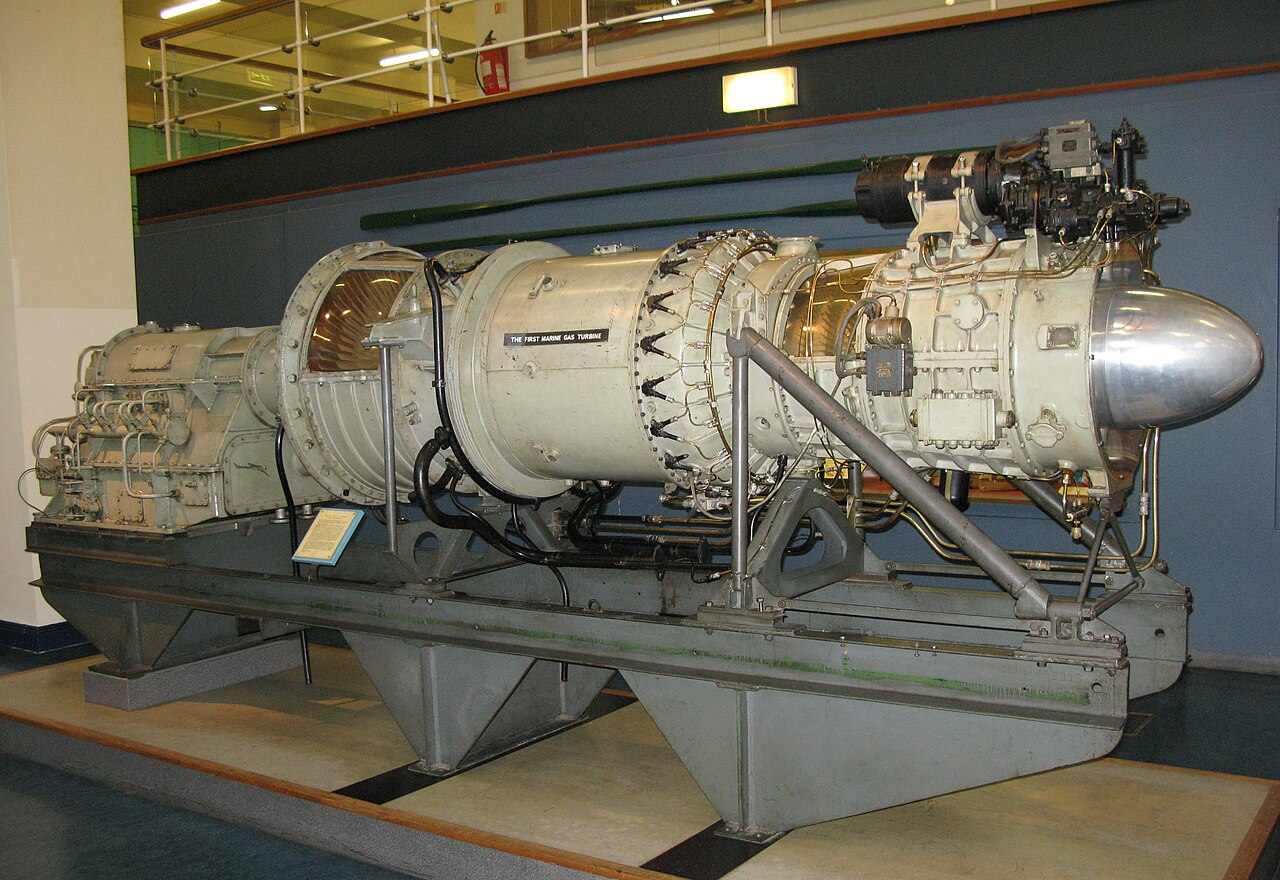
Gas turbine from MGB 2009


Thermodynamic Cycles and Mechanical Design
At its heart, a gas turbine operates on the Brayton cycle, a thermodynamic process involving the compression of air, followed by heat addition (combustion), and then expansion through a turbine. The engine comprises three main sections: the compressor, the combustor, and the turbine. The compressor, typically an axial-flow or centrifugal design, raises the pressure of ambient air significantly.
This high-pressure air then enters the combustor, where fuel is injected and mixed, and combustion occurs at a near-constant pressure, dramatically increasing the temperature and volume of the gas. This superheated gas then expands through the turbine section, which consists of multiple stages of rotating blades. The turbine extracts energy from the expanding gas to drive both the compressor and, in the case of jet engines, a fan or propeller, or in power generation, a generator.
The efficiency of a gas turbine is heavily influenced by the pressure ratio achieved by the compressor and the turbine inlet temperature, which is limited by the material science of the turbine blades. Advanced cooling techniques and exotic alloys are crucial for achieving higher operating temperatures and thus greater efficiency and power output.
From Early Concepts to Supersonic Flight
The theoretical underpinnings of gas turbines date back to the 1st century AD with Hero of Alexandria's aeolipile, but practical application remained elusive for centuries. The late 19th and early 20th centuries saw significant theoretical advancements and experimental prototypes. The critical breakthrough came in the 1930s with the independent development of the turbojet engine by Frank Whittle in Britain and Hans von Ohain in Germany.
Whittle’s early work focused on using the turbine to drive a compressor for a jet engine, while von Ohain’s design was more directly inspired by the continuous combustion principles. World War II accelerated development, leading to the first operational jet aircraft. Post-war, the technology rapidly evolved. The development of the turbofan engine, which bypasses some air around the core for increased efficiency and reduced noise, revolutionized commercial aviation.
Simultaneously, the adaptation of gas turbines for power generation, particularly for rapid response 'peaker' plants and later for combined cycle power plants (CCGT), transformed the energy landscape. Innovations in materials science, aerodynamics, and control systems have continuously pushed the boundaries of performance and efficiency.
The Indispensable Engine
Gas turbines are foundational to modern global infrastructure, playing a dual role in transportation and energy production. In aviation, they are the sole means of propulsion for virtually all jet aircraft, enabling rapid intercontinental travel and global commerce. Their high power-to-weight ratio is unmatched for high-speed flight.
Beyond passenger and cargo planes, they are essential for military aviation, providing speed, altitude, and maneuverability. In the energy sector, gas turbines are critical for electricity generation. They are the backbone of 'peaker plants,' which provide electricity during peak demand periods, ensuring grid stability.
Furthermore, when integrated into combined cycle power plants (CCGT), where the waste heat from the gas turbine is used to generate steam for a separate steam turbine, they achieve very high thermal efficiencies, making them a significant source of baseload power. Their rapid start-up capability also makes them valuable for grid balancing and supporting renewable energy sources like wind and solar, which are intermittent. They also play a role in industrial applications, such as driving pumps for oil and gas pipelines.
Technological Frontiers
The ongoing development of gas turbines is driven by the imperative to increase efficiency and reduce environmental impact. Research focuses on several key areas. Firstly, increasing turbine inlet temperatures through advanced materials (like ceramic matrix composites) and sophisticated cooling techniques is paramount for improving thermodynamic efficiency. Secondly, aerodynamic design of compressor and turbine blades is continuously refined to minimize losses and maximize power extraction.
Thirdly, reducing emissions, particularly nitrogen oxides (NOx) and carbon dioxide (CO2), is a major challenge. Innovations like lean-burn combustors and catalytic converters are employed. Looking ahead, there is significant research into hydrogen combustion, which offers the potential for zero-carbon operation, and the integration of gas turbines with carbon capture technologies.
The development of smaller, more modular gas turbines also opens up new applications, including distributed power generation and potentially even hybrid-electric aircraft propulsion systems. The gas turbine remains a vital technology, poised for further evolution to meet future energy and transportation demands.
See also
Frequently Asked Questions
What is a gas turbine and how does it work?+
Why do gas turbines need special materials?+
How did gas turbines help airplanes fly faster?+
Where are gas turbines used besides airplanes?+
What is a turbofan and why is it better for planes?+
Based on content from Wikipedia · Licensed under CC BY-SA 4.0