

Fermilab: Where Scientists Play with Tiny Things!
Images

Robert Rathbun Wilson Hall (Fermilab)


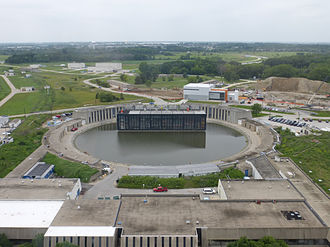




A Legacy of Discovery
Fermi National Accelerator Laboratory (Fermilab), situated in Batavia, Illinois, is a premier U.S. Department of Energy national laboratory with a profound legacy in high-energy particle physics. Since its inception, Fermilab has been at the forefront of exploring the fundamental constituents of matter and the forces that govern them.
Its research has led to groundbreaking discoveries, including the top quark and the W and Z bosons, which have significantly advanced the Standard Model of particle physics. The laboratory's commitment to pushing the boundaries of scientific understanding is evident in its continuous development of cutting-edge technologies and its pursuit of answers to the universe's most profound questions. Fermilab's influence extends beyond its physical location, shaping the global landscape of particle physics research and inspiring future generations of scientists.
The Accelerators
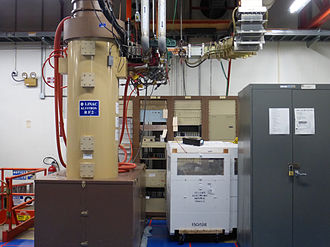
Central to Fermilab's research capabilities are its powerful particle accelerators. The Main Injector, a two-mile-circumference synchrotron, is a critical component of the laboratory's experimental program, providing high-intensity proton beams for various physics investigations. Fermilab has historically hosted the Tevatron, once the world's most powerful particle accelerator, which operated for over two decades and was instrumental in discovering the top quark.
The ongoing upgrade of Fermilab's accelerator complex, including the construction of the PIP-II linear accelerator, signifies a commitment to maintaining its leadership in the field. These colossal machines are not merely tools; they are sophisticated engineering marvels that enable scientists to recreate conditions similar to those shortly after the Big Bang, allowing for the study of fundamental particle interactions and the search for new physics beyond the Standard Model.
The sheer scale and complexity of these accelerators underscore the immense resources and ingenuity required for modern particle physics research.
The Neutrino Frontier
Fermilab is strategically positioning itself as a global leader in neutrino physics, a field crucial for understanding cosmic evolution and fundamental symmetries. The laboratory is the host of the Deep Underground Neutrino Experiment (DUNE), a flagship international project involving thousands of scientists. DUNE aims to unravel mysteries surrounding neutrino oscillations, matter-antimatter asymmetry in the universe, and potentially new physics.
Despite facing challenges and delays, the scientific community remains committed to DUNE's potential to revolutionize our understanding of neutrinos. Fermilab also hosts and supports numerous other neutrino experiments, such as NOvA and ICARUS, which provide complementary data and contribute to a comprehensive picture of neutrino behavior. The pursuit of neutrino physics at Fermilab represents a significant investment in fundamental science with far-reaching implications for cosmology and particle physics.
Diversifying Research
Beyond its core particle physics programs, Fermilab is actively expanding into emerging scientific frontiers. The laboratory has established the Fermilab Quantum Institute and is a key site for the Superconducting Quantum Materials and Systems (SQMS) Center, demonstrating a strong commitment to quantum information science. This diversification reflects the evolving landscape of scientific inquiry and Fermilab's adaptability in exploring new areas of research with potential for transformative impact.
Furthermore, Fermilab maintains vital international collaborations, including its significant contributions to the Worldwide LHC Computing Grid and its participation in experiments at the Large Hadron Collider. This global engagement is essential for tackling complex scientific challenges that transcend national boundaries and require collective expertise and resources. Fermilab's multifaceted approach ensures its continued relevance and leadership in the global scientific community.
Management Evolution and Future Directions
Fermilab's operational structure has seen recent changes, with new management taking over in January 2025 to address performance issues. The Fermi Forward Discovery Group, LLC (FFDG) now leads the laboratory, incorporating expertise from the previous management group and new partners. This transition, while marking a period of adjustment, underscores a commitment to optimizing the laboratory's effectiveness and ensuring its continued success in scientific endeavors.
The laboratory's ongoing pursuit of fundamental knowledge, coupled with its strategic expansion into new fields like quantum science and its robust international collaborations, positions Fermilab to remain a pivotal institution in scientific discovery for decades to come. The dedication of its scientists and staff, combined with evolving leadership, will shape its future contributions to physics and beyond.
Go deeper
Frequently Asked Questions
What is Fermilab and why is it called a playground for scientists?+
What are some of the big discoveries made at Fermilab?+
How do Fermilab's particle accelerators help scientists learn about the universe?+
What is the Deep Underground Neutrino Experiment (DUNE) and why is it important?+
Does Fermilab work on anything besides particle physics?+
Based on content from Wikipedia · Licensed under CC BY-SA 4.0