

Expressionism: Painting Your Feelings!
Images
Expressionism
The Inner Landscape
Expressionism emerged as a powerful counter-movement to the prevailing naturalism and Impressionism of the late 19th century. Artists felt that these styles, while perhaps capturing fleeting moments or visual sensations, failed to address the deeper, often turbulent, psychological and spiritual realities of modern life. The core tenet of Expressionism was the artist's subjective experience.
Instead of meticulously rendering the external world, Expressionists sought to convey their internal emotional landscape, their anxieties, fears, joys, and spiritual yearnings. This led to a deliberate distortion of form, exaggerated perspectives, and the use of intense, often clashing, non-naturalistic colors. The goal was not to depict what the eye saw, but what the soul felt.
This approach allowed for a raw, visceral communication with the viewer, bypassing intellectual interpretation in favor of direct emotional impact. It was an art that screamed, wept, and raged, reflecting the often-unsettling spirit of the age.
Germination of Feeling
The fertile ground for Expressionism was largely found in Germany, with key groups like 'Die Brücke' (The Bridge) in Dresden and 'Der Blaue Reiter' (The Blue Rider) in Munich playing pivotal roles. These artists were reacting to a rapidly industrializing and urbanizing society, the looming specter of war, and a sense of spiritual crisis. They were deeply influenced by the emotional intensity of Post-Impressionists like Vincent van Gogh, Paul Gauguin, and Edvard Munch, whose work already pushed the boundaries of color and form to express inner states.
Expressionists sought to create a new artistic language that could grapple with these profound societal and personal upheavals. They looked to folk art, medieval woodcuts, and non-Western art for inspiration, valuing their directness and emotional power over academic refinement. This was an art born from a sense of urgency, a need to articulate the anxieties and transformations of the modern human condition.
The Enduring Resonance
The significance of Expressionism lies in its radical redefinition of art's purpose. It fundamentally challenged the notion that art's primary role was mimesis (imitation of reality). By championing subjective experience and emotional truth, Expressionism opened the door for subsequent avant-garde movements that continued to explore psychological depth and abstract forms.
Its emphasis on the artist's inner world paved the way for Abstract Expressionism, Surrealism, and even contemporary art that delves into personal identity and emotional states. Expressionism demonstrated that art could be a powerful tool for social commentary, psychological exploration, and personal catharsis. It validated the artist's individual vision and emotional vulnerability as legitimate and vital sources for creative output, profoundly influencing how we understand the relationship between art, the artist, and the human psyche.
The Palette of Emotion
Expressionist artists employed a range of techniques to achieve their emotional intensity. Color was paramount; artists like Wassily Kandinsky used vibrant, often non-representational hues to evoke spiritual or emotional responses, believing color had inherent psychological properties. Ernst Ludwig Kirchner, a leading figure of Die Brücke, utilized harsh, angular lines and jarring color juxtapositions to depict the frenetic energy and alienation of urban life.
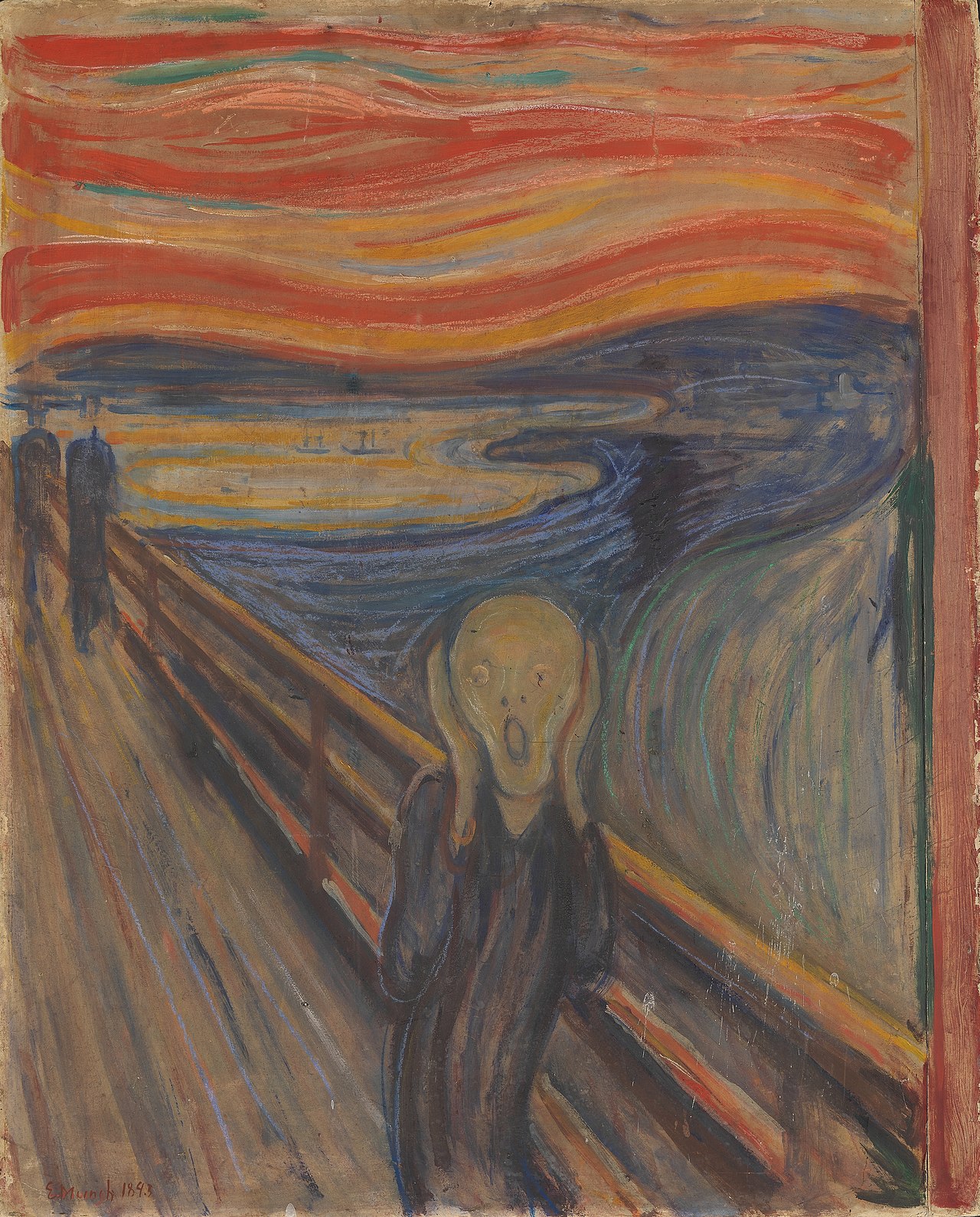
Forms were frequently distorted, elongated, or simplified to heighten their emotional impact. Edvard Munch's 'The Scream' is a quintessential example, where the undulating landscape and the figure's contorted form visually manifest an overwhelming sense of existential dread. Brushwork was often vigorous and visible, adding a tactile quality that underscored the raw, immediate nature of the emotion being conveyed.
This deliberate manipulation of visual elements created a powerful, often confrontational, dialogue with the viewer's own emotional and psychological framework.
Echoes in the Present
While Expressionism as a distinct movement flourished in the early 20th century, its core principles continue to resonate in contemporary art and culture. The idea that art can and should express personal feelings and subjective truths is now widely accepted. Many contemporary artists, across various media, draw upon Expressionist ideas to explore themes of identity, trauma, social injustice, and mental health.
The raw emotional honesty and willingness to confront difficult subjects that characterized Expressionism are still highly valued. Furthermore, the movement's influence can be seen in film, theater, and literature, where techniques like distorted perspectives, heightened emotional dialogue, and symbolic imagery are used to convey inner states. Expressionism's legacy is one of artistic liberation, empowering artists to look inward and share their most profound human experiences.
Go deeper
Frequently Asked Questions
What is Expressionism?+
Why did Expressionist artists paint their feelings instead of what they saw?+
How do Expressionist paintings look different from other styles?+
Where did Expressionism start and which groups were important?+
How did Expressionism influence later art styles?+
Based on content from Wikipedia · Licensed under CC BY-SA 4.0