

East Berlin
Images

East Berlin - Potsdamer Platz from Berlin Wall


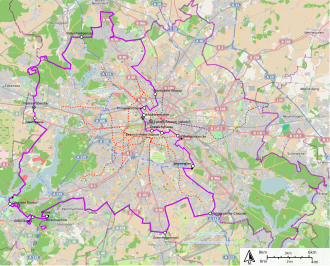


The Soviet Sector
Following World War II, Berlin, like Germany itself, was divided into four occupation zones by the Allied powers. East Berlin became the Soviet sector, and from 1949 onwards, it was designated as the capital of the newly formed German Democratic Republic (GDR). This designation was not universally recognized; the Western Allied powers (the United States, the United Kingdom, and France) continued to view East Berlin as under Soviet control and did not acknowledge the GDR's sovereignty over it.
For the GDR government, however, 'Berlin, Hauptstadt der DDR' (Berlin, Capital of the GDR) was its official and crucial title, positioning the city as the political and administrative heart of their socialist state. This dual status created a unique and often tense geopolitical situation right in the center of Europe.
The Berlin Wall
The most defining feature of East Berlin's existence was its physical separation from West Berlin by the Berlin Wall, erected on August 13, 1961. This barrier, evolving from barbed wire to a complex system of concrete walls, guard towers, and 'death strips,' was a stark symbol of the Cold War and the Iron Curtain. Its primary purpose was to halt the mass emigration of East Germans to the West, a 'brain drain' that threatened the GDR's stability.
The wall not only divided a city but also families, friends, and a nation, creating profound psychological and social impacts. The period from 1961 to 1989 was characterized by a heavily fortified border, constant surveillance, and tragic attempts to cross, making East Berlin a focal point of global attention and tension.
Life and Governance in the GDR's Capital
As the capital of the GDR, East Berlin was the seat of the ruling Socialist Unity Party (SED) and the government. Life for its citizens was governed by a socialist system that emphasized state control over the economy and society. Industries focused on heavy manufacturing, with significant state-owned enterprises.
While basic needs like housing and employment were generally provided, citizens faced restrictions on political freedoms, freedom of speech, and international travel. The state security service, the Stasi, maintained extensive surveillance to suppress dissent. Despite these limitations, East Berlin possessed a distinct cultural identity, with state-sponsored arts, theaters, and educational institutions that promoted socialist ideology.
The End of Division
The peaceful revolution of 1989 led to the dramatic fall of the Berlin Wall on November 9, 1989, an event that resonated globally. This pivotal moment signaled the imminent collapse of the GDR and the end of Germany's division. The subsequent reunification process culminated on October 3, 1990, when East and West Germany, and consequently East and West Berlin, formally reunited.
This marked the end of East Berlin as a separate political entity. The integration presented significant challenges, including economic disparities and the need to reconcile different political and social systems, but it ultimately led to the creation of a single, unified Berlin and a reunified Germany.
Legacy and Modern Relevance
The legacy of East Berlin continues to shape contemporary Berlin and Germany. The physical remnants of the Wall, such as the East Side Gallery, serve as powerful historical markers and tourist attractions. The distinct architectural styles and urban planning decisions from the GDR era are still visible throughout the eastern parts of the city.
The experience of living under a socialist regime has left a lasting imprint on the collective memory of its former inhabitants, influencing social dynamics and political discourse. Understanding East Berlin's history is crucial for comprehending the complexities of post-Cold War Europe, the challenges of post-communist transitions, and the ongoing process of integrating diverse historical experiences within a unified urban landscape.
Go deeper
Frequently Asked Questions
What was East Berlin and why was it special?+
Why did the Berlin Wall go up in East Berlin?+
How did life look for people living in East Berlin?+
When did the Berlin Wall fall and what happened after?+
What can we see today that remembers East Berlin?+
Based on content from Wikipedia · Licensed under CC BY-SA 4.0