

Dipole
Images
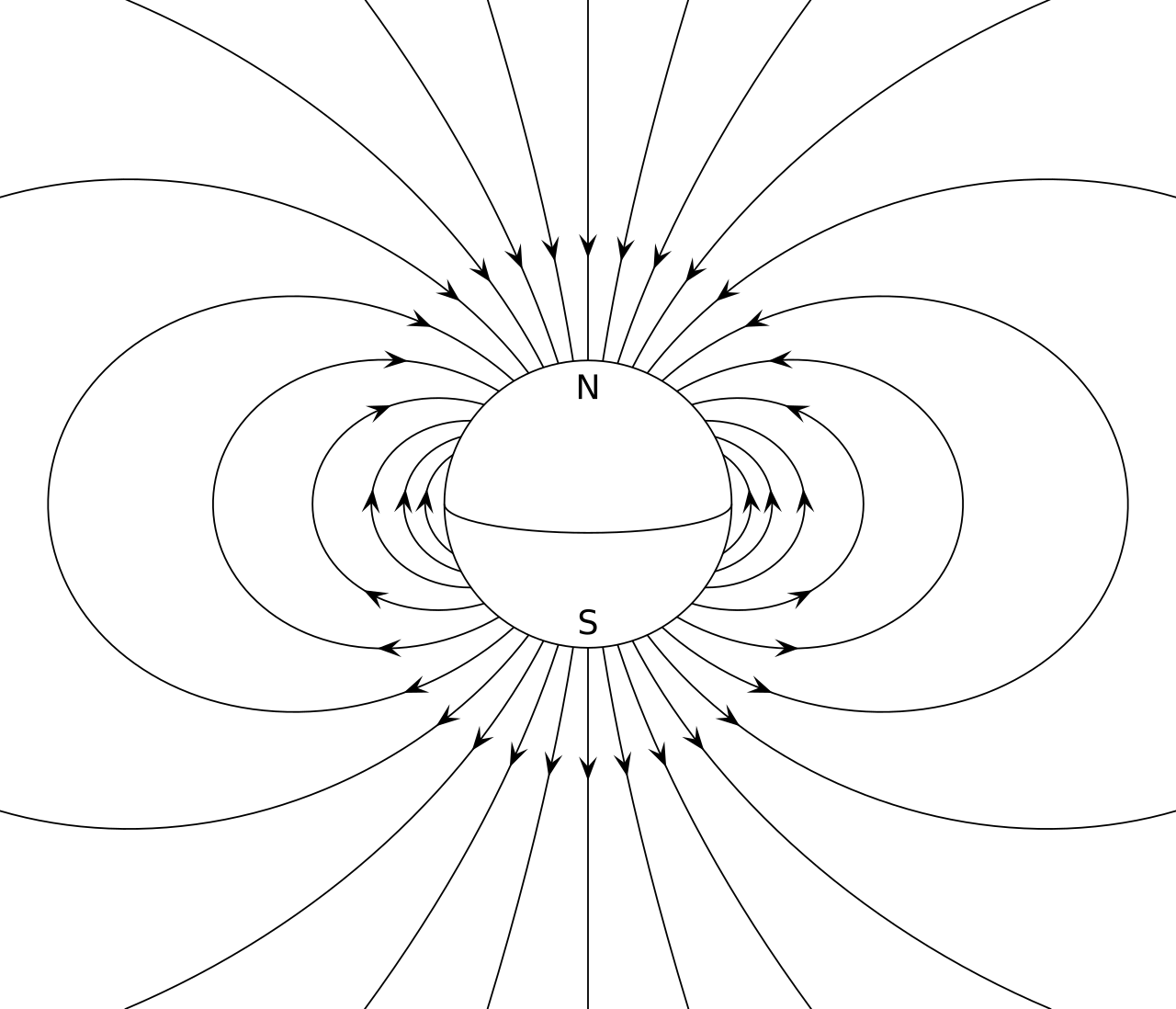
Dipole


Defining the Dipole
A dipole, in its most fundamental sense, is a system characterized by a separation of positive and negative electrical charges. This separation can occur at various scales, from subatomic particles to macroscopic objects. Mathematically, a simple electric dipole is often represented by two equal and opposite point charges, +q and -q, separated by a vector distance 'd'.
The dipole moment, a vector quantity, is defined as p = qd, pointing from the negative to the positive charge. This moment quantifies the strength and orientation of the dipole. However, the concept extends to more complex charge distributions.
In molecules, a permanent dipole moment arises from the asymmetric arrangement of atoms with differing electronegativities, leading to a net charge imbalance. Induced dipoles can also form when an external electric field distorts the electron cloud of an atom or molecule, creating a temporary dipole moment. The behavior of matter in electric fields is profoundly shaped by these dipole characteristics, influencing dielectric properties, intermolecular forces, and optical phenomena.
Historical Roots
The understanding of dipoles has evolved alongside our comprehension of electricity and matter. Early investigations into static electricity by figures like Benjamin Franklin hinted at the existence of positive and negative charges, the fundamental components of dipoles. However, the formalization of the dipole concept gained traction with the development of classical electromagnetism. James Clerk Maxwell's equations unified electricity and magnetism, providing a framework to describe electromagnetic fields generated by charge distributions, including dipoles.
In chemistry, the discovery of the electron and the subsequent development of atomic and molecular theory in the early 20th century revealed that molecules themselves could possess permanent dipole moments due to their structure and the nature of chemical bonds. Pioneering work by scientists like Peter Debye, who studied the dielectric properties of matter, further solidified the importance of molecular dipoles. The dipole antenna, a practical application, emerged from early 20th-century radio research, demonstrating the tangible impact of this theoretical construct.
The Pervasive Influence
The significance of dipoles permeates nearly every branch of science and technology. In materials science, the presence and behavior of dipoles determine a material's dielectric constant, its ability to store electrical energy in capacitors, and its response to electromagnetic radiation. Ferroelectric materials, for instance, exhibit spontaneous electric polarization due to aligned dipoles, enabling applications in memory devices and sensors.
In chemistry, dipole moments are crucial for predicting molecular polarity, solubility, boiling points, and intermolecular forces like dipole-dipole interactions and hydrogen bonding, which are fundamental to biological systems. In physics, dipoles serve as essential models for understanding the interaction of matter with electromagnetic fields, from the behavior of light scattering to the design of particle accelerators. The ubiquitous dipole antenna remains a cornerstone of wireless communication, from radio and television broadcasting to Wi-Fi and mobile networks, directly translating the abstract concept of a dipole into global connectivity.
Mechanisms of Dipole Formation and Interaction
Dipoles arise from the separation of electric charge. A permanent dipole moment in a molecule is established when the centers of positive and negative charge do not coincide. This typically occurs in molecules composed of different elements (heteronuclear molecules) where electronegativity differences create partial positive and negative charges on different atoms, and the molecular geometry does not allow these partial charges to cancel out.
For example, water (H₂O) is a bent molecule with oxygen being more electronegative than hydrogen, resulting in a net dipole moment. Induced dipoles form when an external electric field perturbs the electron distribution of a neutral atom or molecule. The field pulls the positive charges in one direction and pushes the negative charges in the opposite direction, creating a temporary dipole.
These induced dipoles are responsible for van der Waals forces, specifically the London dispersion forces and Keesom forces (dipole-dipole interactions). The interaction between dipoles, whether permanent or induced, is governed by electrostatic forces, leading to attraction or repulsion depending on their relative orientation and distance.
Dipoles in Action
The concept of the dipole extends into quantum mechanics, where it describes the electric dipole moment of elementary particles and atomic states. For instance, the interaction of light with matter is often described in terms of electric dipole transitions, where a photon causes an electron to jump between energy levels, changing the atom's dipole moment. In engineering, the dipole antenna is a prime example.
A simple dipole antenna consists of two conductive elements aligned end-to-end. When an alternating current is applied, charges oscillate back and forth along the elements, creating time-varying electric and magnetic fields that radiate as electromagnetic waves. The length of the antenna is typically related to the wavelength of the signal being transmitted or received, often being half a wavelength.
This elegant application of the dipole principle underpins much of our modern wireless infrastructure, demonstrating its enduring practical relevance.
Go deeper
Based on content from Wikipedia · Licensed under CC BY-SA 4.0