

Darts!
Images

Darts
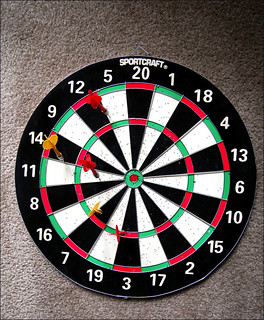


The Aerodynamics and Biomechanics of Dart Flight
The flight of a dart is a complex interplay of physics and biomechanics. A standard dart comprises a tungsten or brass barrel, a shaft, and flights. The barrel’s weight and shape are critical for balance and grip, influencing the thrower's release.
Tungsten, denser than brass, allows for slimmer barrels, enabling tighter groupings on the board. The shaft connects the barrel to the flights, and its length can affect the dart's stability. The flights, typically made of plastic or polyester, are crucial for aerodynamic stability, acting as stabilizers to keep the dart traveling point-first.
Their size, shape, and angle are meticulously designed to counteract air resistance and prevent the dart from tumbling. The throw itself involves a precise sequence of movements: a stable stance, a smooth arm swing, wrist action, and a controlled follow-through. Elite players develop an almost unconscious mastery of these elements, achieving remarkable consistency.
The trajectory is influenced by the release angle, velocity, and spin imparted, all of which must be finely tuned to hit specific scoring zones on the board, especially the narrow treble segments.
From Battlefield Practice to Global Spectacle
The origins of darts are deeply intertwined with military history, evolving from the practice of archers and soldiers honing their projectile skills. Early forms likely involved throwing sharpened sticks or short arrows at targets like tree stumps or shields. As archery declined in military importance, this practice transitioned into a recreational pastime, particularly in English taverns and inns during the Middle Ages.
The development of the modern dartboard, with its standardized 20-segment layout and scoring system, is often attributed to the 19th century. Legend suggests a dart maker named Brian Gamlin patented the current numbering system in 1898, designed to penalize inaccuracy by placing high-scoring numbers next to low-scoring ones. The game gained significant traction in the 20th century with the advent of professional organizations like the British Darts Organisation (BDO) and the Professional Darts Corporation (PDC).
This professionalization led to televised tournaments, increased prize money, and a global fanbase, transforming darts from a pub game into a legitimate and widely watched sport.
The Cognitive Demands
Beyond the physical dexterity required, darts is a profound mind sport that demands significant cognitive abilities. Players must possess exceptional concentration and focus to maintain accuracy over extended periods, often under the pressure of competition. This involves filtering out distractions and maintaining a consistent mental state.
Strategic thinking is paramount; players don't just aim for high scores but must also plan their shots to set up subsequent throws, especially when approaching the game's end. For instance, a player might need to hit a specific double to finish the game, requiring precise calculation and execution. This strategic planning involves constant score-keeping and anticipating the opponent's potential moves.
Furthermore, darts requires significant mental resilience to cope with errors, bad luck, and the psychological pressure of high-stakes matches. The ability to remain calm, adapt strategies, and perform consistently under duress are hallmarks of successful dart players, underscoring the sport's deep cognitive dimension.
The Evolution of Equipment and Playing Standards
The equipment used in darts has undergone significant evolution, directly impacting playing standards and the sport's professionalization. Early darts were crude, often made from wood with feather fletchings and simple metal points. The introduction of tungsten as a primary material for dart barrels revolutionized the game.
Tungsten alloys allow for much denser, slimmer barrels, enabling players to achieve tighter groupings on the dartboard. This density means a player can use heavier darts without them being excessively thick, which is crucial for controlling trajectory and minimizing interference between darts. Shafts have also evolved, with materials like nylon, aluminum, and carbon fiber offering different flexibilities and weights.
Flights, too, have seen innovation, with various shapes and sizes (like pear, kite, and slim) designed to optimize aerodynamics. The dartboard itself has become more standardized, with improved materials and construction ensuring consistent playability and durability. These advancements in equipment have contributed to the incredibly high scoring averages seen in professional darts today, pushing the boundaries of human skill.
Darts in Contemporary Culture and Global Reach
In the modern era, darts has transcended its pub game origins to become a globally recognized sport with a significant cultural footprint. Professional darts leagues, such as the PDC, attract massive audiences, with major tournaments broadcast internationally and featuring substantial prize funds. The sport’s accessibility, requiring relatively minimal equipment and space, allows it to be played and enjoyed by people of all ages and backgrounds worldwide.
This broad appeal has fostered a diverse and passionate fanbase. Beyond professional play, darts remains a popular social activity, fostering community in pubs and clubs. Its inclusion in video games and its presence in popular culture further solidify its relevance.
The sport’s narrative often features compelling underdog stories and intense rivalries, adding to its spectator appeal. The ongoing professionalization and global expansion of darts suggest a continued trajectory of growth and increasing mainstream recognition.
See also
Frequently Asked Questions
What is a dart made of?+
How do darts stay straight when they fly?+
Why do some darts have slimmer barrels?+
Where did the game of darts come from?+
How do players keep their focus while playing?+
Based on content from Wikipedia · Licensed under CC BY-SA 4.0