

Metal
Images
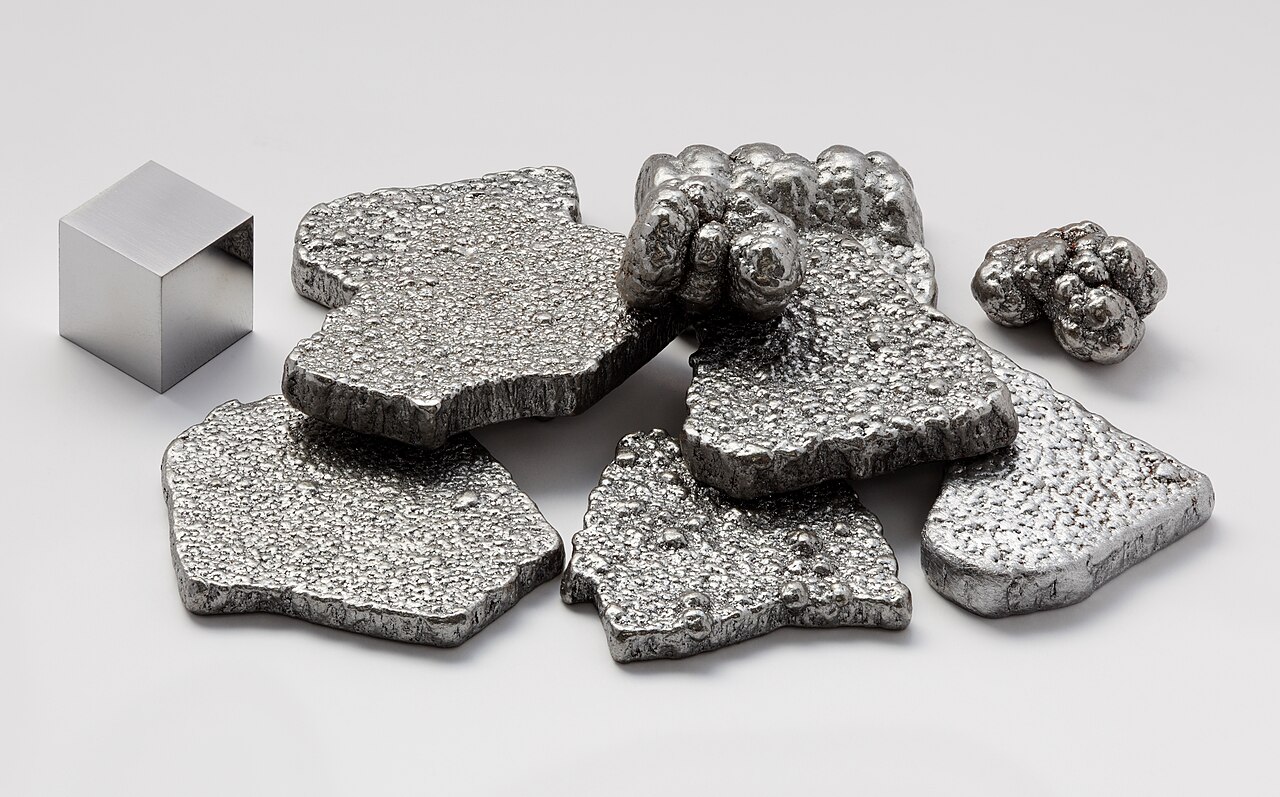
Metal


The Electron Sea
Metals are fundamentally defined by their unique electronic structure, characterized by metallic bonding. Unlike covalent or ionic bonds, metallic bonding involves a 'sea' of delocalized valence electrons that are shared among a lattice of positively charged metal ions. This electron mobility is the direct cause of metals' hallmark properties: high electrical and thermal conductivity. Heat energy is efficiently transferred through these mobile electrons, and electrical current is simply the flow of these electrons.
The lustrous appearance arises from the interaction of light photons with these free electrons, causing reflection. Furthermore, the delocalized nature of the electrons allows metal atoms to slide past one another without breaking the overall structure, explaining their ductility and malleability. This electron sea is also responsible for the characteristic 'ping' sound when metals are struck, as the vibrations propagate through the electron lattice.
A Chronological Tapestry of Metallurgical Milestones
The human relationship with metals spans millennia, marking distinct epochs of technological and societal progress. The Chalcolithic period, or Copper Age, began around 11,000 years ago with the earliest use of native copper. The subsequent Bronze Age, emerging in the fifth millennium BCE, was defined by the development of alloying copper with tin, creating a material significantly harder and more versatile than pure copper.
Iron, though known earlier from meteoric sources, became widespread during the Iron Age, offering a more abundant and ultimately superior alternative to bronze. The discovery of sodium in 1809 heralded the era of alkali metals, and the 19th and 20th centuries saw the rise of sophisticated steel alloys, revolutionizing construction and industry. Post-World War II advancements have led to high-performance alloys, shape-memory metals, and metallic glasses, continually expanding the frontier of materials science.
The Ubiquitous Influence of Metals in Civilization
Metals are indispensable pillars of modern civilization, underpinning infrastructure, technology, and daily life. Their high tensile strength and resistance to corrosion make them essential for large-scale engineering projects like skyscrapers, bridges, and dams. In transportation, metals are critical for automotive bodies, aircraft frames, and railway tracks, enabling global mobility.
The electronics industry relies heavily on metals for conductive pathways, connectors, and components, including specialized alloys and degenerate semiconductors. Historically, precious metals served as a store of value and medium of exchange, and even today, coinage metals are diverse and essential for economies. From the tools in our hands to the appliances in our homes, the pervasive use of metals highlights their unparalleled combination of durability, workability, and functionality.
Beyond the Basics
The definition of a metal extends beyond elemental forms at standard conditions. Under immense pressure, many elements and compounds that are typically nonmetallic can exhibit metallic properties. For instance, iodine, a nonmetal at atmospheric pressure, gradually becomes metallic at pressures between 40,000 and 170,000 times that of the atmosphere.
This phenomenon underscores the dynamic nature of matter and the influence of external conditions on electronic structure. Furthermore, the term 'metallic' can also apply to certain molecular compounds, such as polymeric sulfur nitride, which exhibits electrical conductivity. In the realm of semiconductor technology, alloys and compounds like titanium nitride are crucial, demonstrating that metallic behavior is not exclusive to pure elemental metals but can be engineered through various chemical and physical means.
The Interdisciplinary Realm of Metallurgy
The study of metals, known as metallurgy, is a vast and interdisciplinary field. It bridges materials science, condensed matter physics, and solid-state chemistry. Metallurgists investigate the extraction, purification, processing, and application of metals and their alloys.
This involves understanding phase diagrams, heat treatments, mechanical properties, and corrosion resistance. The development of new alloys with tailored properties for specific applications, such as aerospace, biomedical implants, or energy storage, is a key focus. The principles of metallurgy are essential for optimizing the performance and lifespan of metallic components, driving innovation across numerous industries and contributing significantly to technological advancement.
Go deeper
Frequently Asked Questions
What makes a metal shiny?+
Why can metals conduct electricity and heat?+
How did humans first use metals?+
What is an alloy and why is bronze better than copper?+
Can something that isn't a metal become a metal?+
Based on content from Wikipedia · Licensed under CC BY-SA 4.0