

Coat of Arms of Russia
Images

Coat Of Arms Of The Russian Federation


Continuity and Byzantine Legacy
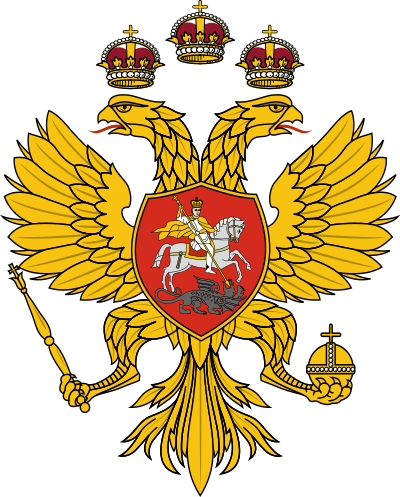
The current coat of arms of the Russian Federation is a direct descendant of the imperial arms, itself rooted in the symbolism of the Byzantine Empire. The double-headed eagle motif, adopted by Ivan III in the late 15th century, signified Moscow's claim to be the 'Third Rome' after the fall of Constantinople in 1453. This adoption was a strategic political and cultural move, linking the nascent Russian state to the prestige and imperial legacy of Byzantium.
The eagle’s two heads, traditionally interpreted as looking east and west, underscore Russia's unique geopolitical position as a transcontinental power, bridging Europe and Asia. The heraldic tinctures, or colors, largely adhere to the 15th-century standard, emphasizing a deliberate continuity with this foundational period of Russian statehood. This historical resonance provides a powerful sense of national identity and historical depth, connecting contemporary Russia to its imperial and even earlier antecedents.
Symbolic Layers and Political Evolution
Beyond its geographical implications, the double-headed eagle is laden with layers of symbolic meaning. The eagle itself is a classical symbol of power, empire, and divine authority, dating back to ancient Rome. In the context of the Russian Empire, the eagle was often depicted with three crowns, representing the Tsarist autocracy and the union of the Grand Duchy of Moscow, the Tsardom of Kazan, and the Tsardom of Astrakhan.
The rider on the eagle's breast, typically Saint George slaying the dragon, symbolizes the triumph of good over evil and the protection of the state. The evolution of the coat of arms mirrors Russia's tumultuous history. Following the 1917 Revolution, the Soviet Union replaced the imperial arms with a new emblem, the hammer and sickle within a red star, symbolizing the unity of workers and peasants.
The re-adoption of the double-headed eagle in 1993, post-Soviet era, was a conscious effort to reclaim and reintegrate historical symbols and national narratives that had been suppressed during the Soviet period, signaling a return to a more traditional understanding of Russian statehood and identity.
Heraldic Tradition and Modern Application
The modern Russian coat of arms, while drawing heavily from its historical precedents, is a carefully defined heraldic achievement. The eagle is depicted in gold, with red tongues and talons, and wears blue crowns adorned with gold crosses. The shield on the eagle's breast features a red field with a silver horseman (Saint George) on a black horse, spearing a black dragon.
This precise iconography is regulated by federal law, ensuring its consistent and proper use. The coat of arms serves as the ultimate symbol of the Russian Federation's sovereignty and territorial integrity. It is displayed on official government buildings, the presidential standard, currency, and official documents, reinforcing the authority of the state.
Its presence is a constant visual reminder of Russia's historical continuity, its vast territorial expanse, and its enduring role on the world stage. The adherence to specific heraldic rules ensures that the symbol is recognized and respected both domestically and internationally.
Geopolitical Resonance and National Identity
The double-headed eagle continues to resonate deeply within Russia's geopolitical identity. Its dual gaze symbolizes not only Russia's transcontinental nature but also its historical role as a bridge and sometimes a barrier between Eastern and Western civilizations. This duality has shaped Russia's foreign policy and its perception of itself in the global order.
The symbol evokes a sense of historical destiny and national pride, drawing on centuries of imperial tradition. For many Russians, the eagle represents stability, strength, and the enduring spirit of the nation, transcending political regimes. Its re-establishment after the Soviet period was instrumental in forging a new national identity that sought to reconcile the Soviet past with pre-revolutionary heritage.
The coat of arms, therefore, is not merely an emblem but a complex repository of historical memory, national aspirations, and geopolitical positioning.
See also
Frequently Asked Questions
What does the double-headed eagle on Russia's coat of arms look like?+
Why does the eagle have two heads?+
When did Russia start using the double-headed eagle?+
What happened to the coat of arms during the Soviet era?+
Where can we see Russia's coat of arms today?+
Based on content from Wikipedia · Licensed under CC BY-SA 4.0