

Automaton
Images
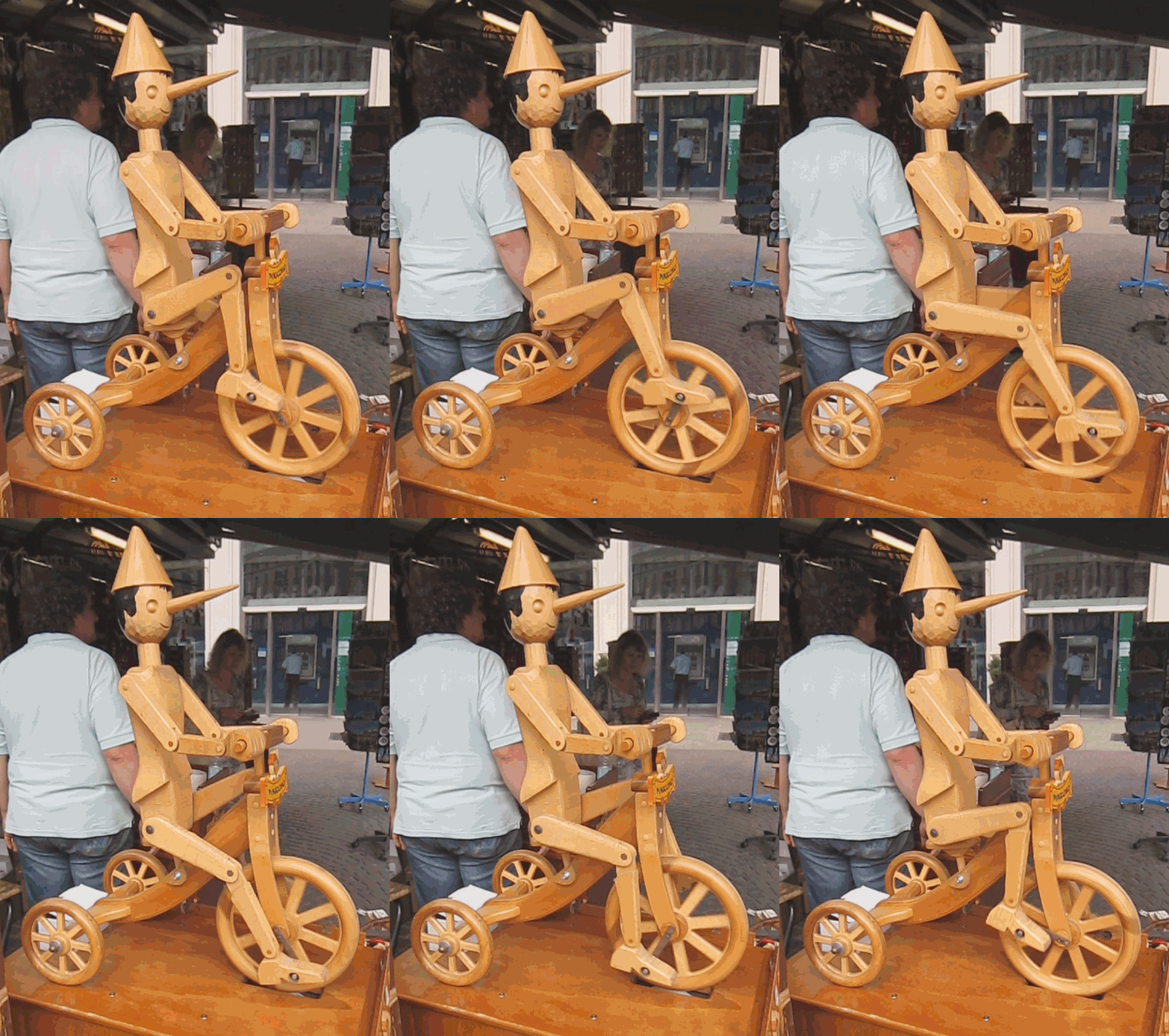
Automaton


The Genesis of Autonomous Machines
An automaton is fundamentally a self-operating machine or control mechanism engineered to execute a predetermined sequence of operations or respond to specific stimuli. The concept transcends mere mechanical toys; it represents humanity's enduring fascination with replicating life and intelligence through artificial means. Historical accounts and archaeological evidence point to the creation of sophisticated automatons in ancient Greece, exemplified by Hero of Alexandria's ingenious devices powered by water pressure and steam.
During the Islamic Golden Age, scholars like Al-Jazari advanced the field significantly, designing programmable automatons, including elaborate water clocks and automated musical ensembles. These early creations, often driven by complex arrangements of gears, cams, and weights, were not only technological marvels but also served as powerful symbols of human ingenuity and a precursor to modern automation, demonstrating the potential for machines to perform complex, lifelike actions.
A Chronological Tapestry
The evolution of automatons is a rich narrative spanning millennia. Following ancient innovations, the Renaissance and Enlightenment periods saw a resurgence of interest, particularly in Europe. The 18th century, often called the 'Golden Age of Automata', produced legendary creations by figures like Jacques de Vaucanson and Pierre Jaquet-Droz.
Vaucanson's 'The Digesting Duck' and 'The Flute Player' were not mere novelties but sophisticated demonstrations of biomechanical principles. Jaquet-Droz's 'The Writer', 'The Musician', and 'The Draftsman' were incredibly complex, capable of writing text, playing music, and drawing intricate designs, showcasing advanced programming through intricate cams and gear trains. These mechanical marvels paved the way for the industrial revolution's automation and, later, the electronic and digital age, leading to modern animatronics and programmable robots.
The Enduring Significance
The pursuit of creating automatons has been a powerful catalyst for technological advancement, pushing the frontiers of mechanical engineering, physics, and mathematics. Beyond their entertainment value, automatons represent a crucial step in our quest to understand and replicate intelligence and autonomy. They serve as foundational models for robotics, artificial intelligence, and control systems.
The challenges in designing and building automatons have led to breakthroughs in precision manufacturing, gear design, and power transmission. Furthermore, studying their mechanisms provides insights into biological systems and the principles of motion and control. In essence, automatons are not just historical artifacts but living testaments to human ambition and the ongoing quest to create machines that can perceive, decide, and act.
Mechanisms of Action
The operational principles of automatons vary significantly with their historical period and complexity. Early mechanical automatons relied on intricate clockwork mechanisms. These involved precisely shaped cams rotating on shafts, which would engage levers and linkages in a specific sequence to produce movement.
Think of a music box's cylinder with pins that trigger notes, but on a vastly more complex scale. The sequence of operations was physically encoded in the shape and arrangement of these mechanical components. Modern automatons, particularly animatronics and industrial robots, integrate electronics, sensors, and computational power.
Sensors gather data about the environment, microprocessors execute sophisticated algorithms based on their programming, and actuators (like electric motors or hydraulic systems) translate these commands into physical motion. This allows for dynamic responses and a far greater range of behaviors than purely mechanical systems.
Contemporary Manifestations
While the term 'automaton' might evoke images of historical clockwork figures, its spirit thrives in numerous modern applications. Animatronics are a prime example, widely employed in theme parks and cinematic special effects to create immersive and lifelike characters. Industrial robots, performing tasks from welding car bodies to assembling microchips, are highly advanced automatons designed for efficiency and precision.
Even consumer products like robotic vacuum cleaners and autonomous drones embody the core principles of self-operation. Looking ahead, the integration of artificial intelligence with advanced robotics promises even more sophisticated automatons capable of complex decision-making and interaction. The ongoing development in areas like soft robotics and bio-inspired designs suggests a future where automatons will become even more integrated into our lives, blurring the lines between the mechanical and the biological.
Go deeper
Frequently Asked Questions
What is an automaton?+
Who made early automatons in ancient Greece?+
What did Al‑Jazari create during the Islamic Golden Age?+
Who built famous automatons in the 18th century?+
How do early automatons work?+
Based on content from Wikipedia · Licensed under CC BY-SA 4.0