

The Great German Showdown of 1866!
Images
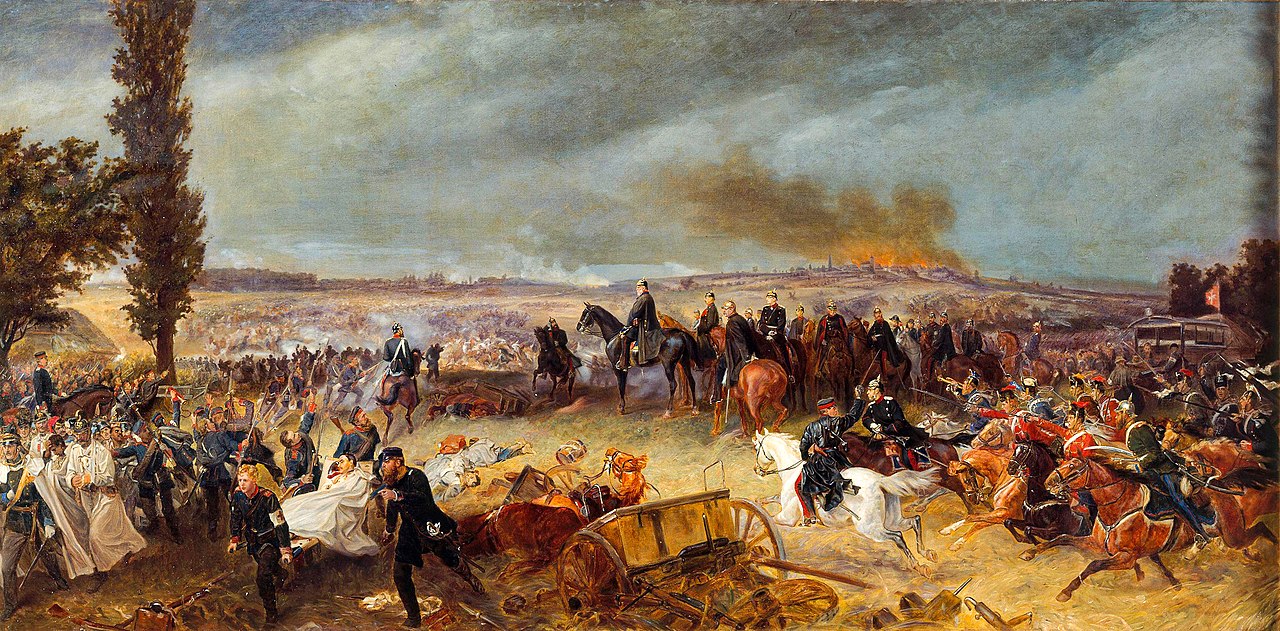
Schlacht Bei Koeniggraetz Von Georg Bleibtreu


Geopolitical Landscape
The Austro-Prussian War, also known as the Seven Weeks' War, unfolded across the complex geopolitical landscape of Central Europe in 1866. The primary theater of operations was within the German Confederation, a loose association of 35 German states and the Austrian Empire, established in 1815. Prussia, a rising industrial and military power, sought to consolidate its influence and challenge Austria's traditional hegemony.
The war's geographical scope included territories in Bohemia (modern Czech Republic), parts of Austria, and the German states themselves. The terrain varied from the plains of Silesia and Saxony, conducive to large-scale maneuver warfare, to the mountainous regions that presented logistical challenges. The climate of early summer, while generally favorable for military operations, could still impact troop movements and supply lines, as evidenced by the rapid pace of Prussian advances.
Roots of Conflict
The war was the culmination of decades of escalating rivalry between Prussia and Austria for leadership within the German Confederation. Prussia, under the astute statesmanship of Otto von Bismarck, aimed to unify the German states under Prussian leadership, excluding Austria (a concept known as Kleindeutschland, or 'Lesser Germany'). Bismarck skillfully manipulated diplomatic tensions, particularly over the administration of the Schleswig-Holstein duchies, to provoke Austria into conflict.
Furthermore, Prussia's alliance with the Kingdom of Italy was crucial, as it tied the conflict to the Italian Risorgimento, Italy's movement for national unification. Italy's participation aimed to secure Venetia from Austrian control, creating a two-front war for the Habsburg Empire and diverting Austrian resources.
Prussian Military Superiority
The decisive Prussian victory was a testament to its significant military modernization. The Prussian army employed the Dreyse needle gun, a breech-loading rifle that offered a substantial rate of fire advantage over the Austrian muzzle-loading Lorenz rifles. This technological edge, combined with superior strategic planning by the Prussian General Staff, led by Helmuth von Moltke the Elder, proved critical.
Moltke's strategy involved rapid mobilization, the use of railways for swift troop deployment, and the implementation of a decisive battle plan focused on encircling and destroying Austrian forces. The Battle of Königgrätz (Sadowa) on July 3, 1866, was the war's pivotal engagement, resulting in a crushing defeat for the Austrians and effectively ending the conflict.
Transformative Outcomes
The Austro-Prussian War fundamentally reshaped the political map of Central Europe. The German Confederation was dissolved, marking the end of Austrian dominance over German affairs. Prussia then established the North German Confederation, a federal state comprising all German states north of the Main River, laying the groundwork for the German Empire proclaimed in 1871.
Austria was excluded from this new German entity, a key objective of Bismarck's policy. Italy achieved a significant diplomatic and territorial gain by annexing Venetia, a crucial step in its unification. The war's outcome signaled the decline of Austrian power and the ascendant rise of Prussia as the preeminent German and a major European power.
Legacy and Lasting Impact
The Austro-Prussian War's legacy extends far beyond the immediate territorial and political shifts. It demonstrated the effectiveness of modern, industrialized warfare and sophisticated military planning, influencing military doctrines worldwide. Bismarck's successful pursuit of Prussian dominance and German unification through 'blood and iron' set a precedent for realpolitik in international relations.
The exclusion of Austria from the new German state created a lasting dynamic in Central European politics, contributing to future alliances and rivalries. The war's conclusion also solidified the concept of national unification as a powerful force in 19th-century Europe, inspiring other nationalist movements and ultimately contributing to the complex web of alliances that would lead to World War I.
See also
Frequently Asked Questions
What was the Great German Showdown of 1866?+
Why did Prussia want to beat Austria?+
How did the Prussian army win the war?+
What happened to Germany after the war?+
Did Italy get anything from the war?+
Based on content from Wikipedia · Licensed under CC BY-SA 4.0