

Arlington Memorial Bridge
Images

skew detail - family group - Sacrifice - Arts of War - Arlington Memorial Bridge - 2013-09-30




Conception and Construction
The genesis of the Arlington Memorial Bridge can be traced back to 1886, reflecting a burgeoning need for improved infrastructure connecting the burgeoning capital with its Virginia counterpart across the Potomac River. However, the bridge's path from conception to completion was protracted, fraught with political wrangling and debates over its memorialistic intent and dedication. Decades passed before the confluence of critical factors-namely, the logistical challenges posed by large public events like the 1921 dedication of the Tomb of the Unknown Soldier and the impending bicentennial celebration of George Washington's birth-galvanized support for its construction.
This urgency, coupled with a desire to create a fitting tribute, finally propelled the project forward. The bridge was ultimately constructed and opened in 1932, a Neoclassical masterpiece realized through the collaborative efforts of architects McKim, Mead, and White, embodying a significant achievement in early 20th-century engineering and urban planning.
Architectural Grandeur and Sculptural Embellishment
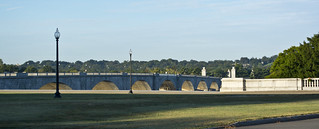
The Arlington Memorial Bridge is a prime example of Neoclassical architecture, characterized by its monumental scale, use of classical forms, and elegant proportions. The architectural firm McKim, Mead, and White meticulously designed the bridge as a grand gateway, integrating its structure seamlessly with the landscape of the National Mall. Beyond its structural elegance, the bridge is distinguished by its rich sculptural program.
Leo Friedlander, a prominent American sculptor, was commissioned to create monumental statues that personify abstract concepts of valor and sacrifice. These powerful works, meticulously cast by the Ferdinando Marinelli Artistic Foundry in Florence, Italy, lend a profound symbolic weight to the bridge. Positioned strategically, these artistic elements elevate the bridge from a mere utilitarian crossing to a significant cultural and commemorative landmark, defining the western terminus of the National Mall and contributing to the symbolic geography of the nation's capital.
Evolution of Functionality
A defining characteristic of the Arlington Memorial Bridge's operational history was its central bascule, a sophisticated drawbridge mechanism designed to accommodate maritime traffic on the Potomac River. This engineering marvel allowed the central span to pivot upwards, facilitating the passage of taller vessels. However, by the mid-20th century, the nature of river traffic and the increasing demands of vehicular transportation rendered the bascule's functionality less critical.
Consequently, in 1961, the decision was made to permanently secure the bascule, transforming the bridge into a fixed structure. This operational shift underscored the evolving priorities of urban infrastructure, prioritizing continuous road access over river navigation. In 2018, the original bascule was replaced by a new, non-opening span, solidifying its role as a permanent and stable transportation link, albeit one that retains the historical memory of its movable past.
Enduring Significance
The Arlington Memorial Bridge's significance extends far beyond its role as a transportation conduit. It functions as a vital artery, facilitating the daily movement of hundreds of thousands of people between Washington, D.C., and Arlington, Virginia, supporting economic activity and connectivity. Simultaneously, it serves as a profound national memorial, commemorating the sacrifices of American servicemen and women and honoring the legacy of George Washington, the nation's first president.
Its prominent location on the National Mall, a space dedicated to remembrance and national identity, amplifies its symbolic power. The bridge is an integral component of the capital's urban fabric, a physical manifestation of historical continuity and national aspirations, bridging not only two geographical locations but also the past and the present.
Go deeper
Frequently Asked Questions
What is the Arlington Memorial Bridge?+
When was the Arlington Memorial Bridge built?+
Why does the Arlington Memorial Bridge have statues?+
How does the bridge let boats pass?+
Where does the Arlington Memorial Bridge lead to on the National Mall?+
Based on content from Wikipedia · Licensed under CC BY-SA 4.0