

Archaeopteryx: The Feathered Dinosaur!
Images

Archaeopteryx


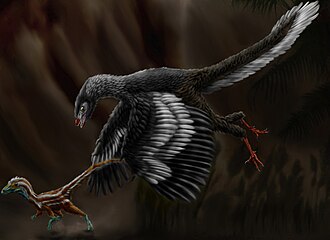


A Window into Evolutionary Transition
Archaeopteryx, whose name translates to 'ancient wing,' stands as one of paleontology's most iconic discoveries. Unearthed from the Solnhofen Limestone quarries in Bavaria, Germany, this creature lived approximately 150 million years ago during the Late Jurassic epoch. The exceptional preservation quality of these Lagerstätten has yielded numerous Archaeopteryx specimens, each providing invaluable data.
These fossils reveal an animal that was roughly 0.5 meters (1.6 feet) in length, with an estimated weight of 0.8 to 1 kilogram (1.7 to 2.2 pounds). Its significance lies in its mosaic of traits, exhibiting a remarkable blend of reptilian and avian characteristics that have made it a cornerstone in understanding the origins of birds. The initial discovery in 1861, just two years after Darwin published 'On the Origin of Species,' provided powerful empirical support for the theory of evolution, demonstrating a clear link between extinct dinosaur lineages and extant avian species.
The Solnhofen Environment
The unique geological setting of the Solnhofen Limestone is crucial to understanding Archaeopteryx. This region was not a terrestrial landscape but a tropical archipelago characterized by shallow lagoons and islands. These lagoons were anoxic (lacking oxygen), which greatly inhibited the activity of scavengers and decomposers, leading to the exquisite preservation of delicate structures like feathers and soft tissues.
Archaeopteryx likely inhabited the wooded islands, utilizing its arboreal adaptations. The fine-grained limestone sediment acted like a natural press, capturing the faintest impressions of its plumage. This environment allowed for the fossilization of not only Archaeopteryx but also a diverse array of other Jurassic life forms, including insects, fish, and marine reptiles, creating a rich snapshot of a lost ecosystem.
Dietary Habits and Predatory Adaptations
Archaeopteryx was a carnivore, subsisting on a diet of small prey. Analysis of its teeth and jaw structure suggests it hunted insects, small lizards, and possibly small mammals or other terrestrial vertebrates. Its jaw was lined with approximately 20 sharp, serrated teeth, a distinctly reptilian feature absent in modern birds. Furthermore, Archaeopteryx possessed three distinct claws on each wing, which are thought to have aided in climbing trees, grasping branches, or potentially even in subduing prey.
While it bore well-developed flight feathers, its asymmetrical feather structure indicates an adaptation for aerial locomotion. However, its skeletal anatomy, including a long, bony tail and a less robust sternum compared to modern birds, suggests that its flight was likely less efficient, possibly involving gliding or short, flapping bursts rather than sustained, powerful flight.
Archaeopteryx as a Keystone in Evolutionary Theory
The scientific importance of Archaeopteryx cannot be overstated. It serves as a critical transitional fossil, embodying the evolutionary shift from non-avian theropod dinosaurs to birds. Its theropod ancestry is evident in features such as its teeth, the three-fingered hand with claws, and its long, bony tail.
Conversely, its avian characteristics include the presence of feathers, which, in their asymmetrical structure, are clearly adapted for flight, and a furcula (wishbone). The ongoing debate surrounding its precise phylogenetic position-whether it is a direct ancestor of modern birds or a close relative on an extinct side branch-underscores its complexity. Regardless, Archaeopteryx remains an indispensable piece of evidence supporting the dinosaurian origin of birds, fundamentally reshaping our understanding of vertebrate evolution and the diversification of life on Earth.
Ongoing Research and Future Discoveries
Despite over a century of study, Archaeopteryx continues to be a subject of intense scientific research. New discoveries and advanced imaging techniques, such as synchrotron scanning, allow paleontologists to examine fossil details with unprecedented clarity, revealing subtle anatomical features and even traces of soft tissues. Researchers are continually refining our understanding of its locomotion, diet, and ecological niche.
The discovery of other feathered dinosaurs, like Sinosauropteryx and Microraptor, has further contextualized Archaeopteryx, demonstrating that feathers evolved before flight and were initially used for insulation or display. Future fossil finds may yet reveal even more about the evolutionary journey from feathered dinosaurs to the birds that fill our skies today, with Archaeopteryx remaining a pivotal benchmark in this ongoing scientific narrative.
Go deeper
Based on content from Wikipedia · Licensed under CC BY-SA 4.0