

American Basswood: The Tree That's Like a Sweet Treat!
Images

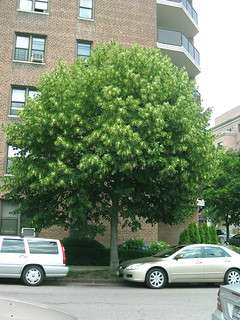
Tilia americana, American Basswood, GFG, Howard County, Md, Helen Lowe Metzman_2018-06-20-23.33.03 ZS PMax UDR



Ecological Niches and Distribution of Tilia americana
The American basswood, scientifically classified as Tilia americana, is a prominent member of the Malvaceae family, native to eastern and central North America. Its geographical distribution spans from the Canadian provinces of Manitoba and Quebec southward through the Great Lakes region and Appalachian Mountains, extending as far south as Oklahoma and Georgia.
This species thrives in mesic, well-drained soils, often dominating the understory or mid-canopy layers of mixed hardwood forests. It exhibits a preference for cooler climates and is frequently found in association with species like sugar maple (Acer saccharum), red oak (Quercus rubra), and white ash (Fraxinus americana). The tree’s distinctive cordate (heart-shaped) leaves, often asymmetrical at the base, and its strongly scented, pale yellow flowers are key identifiers.
These flowers, blooming in late spring to early summer, are critical for supporting insect populations, particularly native bees and honeybees (Apis mellifera), making the basswood a vital component of forest pollination networks.
The Sweet Bounty
The floral resources provided by Tilia americana are exceptionally valuable, most notably for their contribution to apiculture. The nectar produced by basswood flowers is rich in sugars and yields a monofloral honey that is highly prized for its exceptionally light color, mild flavor profile, and smooth texture. This honey is often described as having buttery or creamy notes, distinguishing it from darker, more robust honeys.
The prolific blooming of basswood trees can lead to significant honey flows, supporting strong honeybee colonies. Beyond honey production, the flowers provide essential early-season sustenance for a wide array of native pollinators, including bumblebees, solitary bees, and syrphid flies, thereby bolstering overall insect biodiversity within its habitat. The tree’s seeds and samaras (winged fruits) also offer a food source for various bird species and small mammals during autumn and winter.
Economic Significance
The wood of the American basswood possesses a unique combination of characteristics that have made it economically significant for centuries. It is renowned for its exceptional softness, low density, and fine, uniform texture, which results in minimal grain raising and a smooth finish. This makes it remarkably easy to work with hand or power tools, allowing for precise carving and shaping without splintering or tearing.
Historically, this workability led to its extensive use in the production of woodenware, toys, picture frames, and furniture components. Modern applications continue to leverage these properties, with basswood lumber being favored for high-quality paper pulp, veneer, interior trim, and even musical instruments, such as the bodies of electric guitars and the soundboards of pianos, where its acoustic properties are advantageous. Its light color also makes it an excellent substrate for painting and staining.
Conservation Status and Ecological Resilience
The American basswood is currently listed as 'Least Concern' by the IUCN, reflecting its widespread distribution and abundant populations across its native range. This status underscores its ecological resilience and its robust presence within North American forest ecosystems. As a long-lived species, capable of surviving for well over a century, Tilia americana contributes significantly to forest structure and stability.
Its role extends beyond providing food and habitat; it participates in nutrient cycling and contributes to soil health. While not facing immediate threats of extinction, like all forest species, it is subject to pressures from habitat fragmentation, invasive species, and climate change. Continued monitoring and sustainable forest management practices are crucial to ensure the long-term health and ecological integrity of American basswood populations and the diverse communities they support.
See also
Frequently Asked Questions
What is an American basswood tree?+
Why do bees love American basswood flowers?+
How can we use the wood from an American basswood tree?+
Where can we find American basswood trees?+
Are American basswood trees safe for the environment?+
Based on content from Wikipedia · Licensed under CC BY-SA 4.0