

Albrecht von Wallenstein
Images

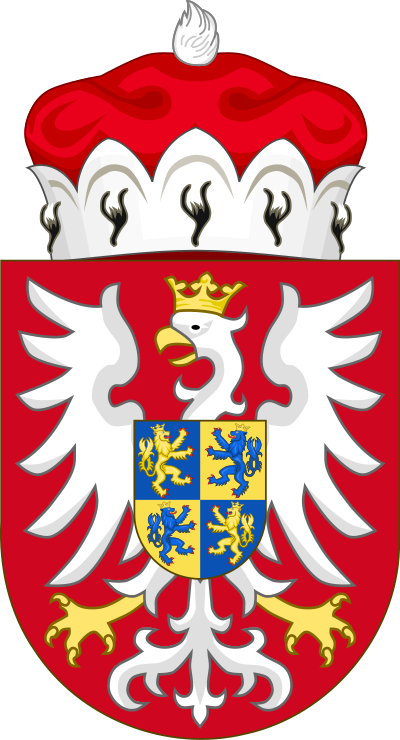
Coat of Arms of Albrecht von Wallenstein, Duke of Friedland, Sagan, Mecklenburg and Gross-Glogau




Origins and Ascent
Albrecht Wenzel Eusebius von Wallenstein (1583–1634) emerged from a relatively modest Bohemian Protestant noble family, adhering to the Utraquist Hussite tradition. His early life was marked by extensive education across Europe, exposing him to diverse intellectual currents. A pivotal moment was his conversion to Catholicism in 1606, aligning him with the dominant religious and political forces of the Holy Roman Empire.
His marriage in 1609 to the wealthy widow of a Bohemian landowner provided the financial bedrock for his meteoric rise. This wealth, combined with his strategic acumen, allowed him to embark on a military career by raising mercenary forces for Emperor Ferdinand II. His early military exploits, including service in the Uskok War and his crucial role in suppressing the Bohemian Revolt, led to significant land acquisitions confiscated from defeated rebels, transforming him into one of the empire's wealthiest and most influential individuals.
The Architect of Imperial Armies
Wallenstein's military genius truly shone when he was tasked with raising and commanding a massive imperial army of 50,000 men in 1625. This force, larger than any previously assembled by the Habsburgs, became the instrument of significant Catholic victories, most notably at the Battle of Dessau Bridge in 1626. His successes earned him titles and vast territories, including the Duchy of Friedland, which he governed with considerable autonomy.
Appointed Generalissimo of land forces and Admiral of the Baltic Sea, Wallenstein wielded immense power. However, his growing influence and independent actions bred suspicion and fear in Emperor Ferdinand II, leading to his dismissal from command in 1630. This period of disgrace underscored the delicate balance between military necessity and political control, as the Emperor grappled with Wallenstein's ambition.
Recalled and Undone
The tide of the Thirty Years' War turned against the Imperial forces after Wallenstein's dismissal, compelling Emperor Ferdinand II to recall him in 1632. Wallenstein returned to command, famously defeating the Swedish king Gustavus Adolphus at Alte Veste, though the Swedish king was later killed at the Battle of Lützen. Recognizing the protracted nature of the conflict, Wallenstein began exploring diplomatic avenues, arranging armistices in 1633 to negotiate peace.
These peace overtures, however, were misinterpreted as treasonous by his enemies at court. Accused of plotting against the Emperor, Wallenstein found himself isolated. Despite his years of loyal service and crucial victories, Emperor Ferdinand II ultimately ordered his assassination, a stark illustration of the brutal political realities of the era.
Enduring Enigma
Albrecht von Wallenstein's legacy is that of a brilliant, enigmatic, and ultimately tragic figure. He revolutionized military organization and logistics, demonstrating the potential of a powerful, centralized army funded by its commander. His strategic brilliance was instrumental in many Imperial victories during the Thirty Years' War, a conflict that devastated Central Europe and reshaped its political map.
Yet, his story is also a profound study in power, ambition, and betrayal. His assassination in 1634 at Eger marked the end of a formidable military career and left a lasting question about his true intentions and the Emperor's motives. He remains a compelling subject for historians, embodying the complex interplay of military prowess, political intrigue, and personal ambition in early modern Europe.
See also
Frequently Asked Questions
Who was Albrecht von Wallenstein?+
How did Wallenstein become very rich?+
What was Wallenstein's biggest military success?+
Why did Emperor Ferdinand II remove Wallenstein from command?+
How did Wallenstein's life end?+
Based on content from Wikipedia · Licensed under CC BY-SA 4.0