

Akdamar Island
Images
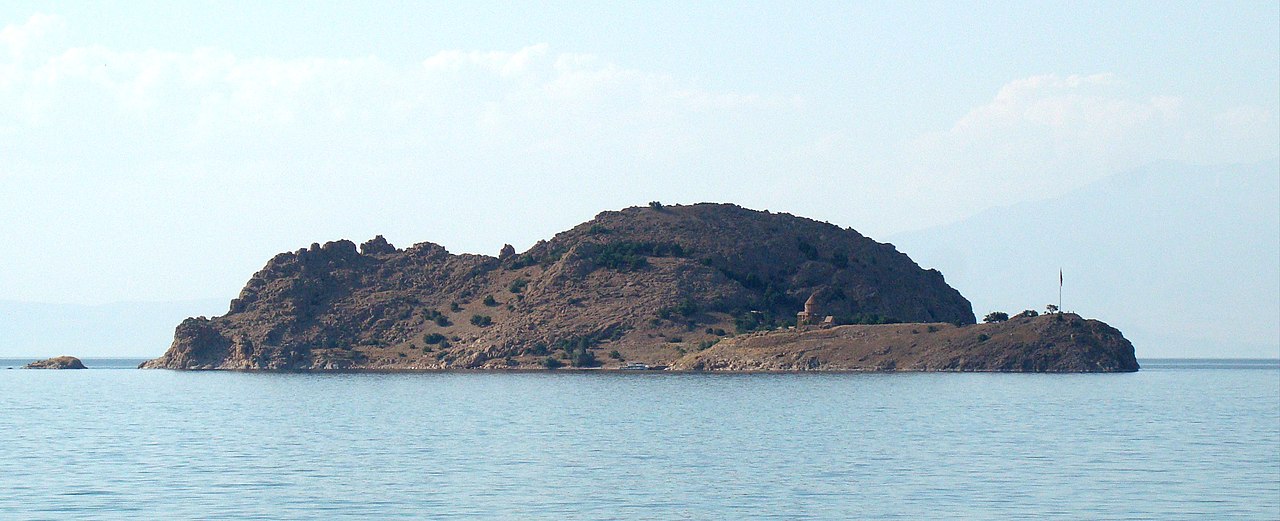
Akdamar Island From Near Gevas


Geological and Geographical Context of Akdamar Island
Akdamar Island, the second largest of the four principal islands in Lake Van, is situated in eastern Turkey. Its geographical footprint spans approximately 0.7 square kilometers, positioned roughly 3 kilometers from the mainland shore. The island exhibits a striking topographical duality.
Its western extremity is characterized by a formidable, hard, grey limestone cliff that ascends 80 meters above the lake's surface, which itself lies at an elevation of 1,912 meters above sea level. This dramatic elevation change underscores the island's volcanic or tectonic origins, common in the Lake Van region. In contrast, the island gently declines towards the east, culminating in a more level terrain.
This lower-lying area is sustained by a natural spring, a critical hydrological feature that provides a consistent and abundant source of fresh water, enabling a degree of self-sufficiency and supporting the island's unique ecosystem and historical habitation. The saline nature of Lake Van further isolates and defines Akdamar's environmental niche.
The Enduring Legacy of the Holy Cross Cathedral
The paramount historical and cultural significance of Akdamar Island is embodied by the Armenian Holy Cross Cathedral, constructed in the 10th century. This architectural marvel was not merely a place of worship but served as the ecclesiastical seat of the Armenian Apostolic Catholicosate of Aghtamar. This prestigious role persisted for an extensive period, from 1116 until 1895, spanning over seven centuries.
During this era, the cathedral was the epicenter of Armenian religious and cultural life in the region, a testament to the historical presence and influence of the Armenian community in eastern Anatolia. The cathedral's intricate carvings and its historical function as a major religious authority underscore its importance as a monument to Armenian heritage. Its survival through centuries of political and social change makes it a vital link to the past.
Socio-Cultural Dynamics and Historical Significance
Akdamar Island's history is deeply interwoven with the Armenian Apostolic Church and the Armenian people who inhabited and utilized the island for centuries. The establishment of the Catholicosate on Akdamar transformed it into a significant religious and administrative center, attracting pilgrims and scholars. The island's relatively small size belies its historical weight as a spiritual capital.
The natural resources, particularly the spring, were instrumental in sustaining life and religious activities. The island's unique position within Lake Van, coupled with its historical role, has made it a focal point for discussions about cultural heritage, religious history, and the complex ethno-cultural landscape of eastern Turkey. Its enduring appeal lies in its ability to connect visitors to a rich and layered past.
Economic Functions
Historically, the economy of Akdamar Island was intrinsically linked to its function as the seat of the Catholicosate. This role generated economic activity through pilgrimage, religious administration, and the sustenance of the clergy and associated community. The spring's water supply would have supported subsistence agriculture, providing food for the inhabitants.
In contemporary times, the island's economic relevance has shifted towards heritage tourism. Visitors are drawn to the island primarily to experience the historical significance of the Holy Cross Cathedral and the unique natural environment of Lake Van. While not a center for traditional industries, Akdamar's economy now relies on its status as a cultural heritage site, contributing to local tourism and preserving its historical narrative through visitor engagement.
Educational and Research Potential
Akdamar Island presents a unique educational and research environment, primarily due to its historical and geological significance. Educational institutions and researchers can utilize the island as a living laboratory for studying medieval Armenian architecture, religious history, and the socio-political dynamics of the region during the time the Catholicosate was active. The island's geology offers opportunities for research into the formation of Lake Van and its surrounding volcanic landscapes.
Furthermore, the island serves as a case study for understanding the preservation of cultural heritage in remote or historically contested areas. Educational programs could focus on the architectural intricacies of the Holy Cross Cathedral, the history of the Armenian Apostolic Church, and the ecological aspects of an island ecosystem sustained by a spring. The island's narrative provides valuable insights into interfaith relations and the impact of historical events on cultural landscapes.
See also
Frequently Asked Questions
What is Akdamar Island?+
Where is Akdamar Island located?+
Why is the Holy Cross Cathedral on Akdamar Island special?+
How can people visit Akdamar Island today?+
What makes Akdamar Island unique in nature?+
Based on content from Wikipedia · Licensed under CC BY-SA 4.0