

A Sunday Afternoon on the Island of La Grande Jatte
Images

A Sunday Afternoon on the Island of La Grande Jatte
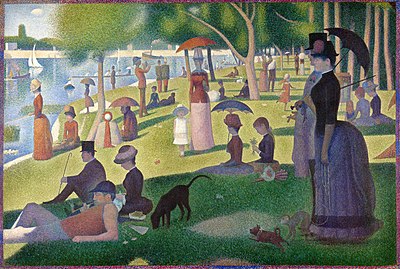


The Social Landscape of Parisian Leisure
Georges Seurat's 'A Sunday Afternoon on the Island of La Grande Jatte' is more than just a depiction of a park; it's a meticulously constructed social commentary on late 19th-century Parisian life. The island itself, La Grande Jatte, was a fashionable bourgeois leisure spot, an urban oasis where the middle and upper classes could escape the city's industrialization and enjoy nature. Seurat captures this atmosphere with striking precision, populating his canvas with figures engaged in various leisurely pursuits.
The composition is deliberately formal and ordered, with figures arranged in a frieze-like manner, reminiscent of classical friezes but imbued with modern subjects. The inclusion of a monkey, a symbol of aristocratic affectation, and the stiff, almost mannequin-like poses of some figures, suggest a subtle critique of the artificiality and social posturing prevalent in bourgeois society. The painting invites viewers to observe not just a scene, but the underlying social dynamics and aspirations of its time.
The Scientific Underpinnings of Pointillism
Seurat was deeply influenced by contemporary scientific theories of color and optics, particularly the work of Michel Eugène Chevreul and Ogden Rood. He rejected the Impressionists' spontaneous application of color, opting instead for a systematic, scientific approach he termed 'chromo-luminarism,' commonly known as Pointillism. This technique involved applying small, distinct dots of pure, unmixed color directly onto the canvas in patterns that would achieve maximum luminosity through optical mixing in the viewer's eye.
Seurat believed this method would create a more vibrant and stable image than traditional blending. The meticulous application of thousands of dots, each carefully chosen for its hue and placement, demonstrates a profound understanding of color relationships and light. The resulting effect is a shimmering, almost animated surface that revolutionized the perception of color in painting and laid the groundwork for future avant-garde movements.
Compositional Mastery and Enduring Influence
The sheer scale of 'A Sunday Afternoon on the Island of La Grande Jatte'-measuring over 10 feet tall and 20 feet wide-contributes to its monumental impact. Seurat spent two years on this painting, undertaking extensive preparatory studies in oil sketches and drawings to perfect the composition, lighting, and color interactions. The resulting work is a testament to his compositional genius, balancing a vast array of figures and elements into a harmonious whole.
The painting’s static, almost timeless quality, achieved through its precise arrangement and the uniform application of dots, contrasts with the fleeting moments often captured by Impressionists. This deliberate control and intellectual rigor set it apart, influencing artists like Paul Signac and paving the way for Fauvism and other movements that explored color's expressive potential. Its enduring presence in the Art Institute of Chicago ensures its continued study and admiration as a pivotal work in the history of Western art.
From Island Park to Global Icon
The journey of 'A Sunday Afternoon on the Island of La Grande Jatte' from a specific Parisian locale to a globally recognized icon is a testament to its artistic merit and cultural resonance. Initially met with mixed reactions, its innovative technique and intellectual depth gradually earned it a place as a cornerstone of modern art. The painting’s current home in Chicago, far from its French origins, underscores its universal appeal and its status as a masterpiece studied and appreciated by diverse audiences worldwide.
It serves as a critical reference point for understanding the transition from Impressionism to more structured, scientific approaches to art, demonstrating how artistic innovation can be deeply intertwined with scientific inquiry and social observation. The painting remains a powerful symbol of artistic evolution and a captivating window into a specific moment in French history.
See also
Frequently Asked Questions
What is "A Sunday Afternoon on the Island of La Grande Jatte"?+
How did Seurat paint the picture with dots?+
Why did Seurat choose the island of La Grande Jatte for his painting?+
What does the monkey in the painting mean?+
Where can we see the painting today?+
Based on content from Wikipedia · Licensed under CC BY-SA 4.0