

Germany's Big Vote in 2025!
Images

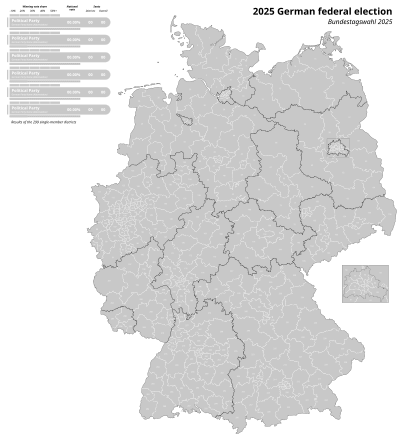
2025 German federal election seats by states




The Genesis of a Snap Election
The 2025 German federal election was not a regularly scheduled event but a consequence of profound political instability. The governing 'Traffic Light' coalition, comprising the SPD, The Greens, and the FDP, fractured in 2024. The loss of its parliamentary majority by Chancellor Olaf Scholz necessitated a strategic move: intentionally losing a motion of confidence.
This constitutional maneuver, designed to trigger new elections, marked the fourth 'snap election' in post-war German history and the first since 2005. The early election date of February 23, 2025, compressed campaign timelines and amplified the urgency for parties to re-evaluate their platforms and appeal to a potentially volatile electorate. This unexpected electoral cycle underscored the fragility of multi-party coalitions and the dynamic nature of German political alliances.
Electoral Tectonics
The election results revealed a dramatic reshuffling of the German political landscape. The conservative CDU/CSU alliance emerged as the largest bloc in the Bundestag, securing 28.5% of the vote. While this was a significant improvement and positioned them to lead the next government, it represented a historical low compared to past electoral successes, highlighting a long-term trend of declining support for traditional major parties.
The most striking development was the doubling of the Alternative for Germany (AfD)'s vote share to 20.8%, propelling them into second place. This surge, despite their isolation from other parties, signals a significant shift in voter sentiment. Conversely, the parties of the former 'Traffic Light' coalition all experienced substantial losses.
The SPD recorded its worst result since 1887 with 16.4%, The Greens fell to 12%, and the FDP, whose exit precipitated the election, suffered their worst-ever outcome at 4.3%, failing to cross the electoral threshold.
The Sahra Wagenknecht Alliance and the 5% Threshold
A notable subplot of the 2025 election was the performance of the Sahra Wagenknecht Alliance (BSW). This populist party, a splinter group from the Left party, had been polling with potential to enter the Bundestag. However, in the final weeks leading up to the election, their support waned.
Ultimately, the BSW narrowly missed the 5% electoral threshold required to gain seats, finishing at 4.98%. This outcome illustrates the critical importance of the electoral threshold in Germany's proportional representation system, which aims to prevent excessive fragmentation of the parliament. The Left party itself, despite earlier concerns, saw a significant last-minute surge, polling well above expectations to secure 9% of the vote, demonstrating the volatility of voter preferences in the final stages of a campaign.
Record Turnout and an Unprecedented Chancellorship Vote
Despite the political turmoil, the 2025 election witnessed an impressive surge in voter participation. An 82.5% turnout was recorded, the highest since German reunification, indicating a heightened public engagement with the democratic process. This robust participation underscored the electorate's desire to have their voices heard amidst the political flux.
The post-election period was equally dramatic. On April 9, 2025, the CDU/CSU and SPD reached a coalition agreement, paving the way for a new government. However, the election of Friedrich Merz as Chancellor on May 6, 2025, was marked by an unprecedented event: he failed to secure a majority in the first round of voting.
This necessitated a second round, a situation unheard of in Germany's post-war parliamentary history, highlighting the complex and evolving dynamics of coalition building and leadership selection in contemporary German politics.
See also
Frequently Asked Questions
What happened in Germany's 2025 election?+
Why did Germany have an early election instead of waiting?+
Which party won the most votes in 2025?+
Why did the AfD get more votes?+
What does the 5% rule mean?+
Based on content from Wikipedia · Licensed under CC BY-SA 4.0