

Wistman's Wood
Images
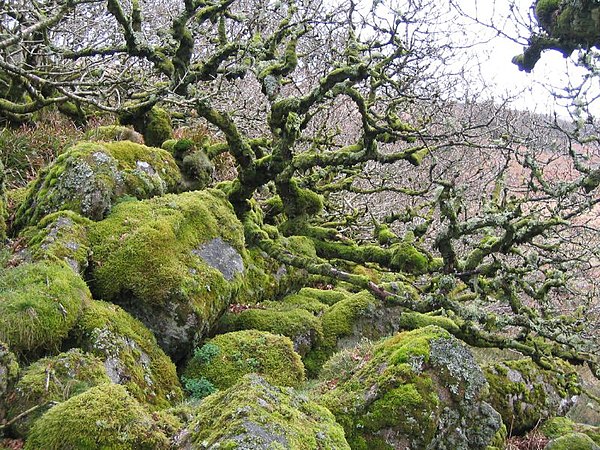
Wistman's Wood
The Arboreal Legacy of Wistman's Wood
Wistman's Wood stands as a profound testament to Britain's dwindling ancient temperate rainforests, a rare and precious ecosystem situated at a high altitude on Dartmoor, Devon. Its significance is multifaceted, rooted in its remarkable age, unique ecological structure, and historical persistence. The defining characteristic of Wistman's Wood is its ancient oak woodland, where individual trees, through dendrochronological analysis, have been found to be hundreds of years old.
This longevity is not merely a number; it signifies a continuous ecological history, a living lineage that has adapted to its challenging environment. The earliest documented references to the wood date back to the 17th century, but the trees themselves represent a far deeper temporal stratum, offering a tangible connection to past landscapes. The very form of the trees, often low-growing and gnarled, is a direct adaptation to the exposed, windy conditions of Dartmoor, creating a distinct and visually striking arboreal character that is rarely found elsewhere in the British Isles.
This ancient woodland is more than just a collection of old trees; it is a complex, self-sustaining environment that has evolved over centuries.
Ecological Rarity and Biodiversity Hotspot
The ecological importance of Wistman's Wood cannot be overstated, primarily due to its classification as an ancient temperate rainforest. Such habitats are exceptionally scarce in the UK, making Wistman's Wood a vital sanctuary for biodiversity. The mature oak trees, often draped in a rich tapestry of mosses, lichens, and ferns, create a microhabitat that supports a specialized array of flora and fauna.
These epiphytic communities, thriving on the bark and branches of the ancient oaks, are indicative of stable, long-established woodland. They, in turn, provide crucial resources and shelter for a variety of invertebrates, amphibians, and avian species that are adapted to this specific environment. The presence of such a diverse and interdependent community underscores the intrinsic value of preserving ancient woodlands.
Wistman's Wood serves as a critical reference point for understanding the ecological dynamics of temperate rainforests and the long-term impacts of climate and landscape on forest development.
Historical Context and Conservation Imperatives
The historical narrative of Wistman's Wood is intrinsically linked to its survival against the odds. While written records are relatively recent, the wood's existence points to a much longer period of relative stability. Its location on Dartmoor, a landscape that has historically been less intensively farmed than many other parts of Britain, may have contributed to its preservation.
However, like many ancient woodlands, it faces ongoing pressures from environmental changes and human activity. The conservation of Wistman's Wood is therefore paramount. It represents not only a unique natural heritage site but also a living laboratory for ecological research.
Studying its resilience, its species composition, and its response to environmental shifts can provide invaluable insights for broader conservation strategies. Protecting this ancient forest is an investment in understanding and safeguarding natural processes that have shaped our planet for millennia, ensuring its legacy for future generations.
The Unique Morphology and Microclimate
The distinctive morphology of the trees in Wistman's Wood is a direct consequence of its high-altitude, exposed location. The prevailing winds on Dartmoor shape the oaks into stunted, often pollarded forms, with branches that twist and spread horizontally rather than growing tall and straight. This creates a dense, interlocking canopy that offers significant protection from the elements, fostering a unique microclimate within the wood.
The high humidity, coupled with the shade provided by the dense foliage, is ideal for the proliferation of mosses, liverworts, and lichens. These organisms not only contribute to the aesthetic character of the wood but also play a vital role in nutrient cycling and soil formation. The fallen logs and ancient stumps further enhance the habitat complexity, providing decaying organic matter that supports a rich invertebrate community.
This intricate interplay between the trees, the climate, and the associated flora and fauna defines Wistman's Wood as a truly exceptional natural environment.
See also
Frequently Asked Questions
What is Wistman's Wood?+
Why is Wistman's Wood special?+
How do the trees in Wistman's Wood stay healthy?+
When did people first write about Wistman's Wood?+
Why do scientists want to protect Wistman's Wood?+
Based on content from Wikipedia · Licensed under CC BY-SA 4.0