

Velociraptor: The Speedy Hunter!
Images
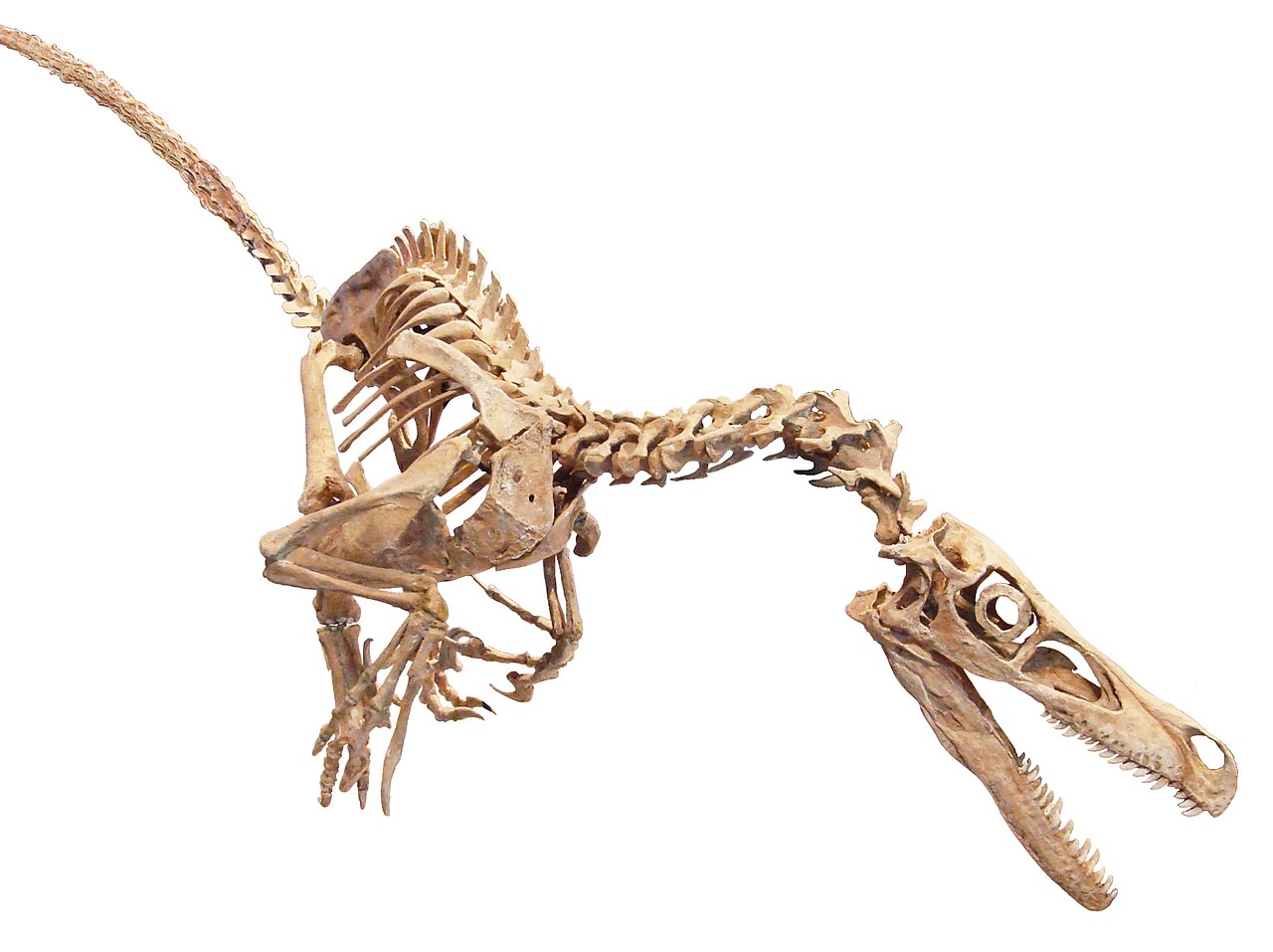
Velociraptor


Morphological Adaptations for Predation
Velociraptor, a member of the Dromaeosauridae family, exhibits a suite of remarkable morphological adaptations that underscore its role as a highly efficient predator. Its name, meaning 'swift seizer,' accurately reflects its primary hunting strategy. Standing approximately 0.5 meters (1.6 ft) at the hip and reaching lengths of up to 2 meters (6.6 ft), Velociraptor was relatively small compared to some of its theropod relatives, but its build was optimized for agility and power.
The long, stiffened tail, supported by ossified tendons, provided crucial counterbalancing during rapid acceleration and sharp turns, enabling it to maneuver effectively in pursuit of prey. The most iconic feature is the enlarged, retractable sickle claw on the second digit of each foot, measuring up to 6.5 cm (2.6 in). This claw was likely used to pin down prey, inflict deep wounds, or potentially to climb.
Its jaws were equipped with numerous serrated teeth, ideal for shearing flesh, and its relatively large brain-to-body mass ratio suggests advanced cognitive abilities, potentially including complex social behaviors and problem-solving skills.
Ecological Niche in Late Cretaceous Asia
The ecological niche occupied by Velociraptor was within the arid and semi-arid environments of Late Cretaceous Asia, specifically regions like the Djadochta Formation in Mongolia and the Yi'an Gobi Formation in China, dating from approximately 75 to 71 million years ago. These habitats were characterized by open landscapes, sand dunes, and scrubby vegetation, providing ample space for pursuit predation. Velociraptors shared this ecosystem with a variety of other fauna, including herbivores like Protoceratops and small ornithopods, which likely formed a significant portion of their diet. Evidence, such as the famous 'fighting dinosaurs' fossil depicting a Velociraptor locked in combat with a Protoceratops, provides direct insight into their predatory interactions.
The hypothesis of pack hunting, supported by the discovery of multiple Velociraptor fossils in close proximity, suggests a sophisticated social structure that would have allowed them to tackle larger prey and defend territories more effectively, thereby playing a significant role in regulating herbivore populations within their environment.
Feathered Integument and Evolutionary Links
The discovery that Velociraptor possessed feathers represents a pivotal moment in our understanding of dinosaur evolution. Fossil evidence, particularly the presence of quill knobs (attachment points for large feathers) on the ulnae of Velociraptor fossils, strongly indicates that these dinosaurs were covered in feathers. These feathers were likely not for flight, as Velociraptor was a terrestrial dinosaur, but served other functions such as insulation, thermoregulation, and potentially for display purposes, similar to the elaborate plumage seen in modern birds.
This finding solidifies the evolutionary link between theropod dinosaurs and birds, placing Velociraptor within the broader context of avian ancestry. The presence of feathers further challenges the scaly, reptilian image often perpetuated in popular culture, revealing a more complex and bird-like creature that was highly adapted to its environment. This feathered integument highlights the dynamic nature of evolutionary pathways and the shared heritage between ancient reptiles and modern avians.
Paleontological Significance and Public Perception
Velociraptor holds immense paleontological significance, not only for its unique anatomical features but also for its role in shaping public perception of dinosaurs. Its relatively small size, feathered appearance, and inferred intelligence distinguish it from the colossal, lumbering giants often depicted in early paleontological thought. The scientific study of Velociraptor has contributed significantly to our understanding of dinosaur behavior, including the potential for complex social structures and pack hunting.
Furthermore, its close evolutionary relationship with birds continues to be a subject of intense research, providing critical data for tracing the origins of flight and avian diversity. However, popular culture, particularly through fictional portrayals, has often exaggerated Velociraptor's size and ferocity, creating a disconnect between scientific reality and public imagination. This discrepancy underscores the ongoing challenge and importance of communicating accurate scientific information about these fascinating prehistoric creatures to a wider audience.
Go deeper
Frequently Asked Questions
What did Velociraptor look like?+
How fast could Velociraptor run?+
Did Velociraptor have feathers?+
Did Velociraptor hunt alone or in packs?+
What did Velociraptor eat?+
Based on content from Wikipedia · Licensed under CC BY-SA 4.0