

Vasco da Gama Bridge
Images

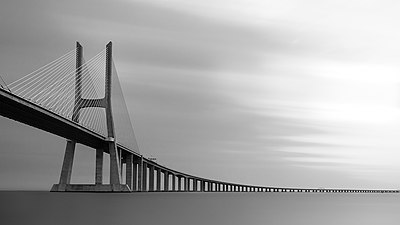
Vasco da Gama bridge panorama




Strategic Infrastructure Development
The Vasco da Gama Bridge represents a significant investment in Portugal's transportation infrastructure, conceived to address critical issues of traffic flow and regional connectivity. Lisbon, situated on the Tagus River estuary, faced considerable traffic bottlenecks, particularly on the existing 25 de Abril Bridge. The decision to construct a second major crossing was driven by the need to alleviate this congestion, facilitate smoother transit between the country's northern and southern regions, and reduce the reliance on the capital city as a sole transit point.
This strategic placement and scale were intended to foster economic growth by improving the efficiency of goods and passenger movement, thereby enhancing Portugal's position within the European Union's transport network.
Engineering Prowess
The construction of the Vasco da Gama Bridge, which commenced in February 1995, was a monumental feat of modern engineering. Its design as a cable-stayed bridge, complemented by extensive approach viaducts, was chosen for its ability to span the considerable width of the Tagus River while maintaining structural integrity and aesthetic appeal. The bridge features impressive concrete pylons, some reaching heights comparable to significant skyscrapers, from which a complex network of steel cables suspends the roadway.
The construction process involved overcoming significant challenges, including building foundations in the riverbed under varying water conditions and managing the logistics of assembling such a massive structure. The project culminated in its opening to traffic on March 29, 1998, a testament to precise planning and execution.
Commemorating Discovery
The timing and naming of the Vasco da Gama Bridge are deeply intertwined with Portugal's rich maritime history. The bridge was inaugurated just in time for Expo 98, a World's Fair held in Lisbon to commemorate the 500th anniversary of Vasco da Gama's historic voyage that established a sea route from Europe to India. By naming the bridge after this pivotal explorer, Portugal not only honored a significant moment in its past but also symbolically linked its historical legacy of discovery and exploration with its contemporary achievements in engineering and infrastructure.
The bridge serves as a modern monument, a tangible connection between Portugal's seafaring heritage and its forward-looking vision.
Socio-Economic Impact and European Significance
The Vasco da Gama Bridge has had a profound socio-economic impact on Lisbon and Portugal. By significantly reducing travel times and easing congestion, it has improved the quality of life for residents and commuters. Economically, it has facilitated trade and commerce, making it more efficient to transport goods and services across the country.
As one of the longest bridges in Europe, it also enhances Portugal's role as a logistical hub within the continent. Its status as the longest bridge in the European Union underscores the nation's capacity for large-scale, impactful infrastructure projects, contributing to both national pride and international recognition.
Technical Specifications and Longevity
The sheer scale of the Vasco da Gama Bridge is impressive. Its total length of 17.2 kilometers (10.7 miles) makes it the longest bridge in the European Union and one of the longest in Europe overall. The design accommodates multiple lanes of traffic in each direction, ensuring high capacity.
The structural engineering employed ensures durability and resilience against environmental factors, including wind and seismic activity. The bridge's construction utilized advanced materials and techniques to guarantee its longevity, aiming for a service life measured in many decades. Its maintenance and operational management are crucial for ensuring its continued function as a vital artery for Portugal.
See also
Frequently Asked Questions
What is the Vasco da Gama Bridge?+
Why was the bridge built?+
How long is the bridge?+
When did the bridge open?+
Why is it named after Vasco da Gama?+
Based on content from Wikipedia · Licensed under CC BY-SA 4.0