

University of Cincinnati
Images

University of Cincinnati Vontz Center for Molecular Studies


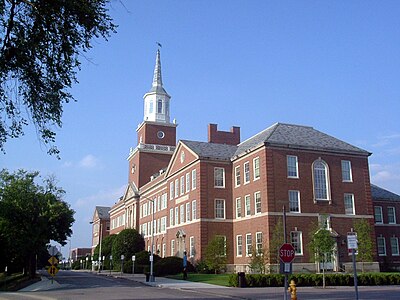


Foundations of Excellence
Established in 1819, the University of Cincinnati (UC) stands as a testament to enduring academic pursuit and societal contribution. Originally founded as the Cincinnati College, it merged with the Medical College of Ohio in 1819 to form the second-oldest public university in the United States. Its journey through more than two centuries has seen it evolve into a major urban research institution, deeply integrated with its community.
The university's primary uptown campus, along with its medical campus, is situated in the vibrant neighborhoods of Clifton Heights and Corryville, fostering a dynamic environment for learning and discovery. The expansion to include branch campuses in Batavia and Blue Ash demonstrates its commitment to accessibility and broader educational reach across Ohio.
Pioneering Discoveries and Their Global Impact
The University of Cincinnati has consistently been at the forefront of scientific and medical advancement. Its research endeavors have yielded discoveries with profound global implications. Notably, UC played a pivotal role in the development of a live polio vaccine, a monumental achievement that has dramatically reduced the incidence of this debilitating disease worldwide.
Furthermore, the university's researchers were instrumental in the creation of diphenhydramine, a widely used antihistamine found in many over-the-counter allergy medications, improving the quality of life for millions. These breakthroughs underscore UC's status as a 'R1: Doctoral University – Very high research activity,' a classification signifying its significant contributions to knowledge and innovation.
The Revolutionary Co-operative Education Model
Perhaps one of UC's most defining contributions to higher education is its pioneering of the co-operative education (co-op) model. Established in 1906, this innovative approach fundamentally changed how students could prepare for their careers. Co-op integrates academic study with practical, paid work experience in fields related to students' majors.
Students alternate periods of full-time study with periods of full-time employment, allowing them to gain invaluable real-world skills, build professional networks, and explore career paths before graduation. This model not only enhances employability but also provides a unique perspective on theoretical concepts learned in the classroom, making UC graduates highly competitive in the job market.
A Comprehensive Academic Ecosystem
UC's academic structure is organized into 14 distinct colleges, offering a vast spectrum of programs designed to meet diverse student interests and societal needs. From the foundational disciplines of architecture, business, education, engineering, humanities, and the sciences, to specialized fields like law, music, and medicine, the university provides a robust educational framework. The College of Medicine is particularly distinguished, housing a leading teaching hospital and advanced biomedical research laboratories.
This comprehensive approach ensures that students receive a well-rounded education, equipped with both theoretical knowledge and practical skills, preparing them for leadership roles in their chosen professions and for active participation in civic life.
Beyond Academics
The University of Cincinnati fosters a vibrant campus community that extends beyond its academic offerings. Its athletic teams, known as the Cincinnati Bearcats, are a significant part of the university's identity, competing in NCAA Division I as members of the Big 12 Conference. This athletic presence not only generates school spirit but also provides opportunities for student-athletes to excel in their sports while pursuing their education.
The university's location in a major metropolitan area offers students access to a rich cultural landscape, diverse recreational activities, and numerous internship and career opportunities, further enriching the overall student experience and preparing them for life beyond graduation.
See also
Frequently Asked Questions
When was the University of Cincinnati founded?+
What is the co-op model that UC started?+
What important medicine did UC help create?+
Where are the main campuses of UC?+
How many colleges does UC have?+
Based on content from Wikipedia · Licensed under CC BY-SA 4.0