

Trinity College Dublin
Images
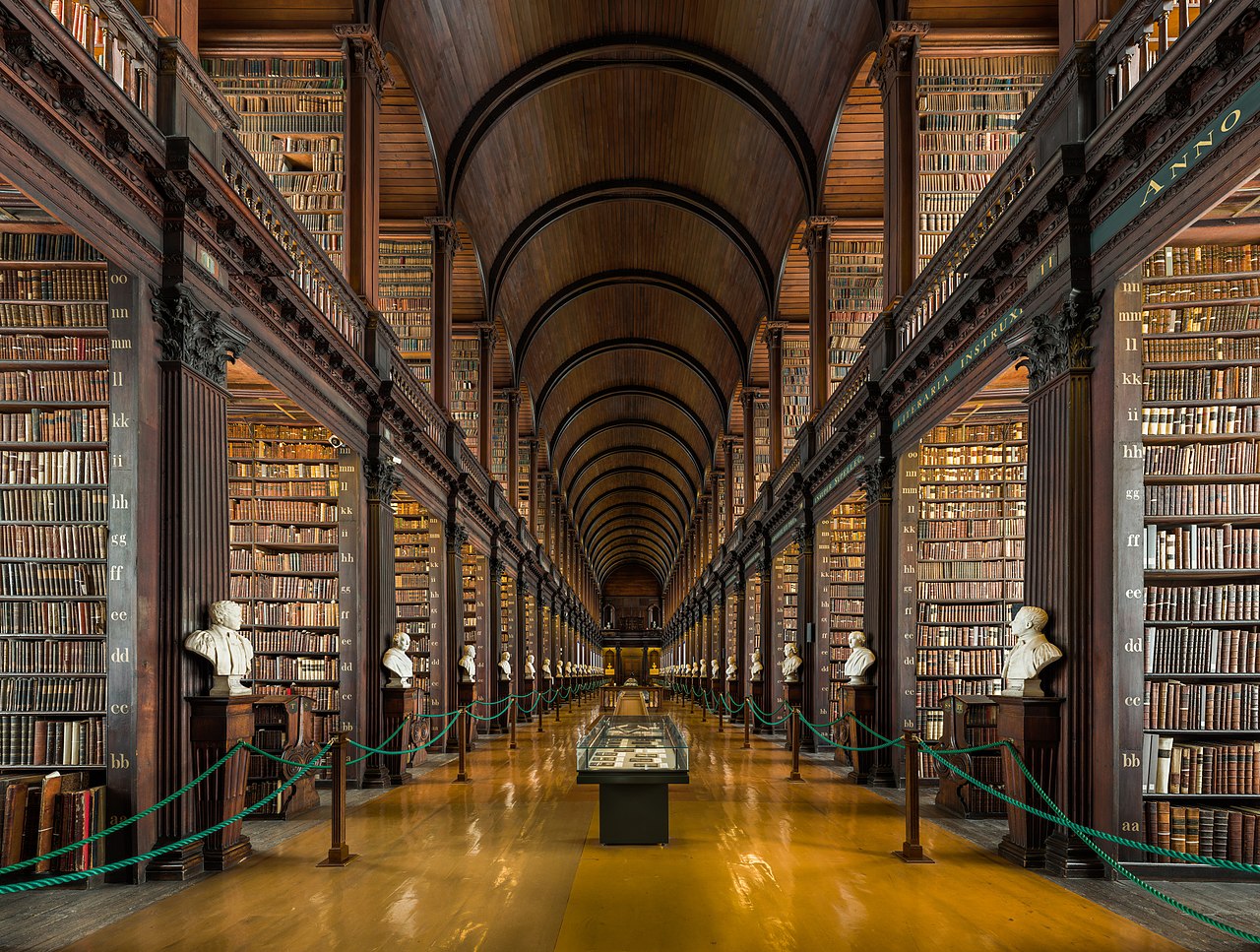
Long Room Interior, Trinity College Dublin, Ireland - Diliff


Founding Principles and Historical Context
Trinity College Dublin, chartered in 1592 by Queen Elizabeth I, stands as Ireland's oldest university in continuous operation and one of the seven ancient universities of Great Britain and Ireland. Its establishment was not merely an academic endeavor but a strategic political move by the Tudor monarchy to consolidate its rule in Ireland. The university was deliberately founded as a Protestant institution, initially serving the Ascendancy, the Protestant ruling elite, for over two centuries.
This historical context is crucial to understanding its early association with social elitism. The site itself was formerly occupied by the Priory of All Hallows, demolished by King Henry VIII, signifying a deliberate break with the past and the establishment of a new order. The university's name, 'The College of the Holy and Undivided Trinity of Queen Elizabeth near Dublin,' reflects its royal and religious origins.
Its founding Provost, Adam Loftus, modeled it after Trinity College, Cambridge, aiming to replicate its academic rigor and institutional structure.
The Old Library
The Old Library at Trinity College Dublin is far more than a collection of books; it is a national treasure and a significant cultural landmark. As a legal deposit library for both the Republic of Ireland and the United Kingdom, it houses an unparalleled collection of Irish and British publications. Its most celebrated artifacts include the Book of Kells, an exquisite illuminated manuscript dating from the early 9th century, renowned for its intricate artistry and historical importance.
Also preserved within its walls are the Brian Boru harp, a symbol of Irish heritage dating back to the 15th century, and a copy of the 1916 Proclamation of the Irish Republic, a pivotal document in Irish history. The library's collections are not only academic resources but also powerful cultural touchstones that attract over two million visitors annually, making Trinity College a major destination for cultural tourism and a vital center for historical scholarship.
Intellectual Prowess and Transformative Discoveries
Trinity College Dublin boasts an extraordinary legacy of intellectual achievement, producing alumni whose work has profoundly shaped literature, philosophy, and science. Literary figures such as Oscar Wilde, Bram Stoker, Jonathan Swift, and Samuel Beckett are among its distinguished graduates, contributing immensely to the global literary canon and solidifying Dublin's status as a UNESCO City of Literature.
Beyond the arts, Trinity alumni have been at the forefront of scientific and technological innovation. They are credited with inventing the binaural stethoscope, the steam turbine, and the hypodermic needle. Their scientific contributions include pioneering seismology, linear algebra, and radiotherapy, as well as performing the first fully artificial nuclear transmutation.
The very term 'electron' was coined by one of its scholars. This consistent output of groundbreaking ideas underscores Trinity's enduring role as a catalyst for human progress.
A Network of Academic Excellence and Enduring Partnerships
Trinity College Dublin is structured into three faculties encompassing 25 schools, offering a comprehensive range of academic disciplines. Its commitment to academic excellence is further demonstrated through its affiliations with institutions like the Royal Irish Academy of Music and the Lir Academy. Trinity is an active member of prestigious academic networks such as LERU (League of European Research Universities) and the Coimbra Group, fostering international collaboration and research.
Notably, Trinity maintains a unique academic partnership with Oriel College, Oxford, and St John's College, Cambridge, through mutual incorporation, a relationship that has persisted since 1636. This enduring connection highlights a shared commitment to academic standards and intellectual exchange across centuries. Furthermore, Trinity is home to 'The Hist,' the world's oldest student society, founded in 1770, which continues to be a vibrant forum for debate and intellectual discourse, reflecting the university's long-standing tradition of fostering critical thinking and public speaking.
Go deeper
Frequently Asked Questions
What is Trinity College Dublin?+
Why was Trinity College Dublin made a Protestant school?+
What cool things can you see in the Old Library?+
Which famous writers studied at Trinity College Dublin?+
What inventions did people from Trinity College create?+
Based on content from Wikipedia · Licensed under CC BY-SA 4.0