

SS Orcades (1947)
Images
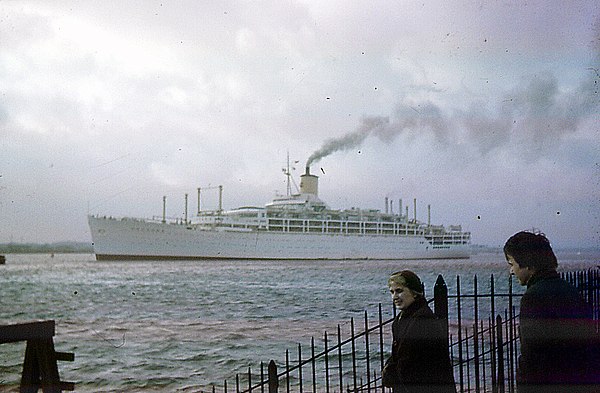
SS Orcades (1947)
Maritime Backbone
Commissioned in the immediate post-World War II era, the SS Orcades represented a significant investment in rebuilding and expanding global maritime transport. Built by Vickers-Armstrong at Barrow-in-Furness, its design was robust and efficient, sharing an identical hull and machinery with P&O's Himalaya, a testament to standardized shipbuilding practices aimed at maximizing output. The Orcades was primarily deployed on the prestigious UK–Australia–New Zealand route, a lifeline for both mail delivery and passenger transport.
In its early years, it served a critical function in facilitating large-scale migration to the Commonwealth nations, offering passage to thousands seeking new opportunities. This role was paramount in reshaping demographics and economies in the receiving countries. The ship's designation as a Royal Mail Ship underscored its importance in maintaining imperial communication networks, a vital service before the dominance of air freight and digital communication.
Engineering Adaptations and Operational Resilience
The operational life of the SS Orcades was marked by continuous adaptation and engineering adjustments. A notable modification occurred in 1952 with the installation of a 'top hat' funnel extension. This seemingly minor alteration was a practical response to passenger comfort, designed to mitigate smoke nuisance on the aft decks, thereby enhancing the onboard experience.
The ship's resilience was tested when it ran aground in Port Philip Bay, Victoria, Australia, on May 7, 1952. The successful refloating and return to service demonstrated the robust construction and efficient salvage capabilities of the time. Furthermore, its deployment as an accommodation ship during the 1956 Melbourne Summer Olympics showcased its versatility.
This function allowed the Games to proceed smoothly by providing essential housing for participants and officials, highlighting the crucial role large vessels could play in supporting major international events.
The Transition to Leisure and Evolving Passenger Experience
The latter half of the SS Orcades' career saw a significant shift from its primary role as a liner to becoming a dedicated cruise ship. This transition reflected broader trends in the shipping industry, as air travel began to eclipse long-distance sea voyages for essential travel. The ship underwent substantial refits in 1959 and 1964, signaling a commitment to modernizing its amenities and adapting to the evolving demands of the leisure market.
The 1964 refit was particularly transformative, converting the Orcades into a single-class vessel. This move democratized onboard luxury, offering a consistent standard of service to all passengers, a departure from the traditional tiered-class system. Concurrently, its hull color was changed from 'Orient corn' to white, a visual modernization that aligned with contemporary cruise ship aesthetics and contributed to a brighter, more appealing profile.
Legacy and Maritime Significance
The SS Orcades (1947) stands as a significant example of mid-20th-century ocean liner design and operational evolution. Its dual role in post-war migration and its successful transition to the cruise market illustrate the adaptability required for maritime success in a changing world. The ship's near-sister status with the Himalaya, Oronsay, and Orsova meant it was part of a successful class of vessels that defined long-distance travel for decades.
Its Latin name, 'Orcades,' referencing the Orkney Islands, connects it to Britain's maritime heritage. While no longer in service, the SS Orcades remains a poignant reminder of an era when ocean liners were not just modes of transport but floating communities that facilitated global connections, supported national policies, and provided unique travel experiences, leaving an indelible mark on maritime history.
See also
Based on content from Wikipedia · Licensed under CC BY-SA 4.0