

Shotokan
Images
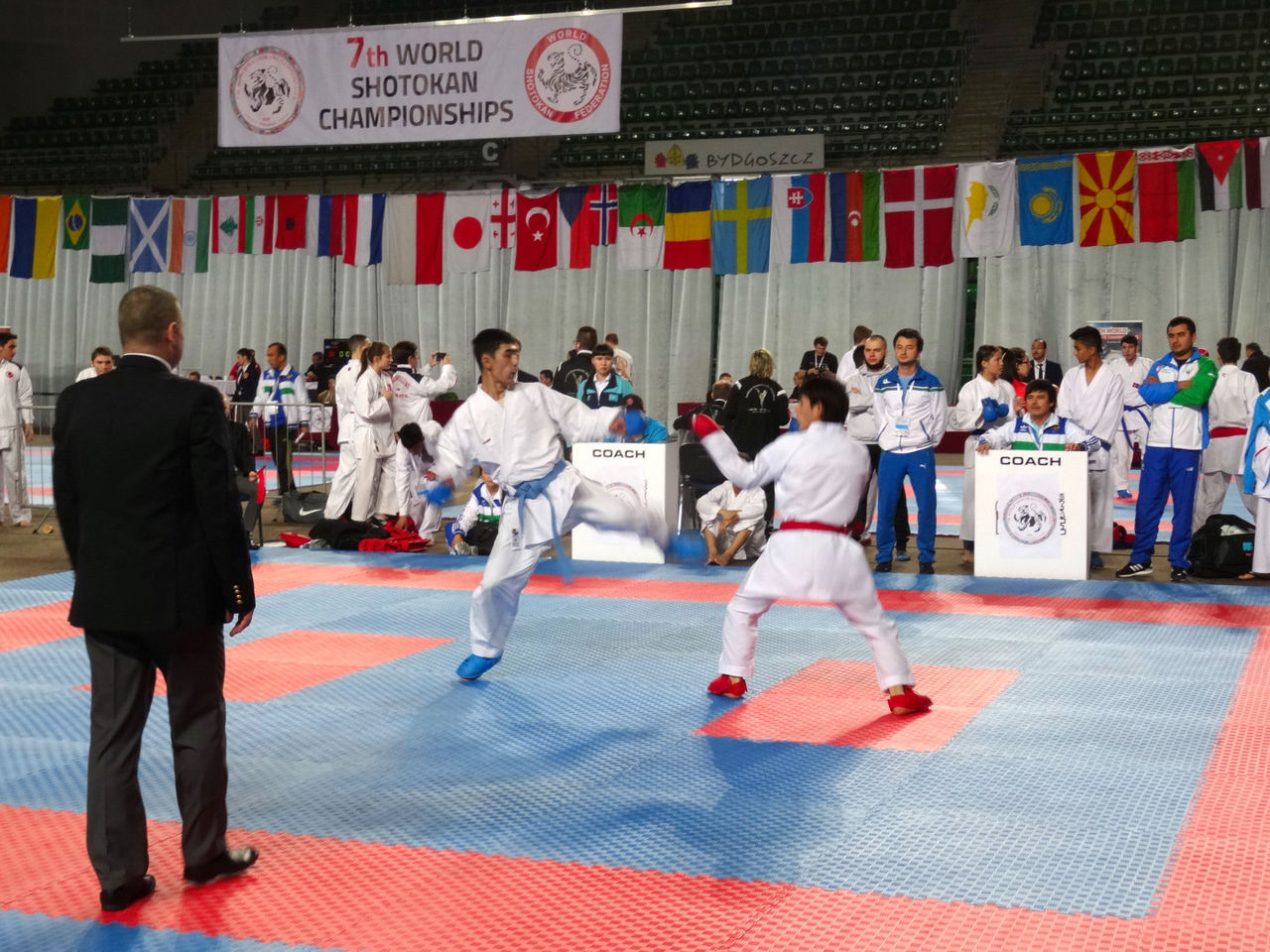
World Shotokan Championships WSF Bydgoszcz 2016w 5 4-2016


The Genesis of Shotokan
Shotokan, the most globally recognized and practiced style of karate, owes its existence to the pioneering efforts of Gichin Funakoshi (1868–1957). Born in Okinawa, a region steeped in martial traditions, Funakoshi was instrumental in synthesizing various Okinawan fighting arts into a cohesive system. He wasn't merely a practitioner; he was a profound philosopher and educator who saw karate as a path to self-improvement and moral development, coining the term 'Karate Do' – the Way of the Empty Hand.
Funakoshi's strategic public demonstrations and his tireless work establishing university karate clubs, including at prestigious institutions like Keio and Waseda, were crucial in introducing karate to mainland Japan and beyond. These university dojos became vital centers for training and dissemination, cultivating a generation of instructors who would carry his teachings forward.
Evolution and Diversification
The legacy of Gichin Funakoshi and his son, Gigo (Yoshitaka) Funakoshi, who also contributed significantly to the style's development, continued after Gichin's death in 1957. However, the unified front began to fragment due to philosophical and organizational differences. A significant point of contention was the role of competition in karate.
Some believed that the emphasis on winning and scoring detracted from the core principles of self-improvement and spiritual development. This led to a major schism, notably between the Japan Karate Association (JKA), led by Masatoshi Nakayama, and the Shotokai organization, headed by Motonobu Hironishi and Shigeru Egami. This divergence resulted in the creation of numerous independent Shotokan federations worldwide, each maintaining Funakoshi's influence but with distinct organizational structures and sometimes subtle variations in technique or philosophy.
The Enduring Significance of Shotokan in Global Martial Arts
Shotokan's status as the most widely practiced karate style underscores its profound global significance. Its enduring appeal lies in its comprehensive approach, which balances rigorous physical training with a strong emphasis on mental discipline, respect, and ethical conduct. The style's philosophical underpinnings, focusing on character building and self-mastery, resonate with practitioners seeking more than just combat skills.
In an era where many traditional practices face challenges, Shotokan's continued prevalence demonstrates its adaptability and the universal appeal of its core values. It serves as a powerful example of how a martial art can foster personal growth, community, and a lifelong pursuit of self-improvement.
Core Principles and Techniques of Shotokan Karate
Shotokan is characterized by its deep, stable stances (like the kiba-dachi, or horse-riding stance) and powerful, linear techniques. The style emphasizes generating maximum force through efficient body mechanics, utilizing the entire body's rotational power to deliver strikes. Key offensive techniques include strong, direct punches (tsuki) and dynamic kicks (geri), while defensive maneuvers focus on solid blocks (uke).
Training in Shotokan involves extensive repetition of basic forms (kata) and sparring (kumite) to hone precision, speed, and power. The philosophy of 'ikken hissatsu' – to annihilate with one blow – highlights the style's focus on decisive, effective action, achieved through dedicated practice and a deep understanding of movement principles.
Shotokan's Influence Beyond the Dojo
The impact of Shotokan extends far beyond the confines of the dojo. The discipline, focus, and perseverance cultivated through Shotokan training are transferable skills that benefit practitioners in all aspects of life. Many individuals find that the structured environment and the emphasis on respect and self-control learned in Shotokan positively influence their academic pursuits, professional careers, and personal relationships.
Furthermore, the global network of Shotokan practitioners fosters a sense of international community, connecting people from diverse backgrounds through a shared passion and a common set of values. This cross-cultural exchange enriches understanding and promotes peaceful interaction worldwide.
Go deeper
Frequently Asked Questions
What is Shotokan karate?+
Who started Shotokan?+
Why do Shotokan students practice kata?+
What does the word "iken hissatsu" mean in Shotokan?+
How do Shotokan karate classes balance body and mind?+
Based on content from Wikipedia · Licensed under CC BY-SA 4.0