

Sewing Needles: Tiny Tools That Stitch Our World Together!
Images

Sewing needle




From Survival Tools to Cultural Artifacts
The sewing needle is one of humanity's oldest and most transformative inventions, predating agriculture and complex societies. Archaeological evidence suggests bone needles were in use as far back as 50,000 years ago, during the Upper Paleolithic period. These early tools were not merely utilitarian; they were instrumental in enabling early humans to adapt to diverse climates by creating fitted clothing and shelters from animal hides.
The development of metalworking, particularly iron and later steel, revolutionized needle production, allowing for greater precision, strength, and mass manufacturing. Beyond their practical function, needles and their storage cases, known as needle books or étuis, also became objects of adornment and status, reflecting the artistry and craftsmanship of different eras and cultures, underscoring their dual role as essential tools and cultural artifacts.
Material Science and Precision Engineering in Needle Manufacturing
Modern sewing needles represent a triumph of material science and precision engineering. Typically manufactured from high-carbon steel wire, their physical properties are carefully controlled to ensure strength, flexibility, and sharpness. The steel is heat-treated to achieve optimal hardness, allowing it to penetrate dense fabrics without bending or breaking.
To combat the inherent susceptibility of steel to rust, needles are plated with corrosion-resistant materials. Nickel plating is common for everyday use, offering a balance of durability and cost-effectiveness. For higher-end applications, 18K gold plating provides superior tarnish resistance. The most advanced needles, often used in specialized embroidery or medical suturing, incorporate exotic alloys like platinum-titanium, chosen for their exceptional biocompatibility, strength, and resistance to chemical degradation, demonstrating a sophisticated understanding of material performance.
The Needle's Pervasive Influence Across Industries
The sewing needle's impact extends far beyond personal garment creation; it is a fundamental component of numerous global industries. In the apparel sector, automated sewing machines, equipped with high-speed needles, are the backbone of mass production, churning out billions of garments annually. The medical field relies on specialized surgical needles for suturing wounds and performing complex procedures, where precision and sterility are paramount.
In the automotive industry, needles are used in the manufacturing of airbags and upholstery. Furthermore, the craft and hobby sector thrives on the accessibility and versatility of sewing needles, fostering creativity and entrepreneurship. The needle's ability to join disparate materials reliably and efficiently makes it an indispensable tool across a vast spectrum of human endeavor.
The Mechanics of Stitch Formation and Needle Design
The seemingly simple act of sewing involves a complex mechanical interaction between the needle, thread, and fabric. The needle's design is optimized for efficient penetration and thread transport. Its conical point tapers to a sharp tip, minimizing the force required to pierce fabric fibers.
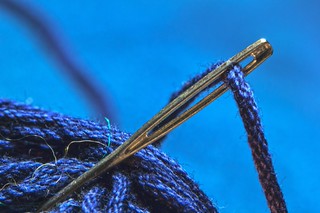
The shaft is engineered for rigidity, preventing buckling under tension. The eye, or 'lumen,' is precisely formed to accommodate the thread without causing excessive friction or damage to the fibers. As the needle moves through the fabric, it creates a channel, and the thread, pulled through this channel, forms a loop.
The subsequent passage of the needle and thread creates a second loop that interlocks with the first, forming a stitch. Variations in needle shape, eye size, and shaft diameter cater to different fabric types and thread weights, illustrating a nuanced understanding of applied mechanics in textile assembly.
Beyond Function
The sewing needle, while primarily a functional object, also serves as a lens through which we can view technological advancement and cultural practices. The evolution of needle materials and manufacturing techniques mirrors broader industrial revolutions, from artisanal craftsmanship to mass production enabled by steel and precision machinery. The historical practice of storing needles in elaborate 'needle books' or 'étuis' reveals insights into social customs, personal adornment, and the value placed on such tools.
These cases, often intricately decorated, transformed a mundane item into a personal treasure. In contemporary society, the needle continues to be a symbol of creation, repair, and connection, representing the enduring human drive to shape and mend our material world through skill and ingenuity.
See also
Frequently Asked Questions
What is a sewing needle and why do we use it?+
How old are sewing needles?+
Why are sewing needles made of steel and sometimes coated with nickel or gold?+
Where else are sewing needles used besides making clothes?+
How does a sewing needle help thread go through fabric?+
Based on content from Wikipedia · Licensed under CC BY-SA 4.0