

Semeru
Images

Mount Semeru


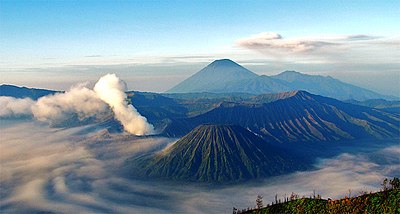


The Apex of Java
Semeru, officially known as Mahameru, commands the highest elevation on the island of Java, Indonesia, reaching approximately 3,676 meters (12,060 feet). Its imposing stature makes it a dominant feature of the East Java landscape and a significant point of reference. As a stratovolcano, its majestic, conical form is the result of successive eruptions of viscous lava flows, pyroclastic deposits, and ash layers, accumulating over millennia.
This geological architecture not only defines its visual prominence but also dictates its eruptive behavior, often characterized by Strombolian or Vulcanian activity. The mountain's summit is frequently shrouded in clouds, adding to its mystique and challenging ascent for climbers, solidifying its status as a formidable natural landmark.
Etymological Roots and Cultural Resonance
The name 'Semeru' is deeply rooted in ancient Indic traditions, reflecting the historical and cultural connections of Indonesia. It is derived from 'Meru,' the cosmic axis or central world mountain in Hindu cosmology, and 'Sumeru,' the celestial abode of gods. The Sanskrit epithet 'Mahameru' translates to 'The Great Mountain,' underscoring its perceived grandeur and spiritual significance.
This nomenclature suggests that Semeru has long been regarded not merely as a geological entity but as a sacred site, a nexus between the terrestrial and the divine, influencing local beliefs, rituals, and folklore for centuries. Its cultural resonance continues to shape its perception as a place of both natural power and spiritual importance.
Tectonic Crucible
Semeru's existence and activity are intrinsically linked to its location within a highly dynamic subduction zone. Here, the oceanic Indo-Australian Plate is being forced beneath the continental Eurasian Plate. This process of subduction involves the descent of the denser oceanic plate into the Earth's mantle, where increasing temperatures and pressures lead to the melting of rock.
The resulting molten material, magma, is less dense than the surrounding mantle and ascends through the overlying crust. Semeru is one of the volcanic manifestations of this subduction process, acting as a conduit for the Earth's internal heat and material to reach the surface. This geological setting is responsible for the frequent seismic activity and the persistent volcanic unrest observed in the region.
Volcanic Dynamics and Eruptive Regimes
As an active volcano, Semeru exhibits a continuous cycle of geological processes. Magma chambers beneath the summit store molten rock, which can periodically ascend through conduits to the surface. Its eruptive style is typically characterized by frequent, relatively small eruptions, often producing ash plumes that can reach several kilometers into the atmosphere.
These events are commonly observed as incandescent rock avalanches or 'hot clouds' (pyroclastic flows) descending the volcano's flanks. The consistent activity means Semeru is in a state of near-constant eruption, making it one of Indonesia's most active volcanoes. Scientific monitoring is crucial for understanding its behavior, predicting potential hazards, and ensuring the safety of surrounding populations.
Socio-Economic and Scientific Implications
Semeru's impact extends beyond its geological and cultural significance. Its fertile volcanic soils, enriched by ash deposits, support intensive agriculture in the surrounding lowlands, contributing significantly to the regional economy. However, its active nature also poses considerable risks.
Volcanic hazards, including ashfall, pyroclastic flows, and lahars (volcanic mudflows), can devastate communities and infrastructure. Consequently, Semeru serves as a vital case study for volcanologists and disaster management agencies worldwide, providing critical data for research into volcanic processes, hazard assessment, and mitigation strategies. Its continuous activity offers unparalleled opportunities for scientific observation and the advancement of our understanding of Earth's powerful geological forces.
See also
Frequently Asked Questions
What is Semeru?+
Why is Semeru called "Mahameru"?+
How does Semeru erupt?+
Where does Semeru’s heat come from?+
Why is Semeru important for people nearby?+
Based on content from Wikipedia · Licensed under CC BY-SA 4.0