

Schwerin
Images

Schwerin Castle Aerial View Island Luftbild Schweriner Schloss Insel See




Geographical Identity
Schwerin's identity is intrinsically linked to its unique geographical setting. Situated on the southwestern shores of Lake Schwerin, the second-largest lake in the Mecklenburg Lake Plateau, the city is a testament to human adaptation to a water-rich environment. The presence of eleven additional lakes within its administrative boundaries creates a distinctive urban landscape, influencing everything from its layout to its recreational opportunities.
This abundance of water also places Schwerin within the eastern periphery of the Hamburg Metropolitan Region, a strategic position that connects it to a broader economic and cultural network. The city's name itself, derived from the Slavic root 'zvěŕ' (wild animal) or 'zvěŕin' (game reserve), speaks to a long-standing relationship with the natural world that continues to define its character and appeal.
Centuries of Governance
Schwerin holds the distinction of being the oldest city in Mecklenburg-Vorpommern, with its first recorded mention in 1018 and the granting of city rights in 1160. Its historical trajectory is deeply intertwined with the House of Mecklenburg, a prominent dynasty of Slavic origin. For centuries, Schwerin served as the seat of power for various Mecklenburg states, including the Duchy of Mecklenburg-Schwerin (1379-1815) and the Grand Duchy of Mecklenburg-Schwerin (1815-1918).
Following the abolition of monarchies, it continued its role as a capital for the Free State of Mecklenburg-Schwerin and later the District of Schwerin. This continuous legacy as a center of administration and governance has shaped its urban development and preserved much of its historical architectural fabric, particularly in the Altstadt and Schelfstadt quarters, which suffered minimal damage during World War II.
Schwerin Palace
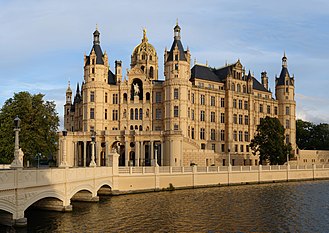
The undisputed centerpiece of Schwerin is its romantic palace, an architectural marvel situated on its own island. Renowned for its striking golden dome, the palace complex is a historical treasure trove, featuring the Castle Church and the opulent throne room. It was once the primary residence of the dukes and grand dukes of Mecklenburg-Schwerin, embodying the grandeur of the era.
Since 1990, the palace has transitioned into a modern seat of governance, housing the state parliament of Mecklenburg-Vorpommern. This dual role as a historical monument and an active center of political life underscores its enduring significance. The silhouette of Schwerin is further enhanced by the prominent towers of its cathedral and other historic churches, contributing to its picturesque skyline.
Economic Landscape
Schwerin's economy is characterized by a strategic diversification that balances its historical identity with modern industrial demands. Key sectors include high technology and machine building, reflecting a commitment to innovation and advanced manufacturing. The healthcare industry is a significant employer, providing essential services and contributing to the region's well-being.
As the state capital, government agencies form a substantial part of its economic base. Furthermore, Schwerin plays a role in the railway supply chain and produces various consumer goods. Tourism is also a vital component, drawing visitors to its unique blend of natural beauty, exemplified by its numerous lakes, and its rich historical heritage, most notably the Schwerin Palace. While Parchim hosts a regional airport, the city primarily relies on Hamburg Airport for major air travel.
Education and Cultural Fabric
Schwerin places a strong emphasis on education, offering a comprehensive system that caters to learners of all ages. The city is home to various educational institutions, from primary and secondary schools to vocational training centers, ensuring that its residents have access to quality learning opportunities. Higher education is also accessible through nearby universities and specialized colleges, fostering research and development in fields relevant to the region's economy.
Beyond formal education, Schwerin cultivates a rich cultural life. Its well-preserved historical districts, museums, theaters, and galleries provide ample avenues for cultural engagement. The city's numerous lakes and parks offer extensive opportunities for outdoor recreation, contributing to a high quality of life for its inhabitants and attracting those seeking a balance between urban amenities and natural beauty.
Go deeper
Frequently Asked Questions
What makes Schwerin a special city with many lakes?+
Why is Schwerin's castle famous?+
When did Schwerin become a city?+
What jobs do people in Schwerin do?+
How does Schwerin help people today?+
Based on content from Wikipedia · Licensed under CC BY-SA 4.0