

San Gabriel Valley
Images

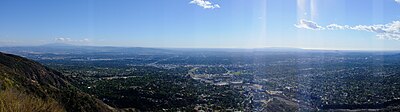
San Gabriel Valley from the summit




Geographical Context
The San Gabriel Valley is a significant geographical feature within Southern California, bordered by distinct landforms that define its character. To the north lie the imposing San Gabriel Mountains, a major watershed and recreational area. The San Rafael Hills to the west separate it from the broader Los Angeles Basin, while the Puente Hills and Chino Hills form its southern and eastern boundaries, respectively, leading into the Pomona Valley and Inland Empire.
The valley's namesake, the San Gabriel River, historically a vital water source, now flows through a largely urbanized landscape. The region's climate is Mediterranean, characterized by warm, dry summers and mild, wetter winters, though water security remains a persistent challenge due to statewide droughts. The valley's topography, with its surrounding mountains and central river, has historically influenced settlement patterns and agricultural development.
Historical Trajectory
The history of the San Gabriel Valley is a narrative of profound transformation. Its origins are tied to the Spanish Mission San Gabriel Arcángel, founded in 1771, marking the initial European settlement and agricultural endeavors in the region. For centuries, the valley thrived as a predominantly agricultural area, renowned for its citrus groves and fertile lands.
However, the 20th century witnessed a dramatic shift towards urbanization. The post-World War II era saw rapid suburban expansion, fueled by population growth and the development of infrastructure, including freeways. This led to the valley becoming almost entirely urbanized, integrating seamlessly into the Greater Los Angeles metropolitan area.
Pasadena, incorporated in 1886, stands as a testament to this early development, being one of the first cities in Los Angeles County. The valley's evolution highlights the dynamic interplay between natural resources, human settlement, and economic development.
Socio-Cultural Landscape
The San Gabriel Valley is celebrated for its extraordinary ethnic and cultural diversity, making it one of the most multifaceted regions in the United States. This rich tapestry is woven from communities with origins across Asia, Latin America, Europe, and beyond. This demographic richness translates into a vibrant cultural scene, evident in the proliferation of diverse culinary offerings, cultural festivals, and community organizations.
The valley serves as a microcosm of global migration patterns, offering a unique environment where various traditions coexist and interact. This diversity is not merely a demographic statistic; it actively shapes the valley's identity, economy, and social fabric, fostering a dynamic and evolving cultural landscape that continues to attract new residents and businesses.
Economic Engine and Governance Structures
Once driven by agriculture, the San Gabriel Valley's economy has diversified significantly. Today, it hosts a robust mix of industries, including technology, healthcare, education, manufacturing, and retail. Major institutions and corporations have established significant presences, contributing to employment and economic growth.
The valley's strategic location within the Los Angeles County provides access to a vast labor pool and extensive transportation networks. Governance within the San Gabriel Valley is complex, involving 31 incorporated cities, each with its own municipal government, alongside unincorporated communities managed by Los Angeles County. This decentralized structure allows for local control while necessitating regional cooperation on issues such as transportation, water management, and economic development.
The ongoing challenge of water security, exacerbated by droughts, underscores the need for coordinated governance and sustainable resource management.
Educational Institutions and Future Prospects
The San Gabriel Valley is home to a comprehensive network of educational institutions, catering to learners of all ages. From numerous public and private K-12 schools to renowned universities and colleges, the region prioritizes education and lifelong learning. Pasadena, for instance, is home to the prestigious California Institute of Technology (Caltech) and Pasadena City College.
Other institutions across the valley contribute to research, innovation, and workforce development. The educational landscape plays a crucial role in shaping the valley's future, preparing its diverse population for the evolving demands of the modern economy. Access to quality education is a cornerstone of the community's continued prosperity and its ability to address future challenges, including environmental sustainability and economic resilience.
See also
Frequently Asked Questions
What is the San Gabriel Valley?+
Why is the San Gabriel River important?+
How did the San Gabriel Valley change after World War II?+
Where do people in the San Gabriel Valley come from?+
What kinds of jobs can you find in the San Gabriel Valley?+
Based on content from Wikipedia · Licensed under CC BY-SA 4.0