

Redshift Survey: Peeking into Space's Secrets!
Images
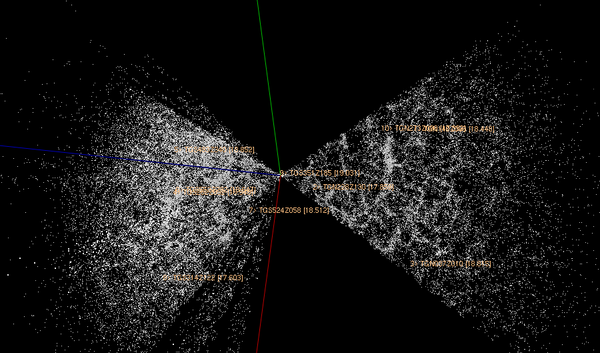
Redshift survey


The Spectroscopic Foundation
Redshift surveys are fundamentally built upon the principle of cosmological redshift, which is an extension of the Doppler effect. As the universe expands, the space between us and distant galaxies stretches, elongating the wavelengths of photons traveling through it. This cosmological redshift (z) is not due to the galaxy's motion through space, but rather the expansion of space itself.
By obtaining spectra of galaxies, astronomers can identify characteristic emission and absorption lines (e.g., hydrogen alpha) and measure their observed wavelengths relative to their rest-frame wavelengths. The redshift parameter 'z' is calculated as z = (λ_observed - λ_rest) / λ_rest. This precise measurement allows for the determination of recessional velocity and, consequently, distance using Hubble's Law (v = H₀d), albeit with nuances for very large distances where the expansion rate has changed.
Redshift surveys are therefore direct probes of the universe's expansion history.
Mapping the Cosmic Tapestry
The primary objective of a redshift survey is to create a three-dimensional map of the universe by measuring the positions of millions of galaxies. While telescopes provide two-dimensional positions on the celestial sphere, redshift surveys add the crucial third dimension: distance. By collecting spectroscopic data for vast numbers of galaxies, astronomers can chart their locations in space.
This data reveals the intricate large-scale structure of the universe, often described as a 'cosmic web.' This web consists of massive filaments and walls of galaxies and dark matter, interconnected and surrounding enormous, nearly empty voids. Studying the statistical properties of this distribution, such as the power spectrum and correlation functions, allows cosmologists to test models of structure formation and constrain cosmological parameters.
The Dark Energy Connection
Redshift surveys have become indispensable tools in the quest to understand dark energy, the mysterious force driving the accelerated expansion of the universe. By mapping galaxies at different redshifts, surveys can trace the expansion history of the cosmos. The rate of expansion is not constant; it has changed over cosmic time.
Dark energy's influence becomes more pronounced at later times, causing the expansion to speed up. Surveys measure subtle variations in the expansion rate by observing the clustering of galaxies at various distances and the effects of phenomena like Baryon Acoustic Oscillations (BAO). BAO are relic sound waves from the early universe that imprinted a characteristic scale in the distribution of matter.
Measuring this scale at different redshifts provides a 'standard ruler' to determine distances and probe the equation of state of dark energy, helping to distinguish between different theoretical models.
Technological Evolution and Future Prospects
The history of redshift surveys is marked by continuous technological advancement. Early surveys like the Center for Astrophysics Redshift Catalog mapped thousands of galaxies, while the Sloan Digital Sky Survey (SDSS) dramatically increased this number to millions using automated spectrographs. Current and upcoming surveys, such as the Dark Energy Spectroscopic Instrument (DESI) and the Euclid space telescope, are designed to map tens of millions to billions of galaxies and quasars.
These next-generation instruments employ highly efficient spectrographs, advanced fiber optics, and wide-field imaging capabilities to survey larger volumes of the universe with unprecedented precision. Future surveys aim to refine measurements of dark energy properties, test fundamental physics, and potentially uncover new cosmological phenomena, pushing the boundaries of our understanding of the universe.
Beyond Galaxies
While mapping galaxies is a primary goal, redshift surveys also provide invaluable data on other cosmic objects and phenomena. Quasars, extremely luminous active galactic nuclei powered by supermassive black holes, are often included in surveys. Their high redshifts make them excellent probes of the very early universe and the intergalactic medium (IGM).
The light from distant quasars passes through intervening gas clouds, creating absorption lines known as the 'Lyman-alpha forest.' By analyzing these absorption patterns at different redshifts, astronomers can map the distribution and properties of the IGM, including its temperature, density, and ionization state. This provides insights into the epoch of reionization and the evolution of cosmic structures over billions of years, offering a complementary perspective to galaxy distribution studies.
See also
Frequently Asked Questions
What is a redshift survey?+
How do scientists know how fast a galaxy is moving away?+
Why do scientists call the galaxy pattern a "cosmic web"?+
What is dark energy and how do redshift surveys help?+
What are Baryon Acoustic Oscillations and why are they useful?+
Based on content from Wikipedia · Licensed under CC BY-SA 4.0