

Radius: The Magic Line of Circles!
Images

Plan of the City of Halifax, Nova Scotia, showing the radius of the blast from the explosion / Plan de la cite d’Halifax en Nouvelle-Écosse, montrant l’étendue du souffle de l’explosion




The Radius
In classical Euclidean geometry, the radius (denoted by R or r) is fundamentally defined as any line segment originating from the center of a circle or sphere and terminating at its perimeter or surface. This definition extends to its length, serving as the primary scalar measure of a circle's or sphere's extent. For regular polygons, the radius is similarly defined as the segment connecting the center to any vertex.
This concept is crucial for establishing congruence and similarity among circular and spherical figures, forming the basis for numerous geometric theorems and calculations. Its consistent distance from the center is what imbues circular objects with their unique properties of symmetry and regularity.
From Chariot Wheels to Abstract Thought
The term 'radius' boasts a lineage tracing back to ancient Rome. The Latin word 'radius' carried multiple meanings, including 'ray' and, significantly, 'spoke of a chariot wheel.' This etymological link underscores the practical origins of geometric concepts, born from observing the physical world. Early mathematicians and artisans likely recognized the consistent length of the spokes from the hub to the rim as a defining characteristic of the wheel's circularity.
This tangible connection between a mechanical component and a geometric property facilitated the abstraction of the radius as a fundamental measurement, evolving from a practical observation to a core element of mathematical theory.
The Radius's Indispensable Role in Mathematical Frameworks
The significance of the radius extends far beyond simple measurement. It is intrinsically linked to other key circular properties: the diameter (D = 2R), the circumference (C = 2πR), and the area (A = πR²). These relationships are foundational in trigonometry, calculus, and analytic geometry.
In the study of regular polygons, the radius (or circumradius) is vital for calculating side lengths, apothems, and areas. Furthermore, the concept has been generalized: the 'circumradius' refers to the radius of the circumscribed circle of a polygon, while the 'inradius' (or apothem for regular polygons) denotes the radius of the inscribed circle. These extensions highlight the radius's adaptability in describing geometric relationships.
Expanding the Definition
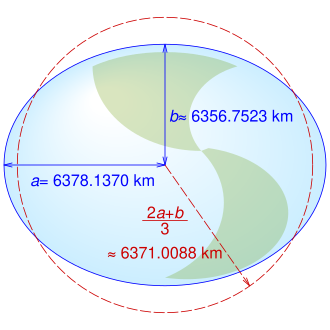
Modern mathematics and science have broadened the application of the radius concept. For objects lacking a distinct center, the 'circumradius' is defined as the radius of the smallest circle or sphere that encloses the object. Conversely, the 'inradius' represents the radius of the largest circle or sphere contained within the object.
In ring theory and topology, 'inner radius' refers to the radius of a cavity within a hollow object. Even in graph theory, the 'radius of a graph' is defined as the minimum eccentricity of any vertex, where eccentricity is the maximum distance from that vertex to any other vertex. This demonstrates the radius's conceptual flexibility across different mathematical domains.
Applied Radii
The radius is a critical parameter in numerous scientific and engineering disciplines. In mechanical engineering, it dictates the design of gears, bearings, and rotating machinery, influencing stress distribution and operational efficiency. Civil engineers utilize radii in designing curved roads, bridges, and tunnels.
In physics, it's fundamental to calculations involving orbits, wave propagation, and electromagnetic fields. In computer graphics and design software, radii are essential for rendering smooth curves, circles, and spheres. Even in data science, concepts like 'radius of gyration' are used to describe the spatial extent of data distributions, showing the enduring relevance of this fundamental geometric measure.
Go deeper
Frequently Asked Questions
What is a radius?+
Why is the radius important?+
How does the radius relate to the diameter?+
Where does the word "radius" come from?+
How is the radius used in engineering?+
Based on content from Wikipedia · Licensed under CC BY-SA 4.0