

Plane (tool)
Images
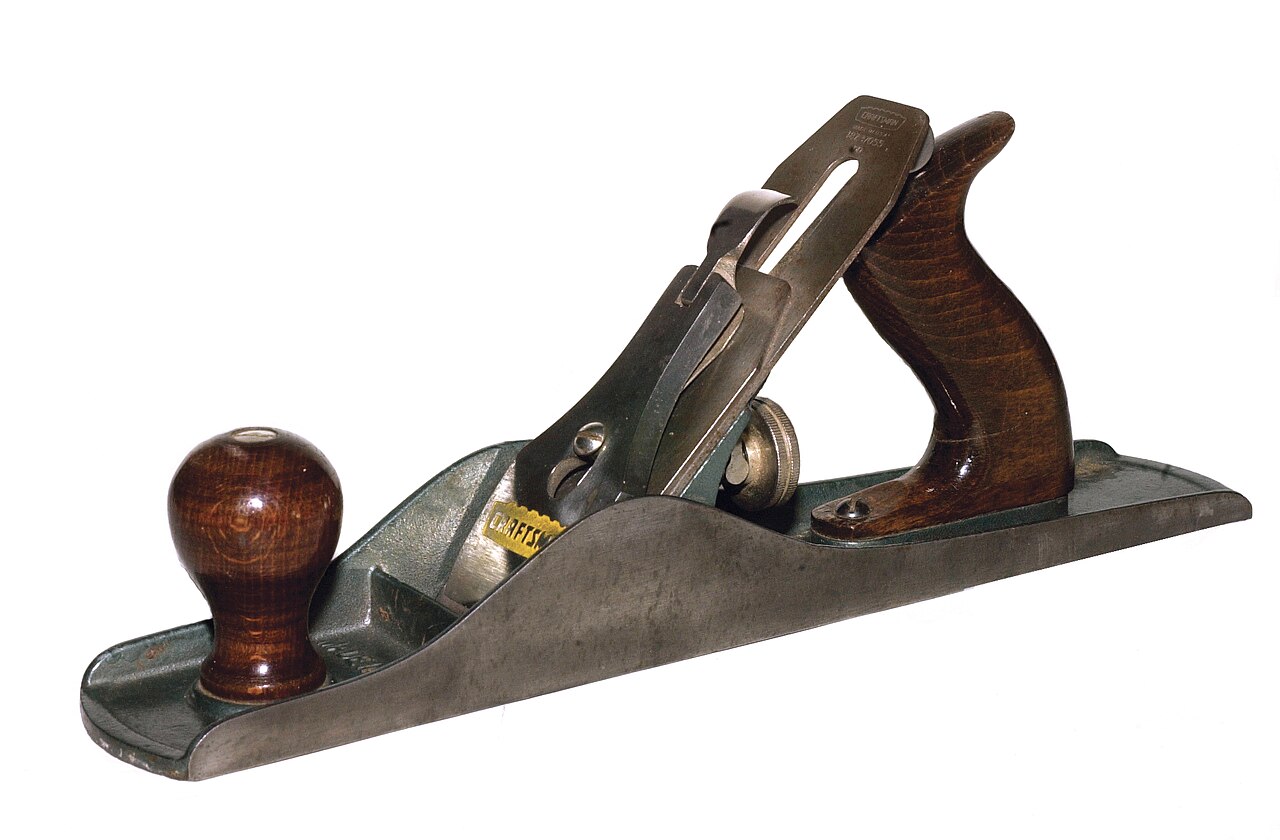
Plane (tool)
The Plane
The plane is a quintessential woodworking tool designed for the precise removal of material from wood surfaces. Its fundamental operation involves a sharpened blade, typically made of high-carbon steel, set at a specific angle within a rigid body. This body acts as a guide, controlling the depth and angle of the cut as the tool is propelled across the wood.
The result is the generation of thin shavings, which progressively flatten, smooth, or shape the timber. This controlled material removal is critical for achieving dimensional accuracy, essential for joinery, structural integrity, and aesthetic finishing. Beyond basic flattening, planes are instrumental in creating perfectly square edges, consistent thicknesses, and intricate profiles, forming the bedrock of both functional construction and fine craftsmanship.
The plane’s ability to transform rough lumber into precisely dimensioned components underscores its indispensable role in the art and science of woodworking, enabling everything from basic carpentry to complex furniture making and architectural detailing.
A Millennia-Long Trajectory
The lineage of the plane is ancient, tracing back to rudimentary scraping techniques employed by early civilizations. Archaeological evidence suggests that tools resembling planes were used in ancient Egypt and Rome, often featuring wooden bodies with bronze or iron blades. These early implements, while basic, established the principle of using a blade set within a stock to shave wood.
The Middle Ages saw significant advancements, with the widespread adoption of iron blades, which offered superior durability and sharpness compared to earlier materials. The Renaissance and subsequent centuries witnessed a proliferation of specialized designs, driven by evolving architectural styles and furniture-making techniques. The 18th and 19th centuries were particularly transformative, marked by innovations such as adjustable iron planes, improved blade adjustment mechanisms, and the mass production of standardized tools.
This historical arc demonstrates a continuous human endeavor to refine tools for greater efficiency, precision, and versatility in manipulating wood, reflecting advancements in metallurgy, engineering, and woodworking practices.
The Indispensable Role of the Plane in Achieving Woodworking Excellence
The significance of the plane extends far beyond mere surface preparation; it is intrinsically linked to the quality and integrity of wooden constructions. Achieving perfectly flat and square surfaces is paramount for creating stable and aesthetically pleasing joints. A wobbly table or a door that doesn’t close properly often stems from inadequately planed components.
Planes provide woodworkers with the control necessary to ensure that pieces fit together with minimal gaps, enhancing both the structural soundness and visual appeal of the final product. Furthermore, planes are crucial for dimensioning lumber to exact specifications, a prerequisite for complex joinery techniques like dovetails or mortise and tenon joints. In fine woodworking, the plane’s ability to produce a smooth, lustrous finish can be an end in itself, contributing significantly to the tactile and visual quality of a piece.
Thus, the plane is not just a tool for shaping wood, but a critical instrument for achieving precision, durability, and artistry.
A Spectrum of Specialization
The contemporary landscape of woodworking tools includes a diverse array of planes, each engineered for specific applications. Bench planes, the workhorses of the workshop, are categorized by length and purpose: jack planes for general-purpose work, fore planes for initial flattening and straightening, and jointers for creating long, perfectly straight edges. Block planes, compact and often operated with one hand, are ideal for tasks like chamfering edges, trimming end grain, and fine-tuning small components.
Specialty planes encompass a wide range of tools designed for intricate work. Router planes, for instance, are used to precisely level the bottom of grooves and dados, ensuring consistent depth. Moulding planes, with their uniquely shaped blades, are employed to cut decorative profiles along the edges of boards, adding ornamental detail.
Scrapers, while sometimes considered a separate category, function similarly by removing material in thin layers, often used for final surface preparation. This extensive typology highlights the plane's adaptability and its central role in addressing virtually every conceivable woodworking challenge.
Go deeper
Based on content from Wikipedia · Licensed under CC BY-SA 4.0