

Palácio do Planalto
Images

Palácio do Planalto


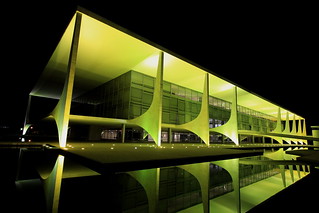
The Architectural Genesis and Symbolism of Planalto
The Palácio do Planalto, inaugurated on April 21, 1960, stands as a monumental testament to Brazilian modernist architecture and a potent symbol of the nation's executive power. Designed by the legendary Oscar Niemeyer, its construction was integral to the ambitious project of creating Brasília, a purpose-built capital city intended to symbolize a new era for Brazil. Niemeyer's design, characterized by its clean lines, sweeping curves, and integration with the surrounding landscape, was revolutionary for its time.
The building's distinctive pillars, resembling hands reaching towards the sky, are often interpreted as symbols of progress and openness. Its location in the Praça dos Três Poderes, the symbolic heart of Brazil's federal government, places it in direct dialogue with the legislative and judicial branches, underscoring the separation and interdependence of powers within the republic.
A Living Chronicle of Brazilian Governance
Since its inauguration, the Palácio do Planalto has been the exclusive workplace for every President of Brazil, making it a continuous witness to the nation's political journey. From Juscelino Kubitschek, who initiated Brasília's construction, to the present day, the palace has hosted countless pivotal moments in Brazilian history. It is here that presidents have made critical policy decisions, navigated complex domestic challenges, and engaged in international diplomacy.
The building's enduring role as the primary seat of the executive branch means that its walls have absorbed decades of political discourse, strategic planning, and the weight of national leadership. This continuity imbues the palace with a profound historical significance, connecting contemporary governance to its past.
The Palácio do Planalto as a Global Landmark
The Palácio do Planalto's architectural brilliance and historical importance have earned it international recognition. In 1987, it was designated as part of the Brasília World Heritage Site by UNESCO, an honor bestowed upon places of outstanding universal value. This designation highlights not only the building's aesthetic merit but also its contribution to the unique urban planning and architectural vision of Brasília.
As a UNESCO site, the palace is recognized as a cultural asset of global importance, necessitating its preservation for future generations. Its inclusion in this prestigious list solidifies its status as a landmark that transcends national boundaries, attracting global attention to Brazil's cultural and architectural heritage.
Operational Dynamics
Beyond its symbolic and architectural grandeur, the Palácio do Planalto functions as the operational core of Brazil's federal executive branch. It houses the President's offices, meeting rooms, and ceremonial spaces, facilitating the day-to-day administration of the country. Key figures such as the Vice-President and the Chief of Staff also operate from within the palace, coordinating the vast network of government ministries situated on the adjacent Ministries Esplanade.
The term 'Planalto' itself has evolved into a metonym, commonly used to refer to the executive branch of the federal government, signifying its central and indispensable role in national governance. The building's design and function are intrinsically linked to the efficient execution of presidential duties and the coordination of national policy.
Beyond the Palace
The Palácio do Planalto does not exist in isolation; it is a crucial component of Oscar Niemeyer's master plan for Brasília. Its placement within the Praça dos Três Poderes, facing the Supreme Federal Court and adjacent to the National Congress, is deliberate. This spatial arrangement visually represents the separation of powers – executive, judicial, and legislative – while fostering a sense of proximity and interaction.
The surrounding Ministries Esplanade, a series of identical modernist buildings, further emphasizes the organized and unified nature of the federal administration. The entire ensemble, including the Palácio do Planalto, represents a bold experiment in urbanism and architecture, aiming to create a functional, modern, and symbolic capital city that reflects Brazil's aspirations for the future.
See also
Frequently Asked Questions
What is the Palácio do Planalto?+
When did the Palácio do Planalto open?+
Who designed the Palácio do Planalto?+
Why is the Palácio do Planalto a UNESCO World Heritage Site?+
What does the word 'Planalto' mean?+
Based on content from Wikipedia · Licensed under CC BY-SA 4.0