

Node (physics)
Images
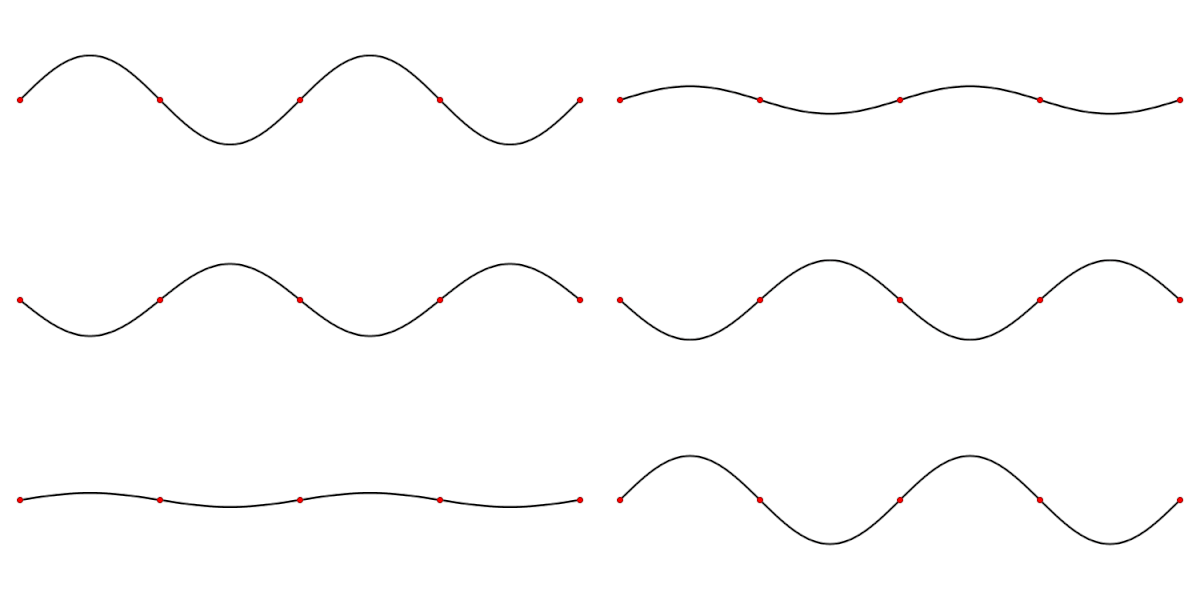
Node (physics)


The Genesis of Nodes
Nodes are fundamental to the concept of standing waves, which arise from the superposition of two identical waves traveling in opposite directions. This phenomenon is typically observed when waves are reflected from a boundary, such as a string fixed at both ends or an air column in a pipe. The incident wave and the reflected wave interfere constructively and destructively.
At points where the waves consistently cancel each other out due to their phase relationship (e.g., a crest meeting a trough of equal magnitude), the net displacement is zero. These points of zero amplitude are defined as nodes. The formation of nodes is a direct consequence of the principle of superposition, where the resultant displacement at any point is the vector sum of the displacements due to the individual waves.
The precise locations of these nodes are determined by the wavelength of the waves and the boundary conditions of the system.
Mathematical Description and Boundary Conditions
Mathematically, a standing wave can be represented by an equation that shows it is a function of position and time, but without a propagating phase term. For a wave on a string fixed at both ends, the boundary conditions dictate that the displacement must be zero at the ends. These fixed points must therefore be nodes.
This leads to a quantization of possible wavelengths and frequencies. For a string of length L, nodes will occur at positions x = n(L/2), where n is an integer (0, 1, 2, ...). The fundamental frequency (n=1) has nodes at the ends and an antinode in the middle.
Higher harmonics (n=2, 3, ...) introduce additional nodes along the string. Similar principles apply to other types of waves, such as sound waves in air columns or electromagnetic waves in cavities, where specific boundary conditions dictate the existence and location of nodes.
Nodes in Musical Instruments and Beyond
The most intuitive application of nodes is in musical instruments. In string instruments like guitars or violins, the frets or finger positions effectively create new nodes, altering the length of the vibrating segment and thus the fundamental frequency, which we perceive as pitch. The harmonic content of the sound is also related to the positions of other nodes and antinodes.
Beyond music, nodes play a critical role in understanding resonance. When an external force or vibration matches the natural frequencies of a system (determined by its node-antinode patterns), resonance can occur, leading to amplified oscillations. This is why engineers must carefully analyze potential resonant frequencies in structures like bridges, buildings, and aircraft to prevent catastrophic failures, such as the infamous collapse of the Tacoma Narrows Bridge, which was exacerbated by aerodynamic flutter and resonance.
The Interplay of Nodes and Antinodes
Nodes are invariably paired with antinodes, which are points of maximum amplitude. Antinodes are located precisely halfway between adjacent nodes. While nodes represent points of minimal energy transfer (as there is no displacement), antinodes represent points of maximum energy transfer.
The pattern of nodes and antinodes divides the standing wave into segments, each oscillating in phase. The number of nodes (including those at boundaries) and antinodes is directly related to the harmonic number. Understanding this nodal structure is crucial for analyzing wave behavior in diverse physical systems, from the quantum mechanical wave functions of electrons in atoms to the propagation of light in optical fibers and the vibrational modes of complex machinery.
See also
Based on content from Wikipedia · Licensed under CC BY-SA 4.0