

Standing Waves: Wiggles That Stay Put!
Images

Standing Wave


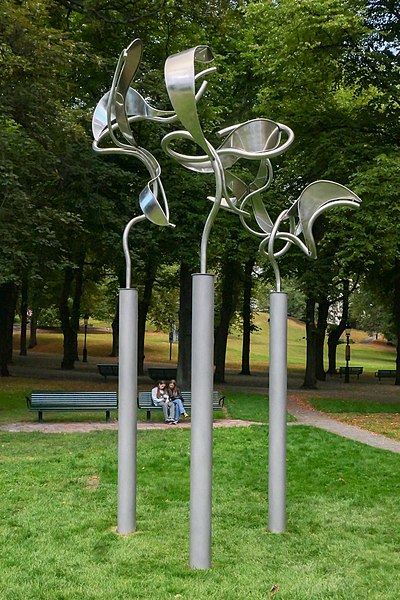


The Paradox of Motionless Waves
A standing wave, also known as a stationary wave, represents a unique mode of oscillation where energy is localized within a medium or space, rather than propagating through it. Unlike traveling waves that transport energy and exhibit displacement across space, a standing wave's defining characteristic is its time-dependent oscillation coupled with a time-independent spatial amplitude profile. At any given point in space, the amplitude of oscillation remains constant over time.
Furthermore, all points along the wave oscillate in phase, meaning they reach their maximum and minimum displacements simultaneously. This phenomenon arises from the superposition of two identical waves traveling in opposite directions. The points of minimum amplitude are termed nodes, where destructive interference perpetually occurs, while points of maximum amplitude are called antinodes, resulting from constructive interference.
The Genesis of Stationary Waves
The formation of standing waves is fundamentally an outcome of wave interference. It occurs when two waves of equal amplitude and frequency propagate towards each other. This can happen in a stationary medium due to the superposition of a wave and its reflection, or in a moving medium where the medium's motion opposes the wave's propagation.
A common and crucial cause of standing waves is resonance. Within a resonator, such as a cavity or a string fixed at both ends, waves are reflected back and forth. When the frequency of these waves matches the natural resonant frequencies of the system, constructive interference leads to the establishment of stable standing wave patterns.
For waves of equal amplitude traveling in opposing directions, the net propagation of energy is zero, as energy is effectively trapped and oscillates within the defined space.
Pioneering Discoveries
The scientific journey into understanding standing waves began with Michael Faraday's meticulous observations in 1831. While experimenting with the surface of liquids in vibrating containers, he documented the formation of stationary wave patterns, a phenomenon that defied conventional wave propagation theories. This early work laid the groundwork for future investigations.
The term 'standing wave' (stehende Welle) was formally introduced around 1860 by German physicist Franz Melde. Melde's classic experiments, which involved vibrating strings under tension, provided clear visual demonstrations of these stationary wave modes and their relationship to frequency and tension. These foundational studies were pivotal in establishing the principles of wave superposition and resonance.
Ubiquitous Applications
Standing waves are not merely a theoretical curiosity; they are integral to numerous scientific and technological applications. In acoustics, they are the basis for sound production in musical instruments. The fixed boundaries of a guitar string, a drumhead, or an air column in a wind instrument necessitate standing waves, which produce the fundamental frequency and its harmonics, defining the instrument's timbre.
In optics, standing waves are crucial for the operation of lasers, where light is confined within an optical cavity, leading to amplified and coherent emission. Furthermore, the concept extends to quantum mechanics, where electrons in atoms and molecules exist in quantized energy states described by standing wave-like wave functions. Understanding standing waves is also vital in fields like structural engineering, where resonance can lead to catastrophic failures, and in the study of electromagnetic waves.
See also
Frequently Asked Questions
What is a standing wave?+
How do standing waves form?+
What are nodes and antinodes?+
Why do musical instruments use standing waves?+
Who discovered standing waves first?+
Based on content from Wikipedia · Licensed under CC BY-SA 4.0