

Your Amazing Body's Super-Fast Messenger System!
Images

Nervous system




Architectural Marvel
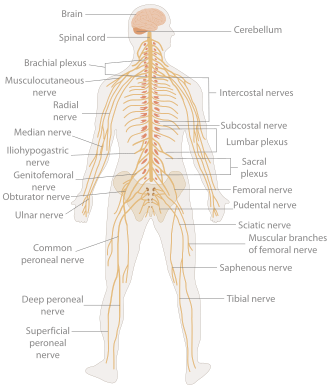
The human nervous system is a marvel of biological engineering, broadly divided into the Central Nervous System (CNS) and the Peripheral Nervous System (PNS). The CNS, comprising the brain and spinal cord, is the command center responsible for processing information, making decisions, and initiating responses. The brain, with its intricate network of billions of neurons, is the seat of consciousness, thought, memory, and emotion.
The spinal cord serves as the primary conduit for information, relaying signals between the brain and the rest of the body, and also orchestrates reflex actions independently. The PNS, in contrast, is the extensive network of nerves extending throughout the body, connecting the CNS to sensory receptors, muscles, and glands. It is further subdivided into the somatic nervous system, which controls voluntary movements, and the autonomic nervous system, which regulates involuntary functions like heart rate and digestion.
This hierarchical organization allows for both rapid, automatic responses and complex, deliberative processing.
The Neuron
At the cellular level, the neuron is the fundamental unit of the nervous system, specialized for rapid communication. Neurons transmit information through electrochemical signals. When a neuron is stimulated, it generates an action potential, a brief electrical impulse that travels down its axon.
This electrical signal triggers the release of neurotransmitters, chemical messengers, at the synapse, the junction between neurons. These neurotransmitters bind to receptors on the next neuron, either exciting or inhibiting it, thus propagating the signal. The diversity of neurotransmitters and receptor types allows for a vast array of complex signaling pathways.
The efficiency of this process is astounding, with signals traveling at speeds up to 120 meters per second, enabling near-instantaneous responses to stimuli. This intricate dance of electrical and chemical events underlies all nervous system functions, from basic reflexes to sophisticated cognitive processes.
Sensory Input and Motor Output
The nervous system acts as the body's primary interface with the external and internal environment. Sensory receptors, distributed throughout the body, detect stimuli such as light, sound, touch, temperature, and chemical changes. These receptors convert these stimuli into electrical signals that are transmitted by sensory neurons to the CNS.
The CNS then processes this sensory information, allowing us to perceive our surroundings and internal states. In response to this processed information, motor neurons carry signals from the CNS to effector organs, primarily muscles and glands. This motor output results in actions, such as muscle contractions for movement or the secretion of hormones.
This continuous loop of sensory input, processing, and motor output is fundamental to survival, adaptation, and interaction with the world.
Neuroplasticity and Modern Relevance
A critical aspect of the nervous system is its remarkable capacity for neuroplasticity, the ability to reorganize its structure and function in response to experience, learning, or injury. This means that neural pathways can be strengthened, weakened, or even rerouted throughout life. This principle is the basis for learning new skills, forming memories, and recovering from brain damage.
In modern medicine and technology, understanding neuroplasticity is revolutionizing treatments for neurological disorders, rehabilitation after stroke, and the development of advanced prosthetics and brain-computer interfaces. The ongoing research into the nervous system continues to unlock deeper insights into consciousness, behavior, and the very nature of what it means to be human.
Go deeper
Frequently Asked Questions
What is the nervous system and why is it important?+
How do neurons send messages so quickly?+
What is the difference between the somatic and autonomic nervous systems?+
How does the nervous system help us feel things like light or sound?+
Can the nervous system change after we learn something new?+
Based on content from Wikipedia · Licensed under CC BY-SA 4.0