

Neodymium
Images
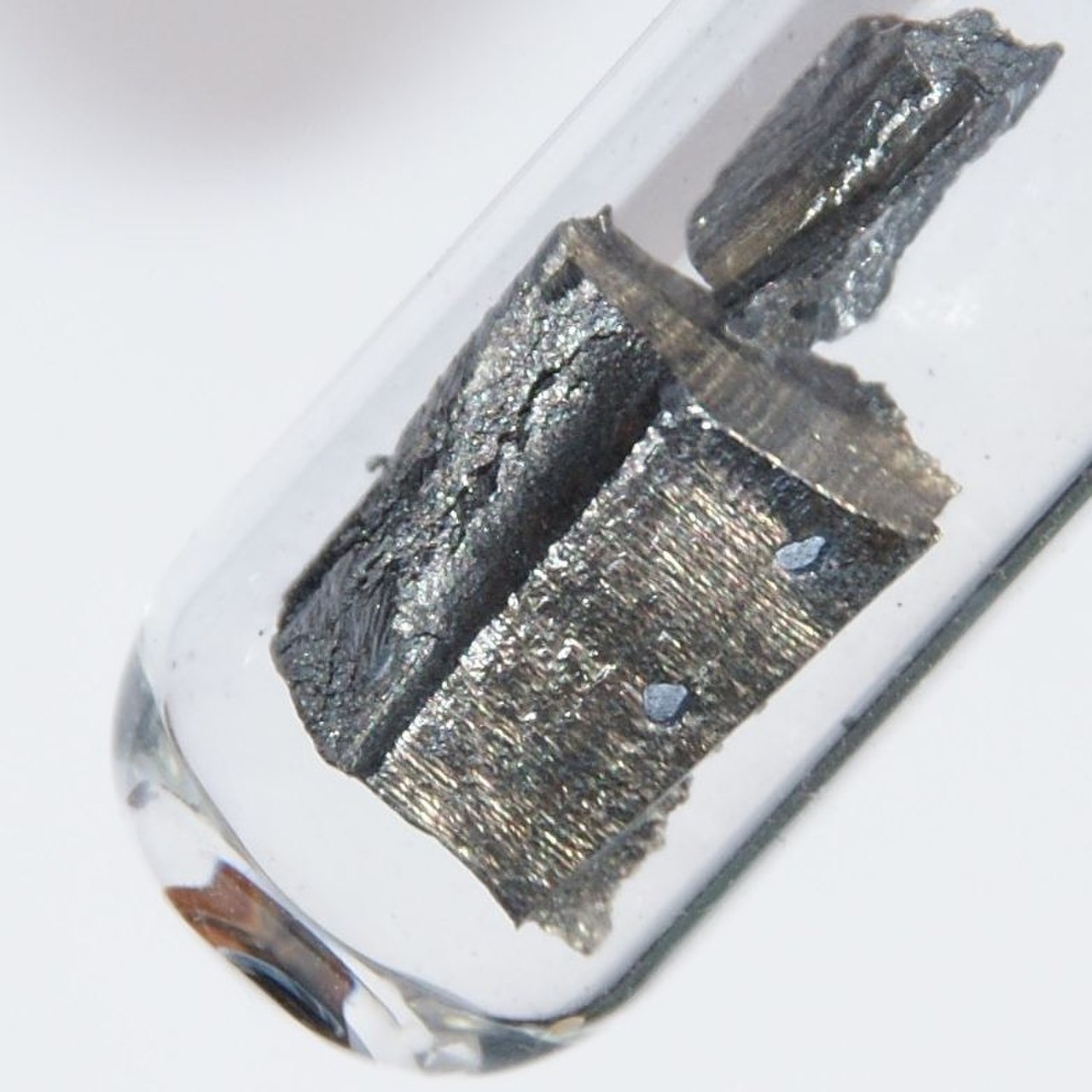
Neodymium
The Nature and Discovery of Neodymium
Neodymium (Nd), atomic number 60, is the fourth element in the lanthanide series, a group of 17 chemically similar metallic elements often referred to as rare-earth metals. It presents as a hard, slightly malleable, silvery metal that readily tarnishes in air due to rapid oxidation, forming a pink, purple, and blue oxide layer. Its discovery in 1885 by Austrian chemist Carl Auer von Welsbach marked a significant step in understanding the rare-earth elements.
Neodymium is not found in metallic form or unmixed with other lanthanides in nature; it is typically extracted from complex mineral ores like monazite and bastnäsite. While classified as 'rare,' its abundance in the Earth's crust is comparable to that of nickel, cobalt, and copper, though its commercial extraction and purification are intricate and energy-intensive processes. China dominates the global supply of Neodymium, as it does for many other rare-earth elements, making its geopolitical significance substantial.
Spectroscopic Marvels and Optical Applications
Neodymium is renowned for its exceptionally complex atomic spectrum, exhibiting numerous sharp absorption and emission lines. This characteristic is fundamental to its use in optical applications. When incorporated into glass, the Nd3+ ion imparts a distinctive reddish-purple color.
This color is not static; it exhibits a fascinating dichroism, appearing to change hue under different lighting conditions. This phenomenon arises from the interaction between Neodymium's sharp absorption bands and the sharp emission bands of ambient light sources, such as mercury vapor lamps or even daylight enriched with specific spectral lines. First commercialized in 1927 as a glass dye, Neodymium-doped glass remains popular for its aesthetic qualities and its utility in specialized filters and scientific instruments.
Furthermore, Neodymium's specific emission wavelengths are harnessed in laser technology.
Neodymium Lasers
The precise spectral properties of Neodymium make it an ideal dopant for solid-state lasers. Lasers utilizing Neodymium, such as Nd:YAG (neodymium-doped yttrium aluminum garnet) and Nd:Glass, emit infrared light at wavelengths typically between 1047 and 1062 nanometers. These lasers are not only used in scientific research but also in high-power applications.
For instance, high-energy Neodymium lasers are critical components in inertial confinement fusion (ICF) research, a field dedicated to achieving controlled nuclear fusion for energy generation. The ability to generate intense, focused beams of light with specific wavelengths makes these lasers invaluable tools for material processing, medical procedures, and advanced physics experiments, demonstrating Neodymium's role at the forefront of scientific innovation.
The Engine of Modern Magnetism
Neodymium's most significant technological contribution lies in its role as a key component in the strongest permanent magnets commercially available: neodymium magnets (NdFeB). These alloys, typically composed of Neodymium, Iron, and Boron, exhibit unparalleled magnetic field strength relative to their size and weight. This high performance-to-volume ratio makes them indispensable in applications where space and mass are critical constraints.
They are integral to high-efficiency electric motors used in hybrid and electric vehicles, advanced generators for wind turbines and aircraft, and compact, powerful actuators. Beyond large-scale applications, they are found in consumer electronics like professional loudspeakers, high-fidelity headphones, computer hard disk drives, and magnetic resonance imaging (MRI) machines. The development and widespread adoption of neodymium magnets have profoundly impacted energy efficiency, miniaturization, and performance across numerous industries.
Go deeper
Frequently Asked Questions
What is neodymium and why is it special?+
Why do neodymium magnets feel so strong?+
How does neodymium change the color of glass?+
Where does neodymium come from?+
What are neodymium lasers used for?+
Based on content from Wikipedia · Licensed under CC BY-SA 4.0