

Boron: The Super-Hard Element!
Images
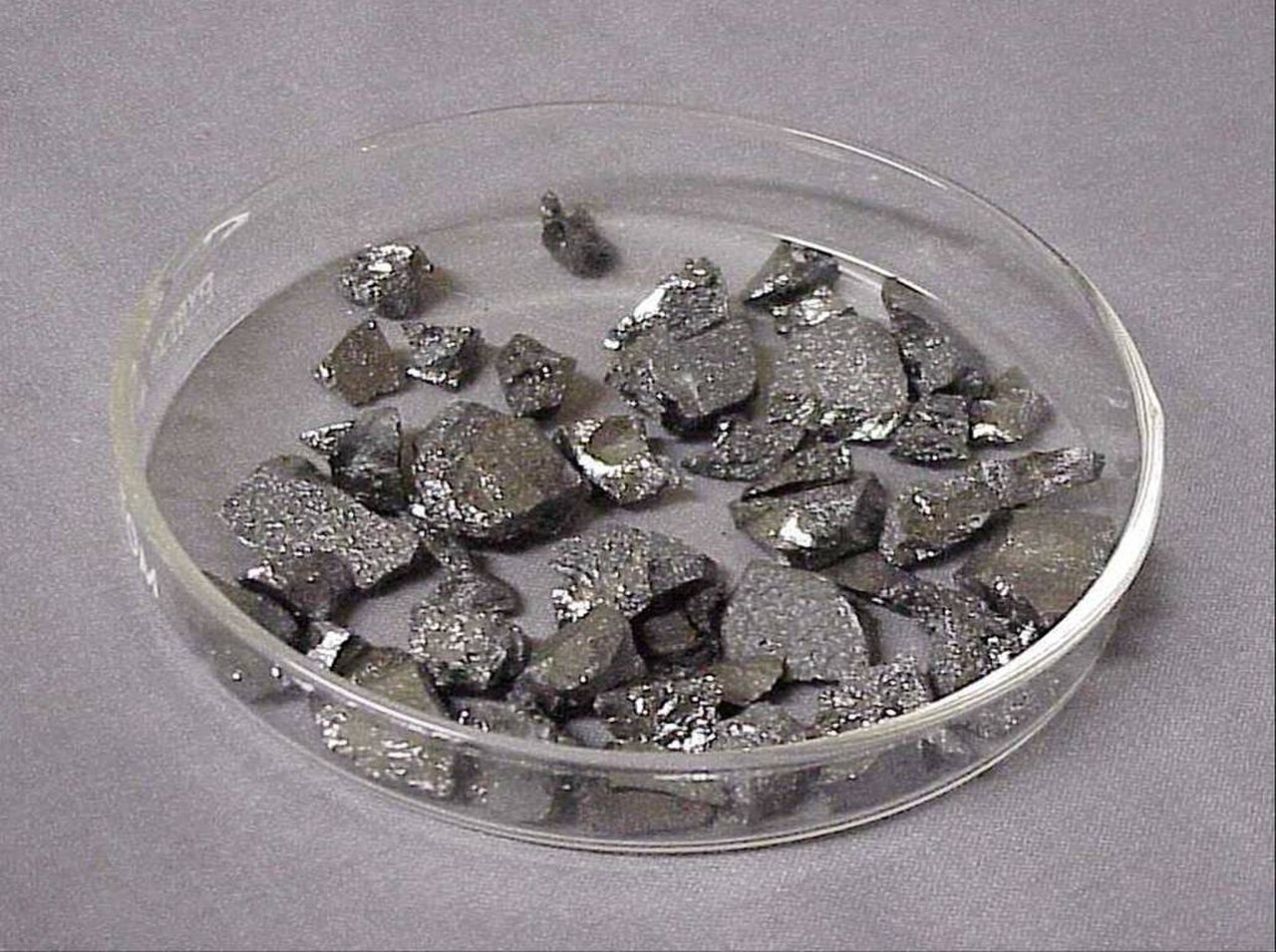
Boron
Cosmic Genesis and Terrestrial Abundance
Boron (B, atomic number 5) occupies a unique niche in elemental cosmology and geochemistry. Unlike elements forged through stellar nucleosynthesis, Boron's primary synthesis occurs via cosmic ray spallation and supernova remnants. This non-stellar origin contributes to its relative scarcity in the Solar System and Earth's crust, where it constitutes a mere 0.001% by weight. Earth's geological processes concentrate Boron through the water solubility of its more common compounds, the borate minerals.
These minerals, such as borax and kernite, are typically mined from evaporite deposits, with Turkey being the world's leading producer. While elemental Boron is virtually nonexistent in uncombined form on Earth, its compounds are industrially significant, driving its extraction and utilization.
Allotropes and Intrinsic Properties
Boron exhibits polymorphism, existing in several allotropic forms. The amorphous allotrope presents as a brown powder, while the crystalline form is a dark, lustrous metalloid. Crystalline Boron is exceptionally hard, registering 9.3 on the Mohs scale, surpassed only by a few other substances like diamond and boron nitride.
Its electrical conductivity at room temperature is notably poor (1.5 x 10^-6 Ω⁻¹cm⁻¹), a characteristic that can be modified through doping. The element's electron configuration, with three valence electrons, facilitates the formation of extensive covalent networks, leading to a rich chemistry and the creation of compounds with remarkable properties. Elemental Boron itself finds niche applications as filaments, analogous to carbon fibers, in high-strength composite materials.
Material Science Marvels
The vast majority of Boron production is channeled into chemical compounds that underpin modern material science. Approximately 50% of global Boron consumption is as an additive in fiberglass, enhancing both its insulating capabilities and structural integrity for applications ranging from construction to automotive parts. Its incorporation into polymers and ceramics yields materials prized for their exceptional strength-to-weight ratios and thermal resistance, crucial for aerospace and high-performance engineering.
Borosilicate glass, a key Boron-containing material, offers superior thermal shock resistance and mechanical strength compared to conventional soda-lime glass, making it ideal for laboratory equipment and cookware. Furthermore, sodium perborate serves as an effective bleaching agent, and Boron compounds are vital as dopants in semiconductors and as intermediates in synthesizing fine organic chemicals.
Biological Significance and Isotopic Utility
Beyond its material applications, Boron plays a critical role in biological systems. Although required only in trace amounts, it is an essential micronutrient for plants, vital for cell wall structure and carbohydrate metabolism. In mammals, borates exhibit low toxicity, comparable to sodium chloride.
Conversely, they are more toxic to arthropods, leading to their use as insecticides. The unique nuclear properties of Boron are also harnessed; Boron-10, one of its two stable isotopes, possesses a high neutron capture cross-section. This characteristic makes it invaluable in nuclear reactor control rods and in Boron Neutron Capture Therapy (BNCT), an experimental cancer treatment. Research continues into Boron-containing organic pharmaceuticals, highlighting the element's diverse and evolving relevance.
Go deeper
Frequently Asked Questions
What makes boron so hard?+
Where does boron come from?+
How is boron used in everyday items?+
Is boron safe for plants and animals?+
What special uses does boron have in science and medicine?+
Based on content from Wikipedia · Licensed under CC BY-SA 4.0